Before buying a dehumidifier, measure the humidity in the room and check the ventilation and airflow. According to ADEME, mechanical ventilation continuously removes moisture, while France Rénov’ recommends having damp patches investigated to identify their cause. If the problem is confined to one area, an appliance can provide extra support. Choose one based on the room size, operating conditions, noise level and how the water is drained. Extraction rates in L/24 h are not directly comparable when the test temperatures and humidity levels differ.
Who might benefit from an additional appliance?
A living space with occasional condensation
If condensation appears, particularly after showering, cooking or drying clothes, start by airing the room and checking the ventilation. You can then use a hygrometer to monitor the humidity in the room before considering an additional appliance.
A room where you dry clothes
For a utility room or any room used for drying clothes, consider the area covered, noise level and water management. A laundry mode may be worth considering, but it does not replace checking the stated capacity and the conditions under which it was tested.
A cellar or another cool room
Check the model’s minimum operating temperature and whether you can drain the water in that room. If damp patches remain on the walls, France Rénov’ recommends having their cause investigated rather than relying solely on a portable appliance.
What should you check before choosing?
First, work out whether the damp is localised or an ongoing problem. Then compare appliances based on the conditions in which you plan to use them.
| Priority |
What to check |
Your needs |
| Cause of the damp |
Measure the humidity with a hygrometer. Check that air inlets and extractor vents are not blocked, and have any persistent damp patches on the walls investigated. |
I want to know whether an additional appliance will address the problem in this room, without masking a ventilation fault or another underlying cause in my home. |
| Room and capacity |
Compare the stated floor area or volume with that of your room. Note the test temperature and relative humidity alongside each L/24 h figure, and check the operating range for a cool room. |
For my room, I want a stated capacity with test conditions I can understand, rather than choosing based on the litres-per-day figure alone. |
| Water drainage |
Check the tank size and what happens when it is full. For continuous drainage, check the hose and its route. If the appliance has a pump, check the permitted pumping height too. |
If the appliance will be used regularly, I want to manage the collected water without relying on a drainage setup that is unsuitable for the room. |
| Noise and electricity |
Check the stated noise level for the mode you plan to use and the power rating in W. To estimate kWh, multiply the power in kW by the number of hours of operation, following the method outlined by Rowenta. |
Noise matters to me in an occupied room. I also want to estimate energy use based on how long the appliance will actually run. |
What mistakes should you avoid?
-
Relying on the appliance as the main solution without checking your home
According to ADEME, mechanical ventilation continuously removes moisture. A portable dehumidifier cannot identify the cause of damp patches on the walls.
Check the airflow and extractor vents before buying. If the damp patches persist, have their cause investigated, as France Rénov’ recommends.
-
Comparing only the litres extracted per day
Qlima states 20 L/24 h for the D 520 at 32 °C and 80% relative humidity, while De’Longhi gives the capacities for the DEX210SF and DD230P at 30 °C and 80%. These figures are therefore based on different test temperatures.
Note the conditions given for each capacity, then check the room size covered and the model’s temperature range for your room.
-
Underestimating the need to empty the tank
Without continuous drainage, you will need to empty the water tank. A hose or pump will only be useful if it can be set up to suit the intended location.
Before choosing, check the tank capacity, whether the appliance switches off when the tank is full, and whether there is a suitable route to a drain.
-
Forgetting about noise and running time
The stated noise level matters in an occupied room. Energy use also depends on the appliance’s power rating and how many hours it runs for.
Check the noise level of the mode you plan to use, and estimate kWh based on the power rating and how long you expect to run the appliance.
Which branded models can help you compare?
These specifications published by the manufacturers can help you decide what to look for. They are not the result of a comparative test in the same room.
Rowenta
Rowenta’s product details for the Extrême Dry Compact+ DH5260F0 describe a dehumidifier for areas of up to 40 m² or a volume of 100 m³.
- Rowenta states an extraction rate of 16 L/day, a noise level below 40.5 dB(A), a 3 L tank and a 1 m hose for continuous drainage.
- These stated figures cannot tell you whether the appliance will extract the same amount at every room temperature and humidity level.
De’Longhi
The Tasciugo range includes the DEX210SF and DD230P. De’Longhi publishes the capacities for both models based on measurements taken at 30 °C and 80% relative humidity.
- De’Longhi states 10 L/24 h and 36 dB(A) for the DEX210SF. For the DD230P, the brand gives an extraction rate of 30 L/24 h and says it can be used from 2 °C.
- The DD230P is also stated to have a noise level of 54 dB(A) and a power rating of 575 W. Consider noise and power alongside capacity for your intended use.
Qlima
Qlima publishes room size and temperature details for the D 520. Its range also distinguishes between compressor models and desiccant models designed for cold environments.
- For the D 520, Qlima states 20 L/24 h at 32 °C and 80% relative humidity, a room volume of 100 to 130 m³, an operating range of 5 to 35 °C and a 4 L tank.
- The D 520’s capacity cannot be directly compared with a capacity published at 30 °C and 80% relative humidity.
Dehumidifiers available on Joybuy
These options are electric dehumidifiers for additional support. To compare them, check each model’s specifications against the room in question, after checking the airflow and ventilation in your home.
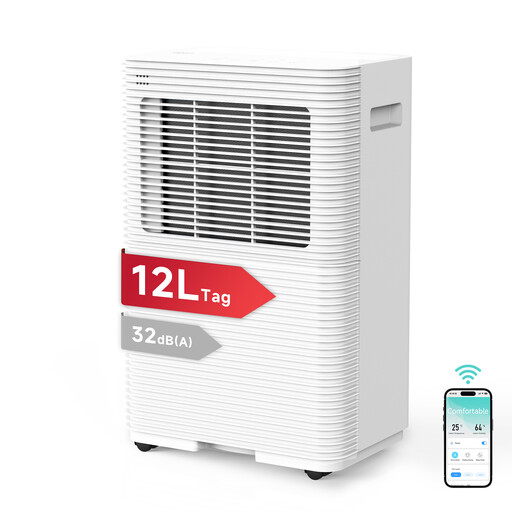 Image unavailable
VINO 12L Smart, 1.8 L tank
For a living space, compare the stated coverage of 24 m² with the size of your room, and check the conditions given for the extraction rate.
The product name indicates Wi-Fi control, automatic, laundry-drying and sleep modes, and a stated noise level of 32 dB. If you are not using continuous drainage, bear in mind that the tank holds 1.8 L.
View on Joybuy
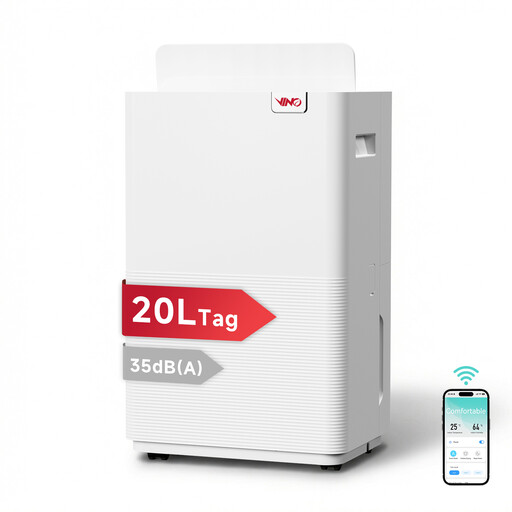 Image unavailable
VINO 20L Smart, 2.5 L tank
If your room is close to the stated coverage of 40 m², also check its layout and the conditions used to measure capacity before choosing.
The product name indicates Wi-Fi control, automatic, laundry-drying and sleep modes, a 2.5 L tank and a stated noise level of 35 dB.
View on Joybuy
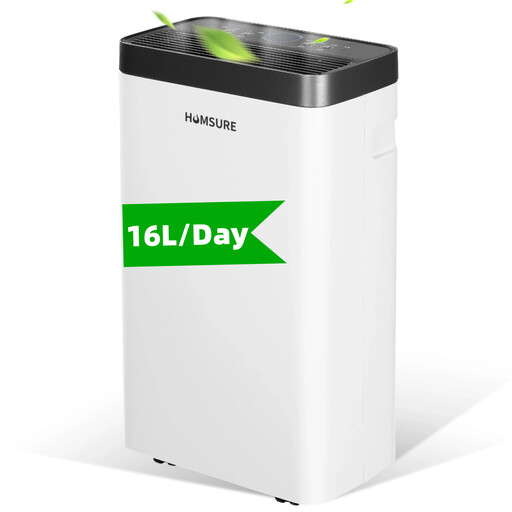 Image unavailable
HUMSURE 16 L/day, 1.4 L tank
If you plan to dry clothes in the room, check that the stated coverage of 25 m² and the conditions given for the 16 L/day extraction rate suit your needs.
The product name mentions a 24-hour timer, automatic defrost and automatic shut-off. Be prepared to empty the 1.4 L tank according to how much water is collected.
View on Joybuy
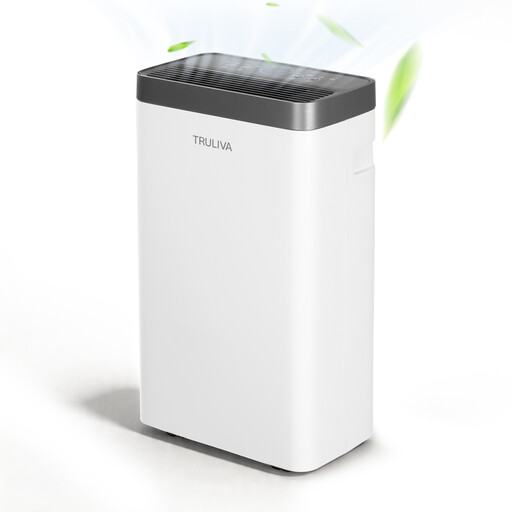 Image unavailable
TRULIVA AP10-2012EE, approx. 32 m²
If you are considering this model for a cool room, confirm its operating temperature range before buying. The automatic defrost feature mentioned in the product name does not tell you the minimum operating temperature.
The product name mentions a 24-hour timer, a laundry-drying function and continuous drainage. Check that the drainage route is suitable for your room.
View on Joybuy
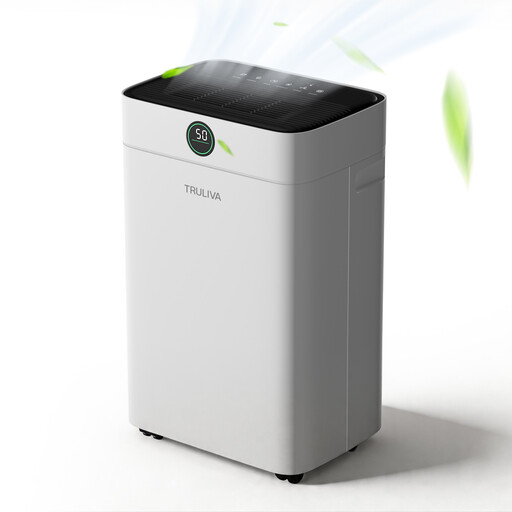 Image unavailable
TRULIVA 25 L/day, 2.8 L tank
For regular use, check the recommended room size and the conditions given for the stated 25 L/day extraction rate, rather than choosing on capacity alone.
The product name mentions laundry drying, automatic defrost, a 2.8 L tank and a continuous drainage hose. Confirm that the drainage setup suits the intended location.
View on Joybuy
Frequently asked questions
Is condensation on windows enough to justify buying a dehumidifier?
No, not on its own. First, check the airflow and ventilation: ADEME says mechanical ventilation continuously removes moisture. Then measure the humidity in the room to work out whether an additional appliance could help.
Can you compare two L/24 h capacities directly?
Only if they were measured under comparable conditions. Qlima states 20 L/24 h for the D 520 at 32 °C and 80% relative humidity; De’Longhi publishes the capacities for the DEX210SF and DD230P at 30 °C and 80%. Also check the room size covered and the temperature range of each model.
How can you estimate electricity use?
Multiply the appliance’s power in kW by the number of hours it runs to estimate energy use in kWh, following the method outlined by Rowenta. The actual running time and your electricity tariff will determine the cost.
When should you choose continuous drainage instead of a tank?
Continuous drainage can save you from having to empty the tank regularly if the appliance runs for long periods and a suitable drain is accessible. Check the hose and its route. For a model with a pump, also check the permitted pumping height.


