
Livraison le jour même ou le lendemain

Qualité garantie

Débloquez vos offres de bienvenue: Livraison GRATUITE | Jusqu'à -80 % | 30 jours d'essai gratuits à JoyPlus
Téléchargez l'application
Personalising your home with frames, photos, or artwork is a real joy, but the thought of getting out the drill can be daunting. Whether you're a renter, simply want to protect your walls, or love to change your decor on a whim, the challenge is the same: how do you hang frames without leaving a single mark?
The market is flooded with no-drill hanging solutions, but not all are created equal. Between marketing promises and real-world performance, it's easy to fall into common traps that can be costly—not just in money, but also in damage to your walls and frames. As a product expert at Joybuy, my mission is to help you navigate your options.
Before you jump on the first solution you find, let's review the classic mistakes you should never make.
adhesive wall hanging system to an unsuitable surface (wallpaper, textured plaster, delicate paint...) will render it completely ineffective, even if the product itself is high-quality.drill-free picture hanger is the ability to change your mind. However, many low-end adhesives turn removal into a nightmare, leaving behind sticky residue that's impossible to remove or, worse, tearing off paint and plaster. A good solution must guarantee a clean, effortless removal.To hang a frame without nails with complete peace of mind, two technical criteria are non-negotiable. They are the foundation of a smart and lasting choice.
This is THE number one criterion. Before any purchase, it is imperative to know the exact weight of the object you want to hang. Use a kitchen scale for small frames and a bathroom scale for heavier ones.
Always choose a hanging solution whose maximum load capacity is greater than the weight of your object. For example, for a 3?kg frame, choose strips that can hold up to 5?kg. This safety margin is crucial, especially if you're looking for how to hang a heavy picture without making a hole. Reputable manufacturers, like 3M with its 3M hanging strips, clearly state the supported weight on the packaging.
Not all adhesive strips are made for every surface. A successful installation depends on the perfect compatibility between the adhesive and your wall.
Always check the manufacturer's recommendations before application. Cleaning the surface with rubbing alcohol is also often essential to remove any grease or dust.
Instead of a random list, here are our targeted, use-case-based recommendations, all selected for their reliability and adherence to the criteria we've just covered.
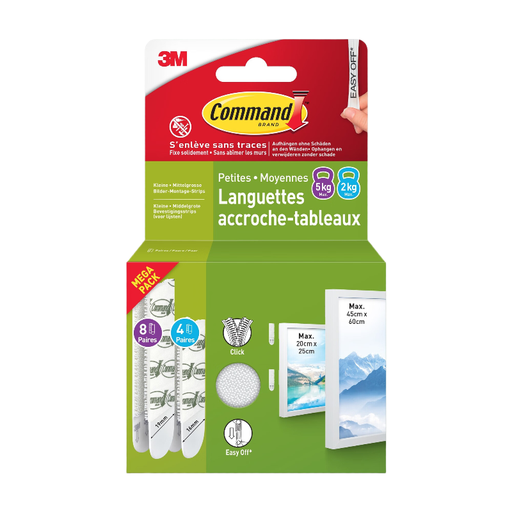
Why we chose it: Perfect for those who love creating photo walls, hanging postcards, or displaying small, lightweight frames. This value pack offers great versatility to adapt to different formats without waste.
It sidesteps the "universal" adhesive trap by offering two distinct sizes, allowing you to precisely match the holding power to the object's weight and prevent overloading.
The multipack format offers an excellent quantity-to-price ratio for starting several lightweight decoration projects at once.
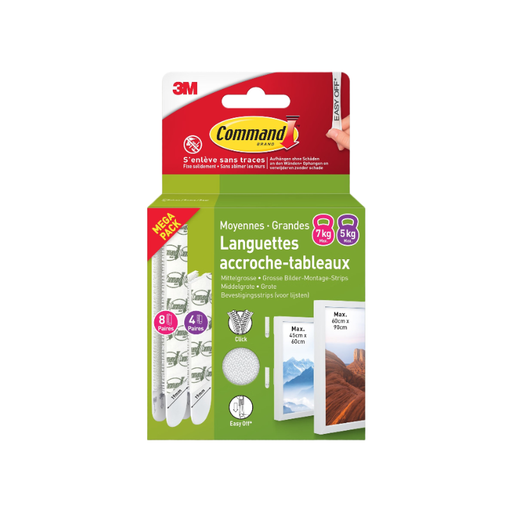
Why we chose it: This is the go-to solution for most uses: family photos, framed posters, and gallery wall arrangements. The M and L sizes cover a wide range of weights and dimensions (up to 60x90 cm).
It relies on 3M's renowned and reliable technology. The stretch-release removal system prevents wall damage, unlike low-end adhesives that tear off paint.
Verified and clearly stated load capacity (up to 7 kg for the large strips), offering true peace of mind for valuable items.
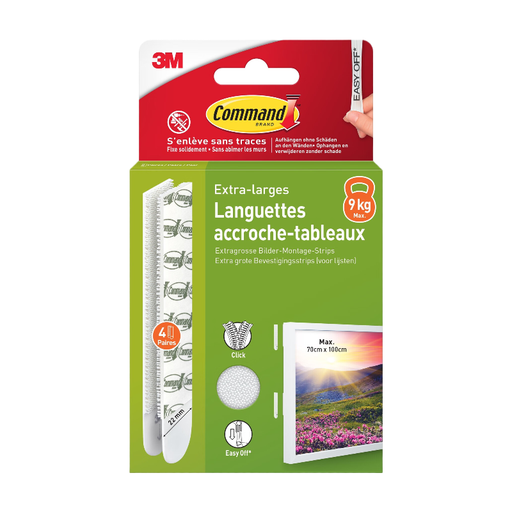
Why we chose it: THE solution for anyone wondering `how to hang a heavy picture without making a hole`. Perfect for large mirrors, canvas frames, or whiteboards that demand superior holding power.
It directly addresses the trap of underestimating weight by providing a solution specifically designed for heavy loads, with a clearly stated and tested capacity.
A high load capacity of up to 9 kg, allowing you to confidently hang bulky items without getting out the drill.
Explore our full selection of products that meet our criteria for reliability and safety.
No, the adhesive part that sticks to the wall and the frame is single-use only. Once removed by stretching it, it loses all its adhesive power and becomes unusable. However, the hook-and-loop fastening system allows you to unhook and re-hang the frame as you please, as long as the strips remain in place on the wall and the frame.
It's a very bad idea. Adhesive strips are designed for smooth, non-porous surfaces. On wallpaper, not only is adhesion not guaranteed, but you also run a high risk of tearing the paper upon removal. Always refer to the manufacturer's instructions to check the list of compatible surfaces.
When applied correctly (on a clean surface, respecting the weight limit, in stable conditions), quality adhesive strips are designed to last. They do not degrade over time and can hold for years. They only come off when you decide to remove them; it is never the result of product wear and tear.