Whether you're tearing down MTB trails or logging miles on the tarmac, perfect vision is crucial for your performance and safety. Wind, insects, debris, not to mention the sun's glare… the hazards are numerous and can quickly ruin a ride. Far from being a mere fashion accessory, a good pair of cycling glasses is an essential piece of gear.
Polarised lenses, photochromic lenses, UV400 standard… Faced with this technical jargon, it's not easy to navigate. Our mission? To guide you step-by-step in making the right choice. This guide breaks down the essential criteria and presents our selection of the best models for the 2026 season.
How to Choose the Right Cycling Glasses??
Before diving into our selection, let's review the key points that will help you make an informed choice, perfectly suited to your cycling discipline.
1. Lens Type?: A Matter of Light and Clarity
This is arguably THE number one criterion. The ideal lens type will depend directly on the light conditions you most often encounter.
- Polarised Lenses?: The ultimate anti-glare weapon. Their specialty? Eliminating the blinding glare caused by reflective surfaces like a wet road, a body of water, or car bodies. The result?: polarised lenses boost contrast, enhance colours, and significantly reduce eye fatigue. Indispensable for long rides under a bright sun.
- Photochromic Lenses?: The ultimate in versatility. These smart lenses adapt in real-time to the ambient light. They darken under a blazing sun and lighten as soon as the weather becomes overcast or you enter a wooded section. This is the ideal solution for those who alternate between shade and light during the same ride, a very common situation in MTB.
2. Protection and Durability?: Safety First
Because your eyes are precious (and fragile!), a good pair of sports glasses must offer impeccable protection.
- UV400 Protection?: This is the absolute baseline, a non-negotiable standard. The UV400 certification ensures that the lenses filter 100% of UVA and UVB rays, the most harmful to your eyes. It's your best insurance against irreversible damage linked to sun exposure.
- Impact Resistance?: On the road as in the forest, flying debris is unavoidable?: gravel, branches, insects… Your glasses are your first line of defence. That's why polycarbonate (PC) lenses are the benchmark?: they are not only lightweight but, above all, virtually unbreakable. Essential protection to prevent injuries in case of impact.
3. Comfort and Fit?: So You Forget You're Wearing Them
A pair of glasses that presses on your nose or constantly slips down can turn a ride into a nightmare. Comfort and a secure fit are therefore crucial, especially over long distances.
- Lightweight Design?: To go unnoticed, a frame must be as light as possible. Materials like TR90 are prized for this. Aim for a weight around 30 grams?: it's often a sign of glasses you won't even feel on your nose.
- Secure Fit?: To ensure your glasses don't end up on the pavement at the first jolt, check for two key elements?: adjustable nose pads and temple tips made of rubber or silicone. This grip is essential to guarantee a perfect hold, even when you're sweating heavily.
Recommended Cycling Glasses
Enough theory, let's get practical! Here are the models that caught our editorial team's attention for their performance and value.
Revoray X3-black Cycling Glasses

- Key Feature?: An aerodynamic design built for speed, with a large single-piece lens that ensures maximum protection.
- What we like?:
- Its large polycarbonate (PC) lens for a panoramic field of view and unbeatable high impact resistance.
- Its ultra-light TR90 frame (approx. 30 g), which becomes unnoticeable from the first pedal stroke.
- Full UV400 protection, blocking 100% of UVA, UVB, and UVC rays.
- The grip from the rubber nose pads and temple tips, for a hold that never fails.
- Best for?? Road cyclists and competitors seeking pure performance, a feather-light weight, and a streamlined design to cut through the air.
Revoray Y1-black Cycling Glasses
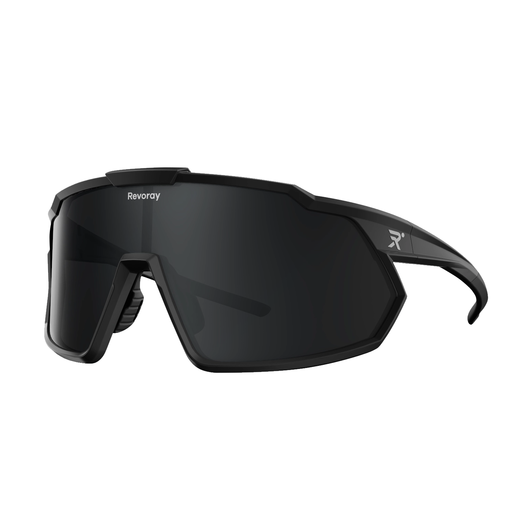
- Key Feature?: The integration of HD TAC polarised lenses, perfect for tackling bright sun and blinding glare.
- What we like?:
- The HD TAC polarised lenses that eliminate glare and offer stunning visual clarity.
- ANSI Z87.1 certification, a mark of impact resistance worthy of professional gear.
- The lightweight TR90 frame (approx. 33 g), which combines flexibility and durability.
- Adjustable silicone nose pads for customised comfort.
- The hydrophobic and oleophobic lens coating, which makes cleaning much easier (water droplets and fingerprints don't stick).
- Best for?? Road cyclists, as well as water sports enthusiasts, who often battle sun glare and demand perfect vision in bright conditions.
OutdoorMaster HAWK LT Photochromic & Polarised Sunglasses

- Key Feature?: The winning combination! This model combines photochromic and polarised technologies for ultimate versatility, whatever the conditions.
- What we like?:
- "Two-in-one" lenses that adapt to light AND filter out glare.
- Their feather-light weight (26-29 g), making them unnoticeable even after several hours.
- The 20% expanded peripheral field of view, ideal for anticipating hazards.
- Adjustable nose pads and memory-fit temples for a perfect, personalised fit.
- The very comprehensive accessory pack, which even includes an insert for mounting prescription lenses.
- Best for?? The Swiss Army knife for do-it-all cyclists (road and MTB) and athletes who don't want to juggle multiple pairs. Ideal for transitioning from dark woods to sun-drenched roads without a second thought.
Looking for Other Options??
Did none of these models catch your eye? Or are you simply looking for a different style or colour? Take a look at our complete collection of sports glasses for men and women.
Explore Our Entire Sports Glasses Collection
Frequently Asked Questions (FAQ)
1. What is the difference between polarised and photochromic lenses?
In short?: polarised lenses are specialists in anti-glare. They block reflections (wet roads, water) and are perfect for very sunny days. Photochromic lenses are chameleons?: their tint varies with the light level (UV), darkening in the sun and lightening in the shade. Your choice will therefore depend on your priority?: fighting glare or adapting to changing light.
2. Is UV400 protection essential for cycling glasses?
Yes, and it's non-negotiable. Repeated exposure to ultraviolet rays (UVA and UVB) can lead to serious and permanent eye damage. The UV400 standard is the only one that guarantees 100% filtration of these harmful rays. It is a safety imperative for any pair of sports glasses.
3. How can I ensure the glasses won't slip during exercise?
For a rock-solid fit, three points are key?: a lightweight frame (TR90 is a safe bet), adjustable and non-slip nose pads (made of rubber or silicone), and temple tips with the same grippy material. This is the winning trio to ensure your cycling glasses don't move an inch, even when you're sweating or on the roughest trails.


