
Livraison le jour même ou le lendemain

Qualité garantie

Débloquez vos offres de bienvenue: Livraison GRATUITE | Jusqu'à -80 % | 30 jours d'essai gratuits à JoyPlus
Téléchargez l'application
Cutting dies have revolutionised the world of crafting, bringing unparalleled precision and finesse to our scrapbooking and card making projects. However, faced with an overwhelming selection, it can be difficult to know where to start. Between promises of ultra-detailed designs and tempting prices, it's easy to end up with tools that tear paper, wear out in record time, or worse, are incompatible with your machine.
This guide deciphers the pitfalls to avoid and gives you the keys to choosing THE cutting die that will elevate your creations, with no nasty surprises.
Before you fill your shopping cart, keep these two common issues in mind that can turn a creative session into a real nightmare.
To make the right choice, focus on a few objective technical points. These are what truly separate a gimmicky die from a reliable tool.
This is the number one criterion. Dies made from carbon steel are the gold standard. This material offers excellent rigidity, preventing it from deforming under the pressure of the machine. Its cutting edge also stays sharp much longer, guaranteeing flawless cuts, even on thick or textured papers. It's a minimal investment for incomparable durability.
Most dies are designed to be compatible with standard manual die-cutting machines (Sizzix Big Shot, Cuttlebug, etc.). However, their thickness can vary slightly. A good quality die will have a consistent and standardised thickness. Before buying, simply check that the die is described as compatible with the main machines on the market. This will save you from having to adjust your cutting plate "sandwich" through trial and error.
For complex designs like a detailed flower die, a lace border die, or a delicate alphabet die, look closely at the product image. The presence of small holes on the surface of the metal stencil is an excellent indicator. These perforations allow you to use a small pointed tool to gently push the cut paper out of the die without risking tearing it. It's a detail that makes all the difference in practice.
To move from theory to practice, here are a few concrete examples from our catalogue, tailored to different needs.
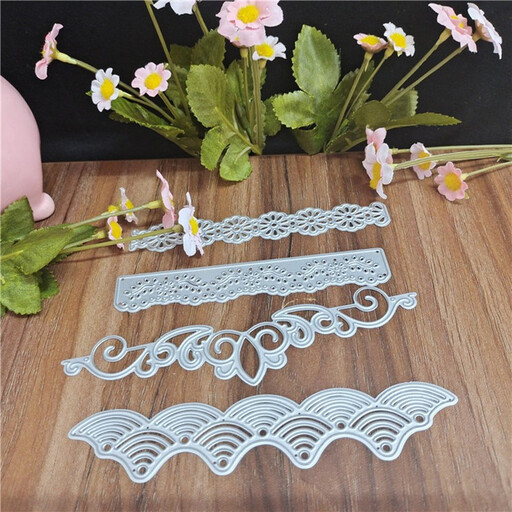
Why we chose it: Perfect for building a solid foundation. This set of simple geometric shapes is versatile and can be used to create card backgrounds, tags, or frames for scrapbooking photos.
The "carbon steel" mention ensures good durability. The simple, wide shapes release effortlessly and won't risk tearing the paper, even for a beginner.
A set of 4 basic shapes that will be useful in a multitude of projects, from simple card making to photo albums.
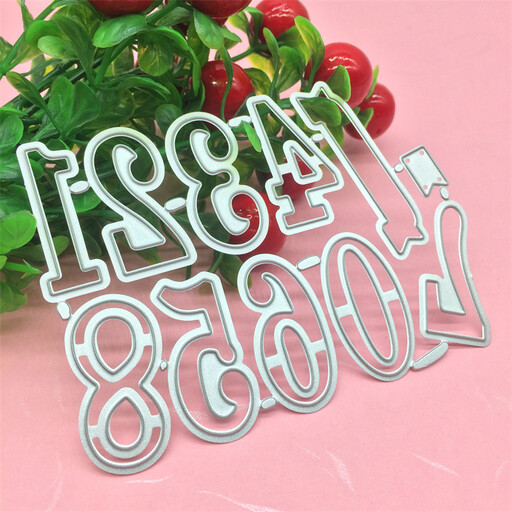
Why we chose it: Essential for enthusiasts who want to add custom titles, names, or messages to their albums and creations.
The font is classic and without excessive flourishes, ensuring a clean cut and good legibility. Each letter is an individual die, making positioning easy.
The set includes all 26 capital letters as well as numbers, offering complete customisation freedom for all your projects.
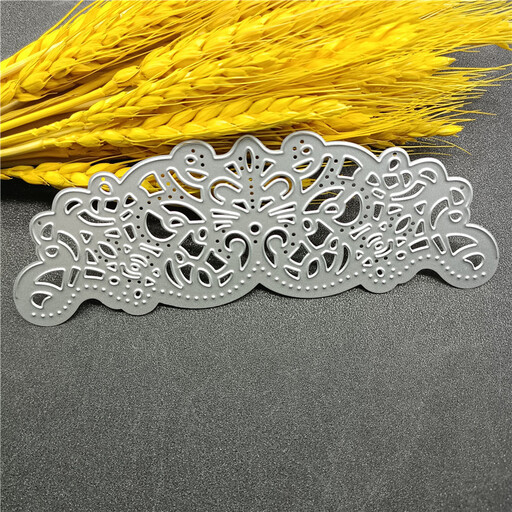
Why we chose it: Perfect for adding a touch of refinement to invitations, greeting cards, or album pages. This type of border die creates a delicate and professional lace effect.
Although the design is intricate, its linear construction and sufficient open spaces facilitate cutting and release, limiting the risk of snagging the paper.
Transforms a simple card into a sophisticated creation with minimal effort. The visual impact is immediate and enhances the project.
We've selected a full range of products that meet our quality criteria to bring all your creative projects to life.
After each use, remove any small, stuck paper pieces with a brush or a pick tool. For a deeper clean, a simple wipe with a dry cloth is sufficient. Store them flat, ideally on magnetic sheets, to prevent them from warping or clashing against each other.
If a carbon steel die seems less effective, here's a handy tip: run it through your machine once or twice, cutting a sheet of aluminium foil folded into four. This can help to slightly resharpen its edge. Also, remember to check the condition of your cutting plates: if they are heavily scored or warped, they can affect the pressure and thus the quality of the cut.
Yes, most dies can also be used for embossing. To do this, simply adapt your machine's "sandwich" by replacing one of the rigid cutting plates with a silicone embossing mat. The die will then impress its design onto the paper without cutting through it. It's an excellent technique for adding relief and texture to your creations.