
Livraison le jour même ou le lendemain

Qualité garantie

Débloquez vos offres de bienvenue: Livraison GRATUITE | Jusqu'à -80 % | 30 jours d'essai gratuits à JoyPlus
Téléchargez l'application
What's the secret to a successful scrapbooking or card making project? It often comes down to one game-changing detail: the perfect cutting die. This magical tool transforms a simple sheet of paper into an exceptional piece. Whether you're a card making pro or want to add dimension to your scrapbooking album, the right cutting die is your best ally. But faced with a vast array of shapes, sizes, and styles, how do you make the right choice?
This guide is here to shed some light. As a product expert at Joybuy, my mission is to unearth the gems for you and provide practical tips for choosing the tools that will perfectly match your craft projects.
Before diving into our selection, let's review a few essential points to check to ensure you make the right decision.
This is the essential starting point. Not all dies are universal. Remember to check the maximum cutting width accepted by your machine (Sizzix Big Shot, Cricut Cuttlebug, etc.). While most thin metal dies are fairly standard, caution is advised for wider or thicker models: a quick look at the specifications will save you from any unpleasant surprises.
Think about how you'll use it.
A good die is one that can be repurposed. A simple frame can be used to frame a photo, create a window on a card, or even, by using the negative of the cut-out, serve as a scrapbooking stencil for applying ink. Thinking about these multiple uses is the best way to get the most out of your purchase and boost your creativity.
Enough theory, let's get practical! Here are a few cutting dies that caught our eye with their design and creative potential.
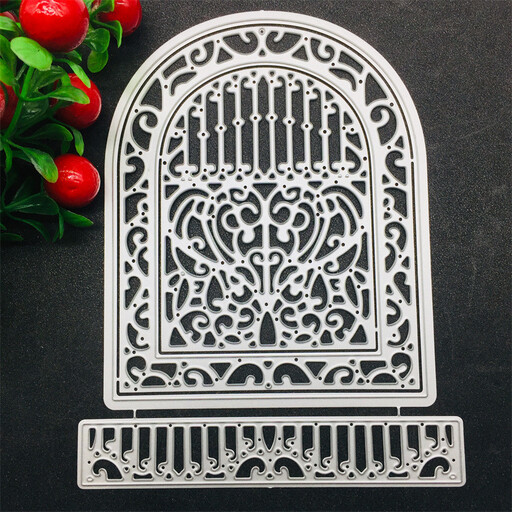
Why we love it: This die successfully combines the elegance of a floral frame with the originality of an openable window. The level of detail, reminiscent of lace, allows you to create cards and announcements with a very refined finish for an immediate "wow" effect.
Key Features:
Who is it for? For anyone who wants to create sophisticated cards or invitations with a little surprise element. A must-have for projects that require a touch of elegance and romance.

Why we love it: The key advantage of this set is its modularity. It contains six different-sized frames that nest together (the famous nesting dies). The faux-stitching (stitched) detail and the deliberately irregular shape bring a modern, handcrafted touch that is a refreshing change from perfect rectangles.
Key Features:
Who is it for? An essential for scrapbooking enthusiasts who love to play with layers (layering). Its versatility makes it an excellent foundation for a multitude of projects, from album pages to the most creative cards.
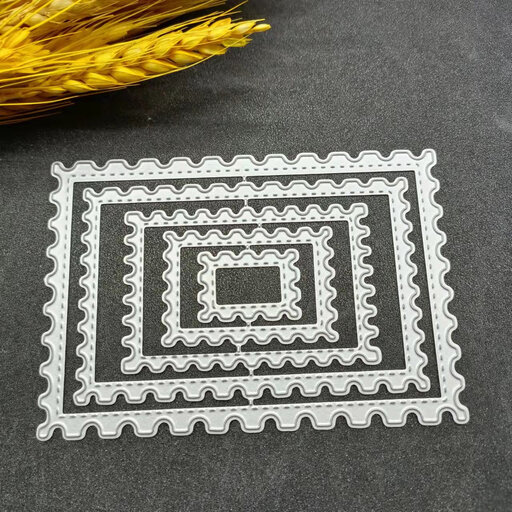
Why we love it: This die stands out for its original design that perfectly mimics a postage stamp with wavy edges. A creative choice that is off the beaten path, perfect for travel or correspondence themes, or simply for adding a charming vintage touch.
Key Features:
Who is it for? For creatives who love to tell a story around themes like travel or correspondence, or for anyone looking for an original frame to add character to their projects.
This selection is just a taste. Do your creative projects call for circles, ovals, hearts, or even more specific patterns? A much larger collection is waiting for you.
Explore our complete collection of artisan craft frames to discover hundreds of other shapes and styles that will fuel your inspiration.
A cutting die is a metal tool with sharp edges. When placed in a die-cutting machine, it exerts strong pressure to cut a clean shape into paper, cardstock, or other thin materials. A scrapbooking stencil, on the other hand, is usually a perforated plastic sheet. It doesn't cut anything; it serves as a guide for applying ink, paint, or texture pastes through its openings.
To ensure your dies last a long time and your cuts remain flawless, a minimum of maintenance is required. After each use, a quick brush or a fine pick is enough to dislodge paper scraps stuck in the corners. Pro tip: for highly detailed dies, run a sheet of wax paper with the die through the machine. This helps lubricate the blade and will make removing future cuts easier. As for storage, store them flat, ideally on magnetic sheets to prevent them from getting warped.
The answer is simple: no. The effectiveness of a die depends on the strong, even pressure exerted by a die-cutting machine. Trying to force it by hand will only yield a poor result, and you risk damaging your paper and your precious die. Purchasing a machine, even a basic, entry-level manual model, is therefore an essential prerequisite to get started.