Hosts who want to serve warm croissants
For a small group, frozen croissants ready to bake let you plan to bake them before serving, as long as you have an oven and follow the storage instructions.


For New Year’s Eve, start by considering how much time you have and what equipment is available. A ready-baked croissant can be served without any preparation, a frozen croissant ready to bake lets you plan to bake at home, while a ready-to-prove product also needs time to rise. When comparing options, check the number of croissants, ingredients, allergens and storage instructions rather than relying solely on the words “all-butter”.
For a small group, frozen croissants ready to bake let you plan to bake them before serving, as long as you have an oven and follow the storage instructions.
For a New Year’s Eve celebration or brunch on 1 January with lots of guests, the number of croissants is only part of the equation: you’ll also need to plan for storage space and, if they need baking, batches.
A ready-baked croissant can go straight on the table without taking up oven space. You’ll have less control over when it was baked than with an option you bake at home.
For New Year’s Eve or the brunch afterwards, start by deciding what you need to organise first: serving them warm, quantities, ingredients or last-minute preparation.
| Criteria | What to check | Who is it for? |
|---|---|---|
| Serving warm | Tell apart products that are ready to bake from those that also need proving, and check the preparation instructions. | If you want to bring warm croissants to the table, how much time you need before serving is key. Around 33% of consumers prioritise this. |
| Quantities and batches | Compare the number of croissants, the storage space needed and your oven’s capacity. | For a large buffet, you’ll need enough croissants without having to bake too many batches at the wrong time. Managing quantities is the top priority for around 25% of consumers. |
| Ingredients and allergens | Read the ingredients and allergen information for the exact product; don’t rely on the words “all-butter” alone. | If ingredients matter to your guests, the product name is no substitute for reading the label. This is the first priority for around 25% of consumers. |
| Ready to serve | Look for “ready-baked” or “ready to eat”, rather than “ready to bake”. | If the oven will be in use during the meal, you may prefer croissants that can be served straight away. Around 17% of consumers prioritise this convenience above all. |
This description alone doesn’t tell you everything about the ingredients, allergens, size or preparation needed.
Compare the ingredients and allergen information for each product, then check its weight and number of croissants.
Auchan’s listing describes the PANAVI croissants as a frozen product containing 40 pieces and weighing 2.4 kg, to be stored at −18 °C. You’ll need enough freezer space and a plan for baking them in batches.
Before choosing this pack size, consider how many guests you’ll have, how much space is available and your oven’s capacity.
Any surplus may also be difficult to store if your guest numbers change.
Bridor says its 75 g Croissant needs to prove for 1 h 45 to 2 h at 27–28 °C before baking. You can’t simply take it out of the freezer and put it in the oven.
Allow time for this step and make sure you have the right equipment, or choose a product clearly labelled ready to bake or ready-baked.
If you don’t allow time for proving, serving may be delayed.
The 75 g Croissant, ref. 38317, is a ready-to-prove option for anyone with the right conditions and equipment for proving and baking.
Two options suit different plans: Carrefour Classic' offers frozen croissants ready to bake, while Carrefour Traiteur offers croissants to order.
The Epi d'Or product sold by E.Leclerc is a household pack of frozen croissants ready to bake.
The PANAVI product listed by Auchan is a large pack of frozen croissants ready to bake.
The all-butter croissant described by Lidl is ready-baked and ready to eat, so you can serve it without baking.
ALDI France lists MANNAPAIN® croissants as a frozen pack that’s ready to bake.
These products are for serving after baking: two packs of plain croissants and a hazelnut-cocoa-filled option. Choose according to how many pieces you need and how much room you can set aside for preparation.
 Image unavailable
This pack of six is a good fit for a small gathering, with baking before the meal. Check the preparation instructions and allergen information on the packaging.
 Image unavailable
If you want to serve six croissants baked at home, allow enough time before serving. Follow the preparation instructions on the packaging and check its allergen information.
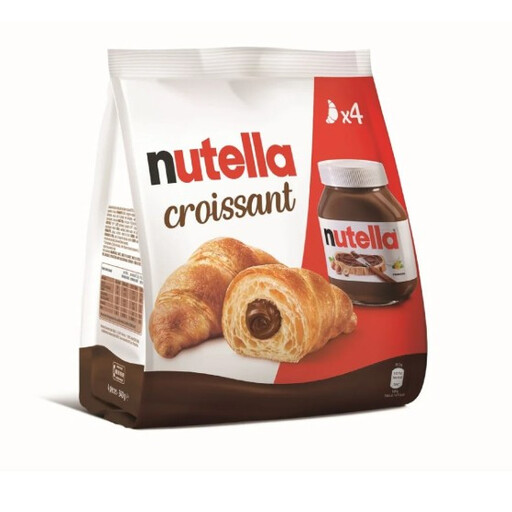 Image unavailable
This filled option offers something different from a plain croissant. The pack contains four pieces; check the baking instructions and allergens for this product before serving.
No: this description doesn’t replace the allergen information. The Carrefour Classic' and Lidl listings state the allergens for their respective products. Check the label on the product you actually buy, including any warnings about traces.
Check its state and the instructions on the listing or packaging. Bridor describes its 75 g Croissant as ready to prove before baking; Carrefour Classic' and Epi d'Or offer frozen products ready to bake, while Lidl describes its product as ready-baked and ready to eat.
Not this product: Carrefour’s listing says not to refreeze a defrosted product. For any other pack, follow the instructions for the product you’ve bought.
Confirm availability and collection times with the relevant store before finalising your plans. E.Leclerc specifically advises checking availability of its Epi d'Or product with your chosen store or Drive.
Compare the product name, ingredients, allergens, net quantity and date shown on each pack. France’s Ministry of the Economy reminds shoppers that allergens must be highlighted in the ingredients list of prepacked food sold to consumers.