To serve an individual pastry, choose a croissant based on its recipe, size and preparation method, rather than assuming it contains wholemeal flour. If wholemeal flour is your priority, bread explicitly labelled wholemeal or brown is a more direct match; you’ll need to portion it and check that your child likes its taste and texture.
Who is this choice for?
Parents mindful of their child’s taste for grains
If your child is reluctant to try new textures, distinguish between the croissant they know and wholemeal or brown bread. Manger Bouger advises offering wholegrain or semi-wholegrain starchy foods according to the child’s appetite, without assuming they’ll like a particular product.
Anyone serving individual portions
If you’re serving one item at a time, check the number of croissants, the pack weight and the storage instructions. Carrefour, for example, offers packs of 8 and 16 croissants; these sizes won’t necessarily suit the same number of planned meals.
Families checking for allergens
Check the ingredients list and any ‘may contain’ warnings on the pack you choose. The croissants described by Carrefour and Lidl include wheat and milk among their listed ingredients; check the composition of each product.
Which criteria should you prioritise?
The choice comes down to two different products: an individual pastry, or bread whose recipe explicitly includes wholemeal flour.
Packaged croissant
Choose this if: you want to serve individual pastries.
Keep in mind: check the recipe before treating it as a wholemeal product, and follow the baking instructions if the croissant is sold frozen.
Wholemeal or brown bread
Consider this if: wholemeal flour in the meal is your top priority.
Keep in mind: you’ll need to portion the bread, and its taste and texture won’t be exactly the same as a croissant’s.
| Criteria |
What to check before buying |
Who is it for? |
| Taste and texture |
The product name and the flours listed in the ingredients. |
If my child is unsure about trying new grains, I want to choose a recipe they’ll be willing to try, without confusing a croissant with wholemeal bread. Around 42% of consumers put acceptance first. |
| Ingredients |
The types of flour, followed by the nutritional values per 100 g, particularly sugars, fat and fibre where listed. |
To include a product that genuinely contains wholemeal flour in the meal, I need to be able to identify that flour on the label. This is the main concern for around 33% of consumers. |
| Pack size and storage |
The number of items, stated weight, and preparation and storage instructions. |
If I’m only serving one item at a time, I need a pack whose contents I can use up under the stated storage conditions. Pack size comes ahead of other criteria for around 25% of consumers. |
Mistakes to avoid
-
Assuming a second type of flour means wholemeal flour
The presence of more than one type of flour doesn’t, by itself, tell you whether a product meets your requirements for wholemeal flour. According to the French Ministry of the Economy, ingredients are listed on the packaging in descending order by weight.
Read the product name and ingredients list for the specific product. If wholemeal or semi-wholemeal flour is your priority, look for an explicit mention of it.
-
Relying on the Nutri-Score alone
Santé publique France explains that displaying the Nutri-Score is voluntary. If it is shown, it won’t tell you which flours have been used or identify allergens.
When comparing two croissants, also check their ingredients and nutritional values on the same per-100 g basis.
-
Forgetting to check the allergens again
The croissants described by Carrefour and Lidl include wheat and milk among their listed ingredients. Two recipes, even if sold under the same retailer’s name, shouldn’t be treated as identical.
Check the highlighted ingredients and any ‘may contain’ warnings on every pack you buy.
-
Choosing a large pack without planning how you’ll use it
A pack of 16 isn’t necessarily suitable if you only serve one at a time and can’t store the rest according to the manufacturer’s instructions.
Compare the number of items with the meals you have planned, then check the date and storage instructions.
Any items not used in accordance with the stated instructions may go to waste.
Brands to know when comparing recipes
Carrefour
Carrefour’s product pages for packs of 8 and 16 packaged croissants let you compare the size and ingredients of two specific products.
- The product page for the pack of 8 gives a weight of 320 g and lists 52% wheat flour, among other ingredients.
- This information isn’t enough to describe these croissants as recipes combining white and wholemeal flour.
Brioche Pasquier
The manufacturer’s product page states a serving size of 40 g and provides nutritional information per 100 g.
- Brioche Pasquier states that this product contains 4.6 g of fibre per 100 g.
- This figure doesn’t mean the croissant contains wholemeal flour, and it doesn’t describe the brand’s other products.
La Boulangère
The brand sells both croissants and wholemeal breads, two product categories to consider separately for this meal.
- La Boulangère describes its croissants as containing wheat flour, eggs and butter.
- The fact that the range includes wholemeal breads doesn’t mean its croissants contain wholemeal flour.
Lidl
Lidl’s product page for a pure butter croissant lets you check the ingredients of this specific product.
- It lists wheat flour, 27% butter and milk, among other ingredients.
- This recipe doesn’t confirm that the croissant contains wholemeal flour.
Croissants to consider on Joybuy
These croissants come in multi-packs and can be served individually after baking. If you’re looking for wholemeal flour, check the ingredients list for each product instead of inferring its composition from the pack size or filling.
 Image unavailable
FOURNIL Organic Croissants x6, 420 g
The pack of six makes it easy to plan one croissant per serving. These croissants are frozen and need to be baked in the oven, so allow for preparation time and follow the storage instructions. To check whether the recipe meets your requirements for wholemeal flour, read the ingredients list on the pack.
View on Joybuy
 Image unavailable
FOURNIL DE PIERRE Croissants à cuire x6, 360 g
The pack of six is a good option if you’d like to bake the croissants as you need them. Keep the product frozen before use; follow the preparation instructions and check the recipe and allergens on the packaging.
View on Joybuy
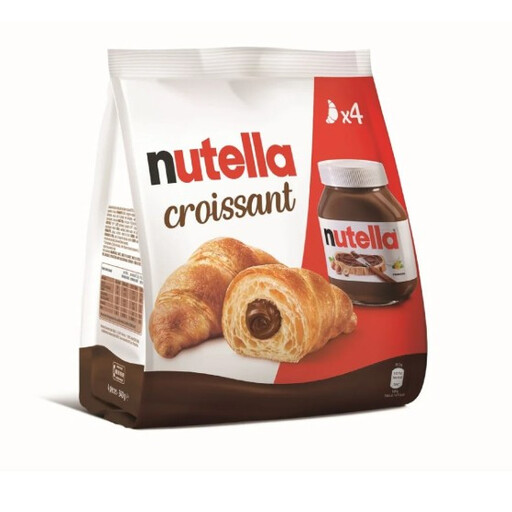 Image unavailable
NUTELLA Croissants fourrés noisette-cacao x4, 340 g
The four croissants can be served individually after baking. These are filled croissants, not plain ones, so check that the filling is suitable for the meal you have planned. Also check the ingredients, allergens and storage instructions on the pack.
View on Joybuy
Frequently asked questions
Is the Nutri-Score compulsory on packaged croissants?
No. In France, Santé publique France explains that producers can display it voluntarily. If it appears on the pack, also check the ingredients list and nutritional information to understand the recipe.
What should I check if a child needs to avoid certain allergens?
Read the highlighted allergens in the ingredients list and check for any ‘may contain’ warnings on the packaging of the specific product. The croissants described by Carrefour and Lidl include wheat and milk among their listed ingredients; don’t assume one product has the same composition as another.
How can I compare two croissants of different sizes?
Start by comparing their nutritional values per 100 g, the basis recommended by the French Directorate-General for Competition Policy, Consumer Affairs and Fraud Control. Then check the weight of each croissant or the serving size shown on the pack to plan individual portions.


