Hosts looking for a wholegrain option
You’re planning a crunchy accompaniment made with wholemeal wheat and want to compare the fibre content listed per 100 g, rather than relying on the product name alone.


To serve alongside crêpes, choose wholegrain crispbread if you want to compare the fibre content shown on the packs, classic Cracotte for a crunchy slice to top, or a brioche version if you’re after a softer recipe. None of these options guarantees a ‘digestive’ effect: check the ingredients, nutritional information and allergens for the specific product you’re serving.
You’re planning a crunchy accompaniment made with wholemeal wheat and want to compare the fibre content listed per 100 g, rather than relying on the product name alone.
You’re looking for a slice to serve alongside crêpes, plain or topped, without presenting it as a substitute for a crêpe.
If guests need to avoid certain ingredients, base your choice on the label for the specific product: classic, wholegrain and brioche recipes don’t necessarily contain the same ingredients.
For crêpe night, first decide what you want the slice to do, then check its ingredients before working out how much to serve.
| Criteria | What to check | Who is it for? |
|---|---|---|
| Wholegrain ingredients and fibre | Look for wholemeal wheat in the ingredients and compare the fibre content per 100 g, without assuming it has a digestive effect. | If I want a wholegrain slice alongside my crêpes, I’d prefer to be able to compare the fibre content on the label. Around 40% of consumers are said to prioritise this type of composition. |
| Texture and toppings | Choose between a classic and a brioche recipe to suit the toppings you’re planning; also check the net weight and number of slices. | To offer a variety of toppings throughout the evening, I’d first look for a crunchy slice that works for the way I plan to serve it. This versatility is said to be the main need for around 30% of consumers. |
| Allergens and catering for guests | Read the allergen and ‘may contain’ information on the exact pack before choosing the crispbread and toppings. | If a guest needs to avoid an ingredient, I need to know the exact recipe of what I’m serving them. Allergen checks are said to come first for around 30% of consumers. |
The ingredients and fibre content listed on a pack don’t prove that a particular crispbread will help an individual digest their food.
Compare the ingredients and fibre per 100 g if these factors matter to you, but don’t assume the word ‘wholegrain’ means it has a particular effect.
The E.Leclerc product listing for Epi d’Or brioche crispbread mentions concentrated butter and eggs, among other ingredients. Other recipes may carry different ‘may contain’ information.
Ask about dietary requirements before you buy, and keep the packaging for each product to hand during the evening.
Net weight and slice count are no substitute for comparing nutritional values. The DGCCRF says that nutrition information per 100 g makes it easier to compare pre-packed products.
Compare the values per 100 g, then check the net weight and number of slices to plan how you’ll serve them.
Anses says that acrylamide can form when certain starchy foods are cooked at high temperatures; this doesn’t quantify the exposure associated with any particular product.
Serve the slices ready to eat if that suits you. If you warm them up, take care not to burn them.
Carrefour listings include an Original Wheat version and a Wholegrain Cereals version.
Auchan listings include 500 g wholemeal wheat crispbread and a 250 g organic wholemeal flour product.
The E.Leclerc range includes several Epi d’Or crispbreads, including a brioche recipe.
The Carrefour range includes plain, wholegrain and brioche crispbreads, as well as toast slices.
These products make it easy to plan crunchy slices to serve alongside crêpes: two wholegrain options and classic Cracotte to top. Compare their labels if the ingredients are important to your choice.
 Image unavailable
A wholegrain option for serving slices alongside crêpes. Check the pack for allergens and how many slices you’ll need for your guests.
 Image unavailable
A 425 g pack to consider if you’re planning to serve wholegrain slices to several guests. Check the pack for allergens and the number of slices before deciding how much to buy.
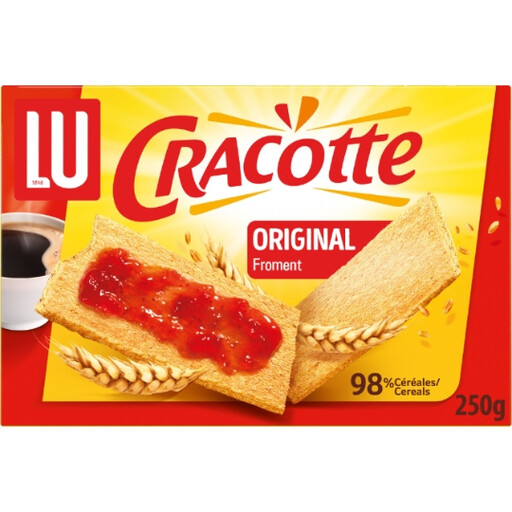 Image unavailable
A classic slice to serve with toppings alongside crêpes. The product listing mentions wheat, rye and milk powder; check the packaging if these ingredients may be an issue for your guests.
No. The term ‘wholegrain’ and the fibre content don’t prove an individual digestive benefit. If you’re choosing between several products, compare their ingredients and fibre content per 100 g.
Read the ingredients list and ‘may contain’ information on each pack: depending on the recipe, the products mentioned may contain wheat, milk or eggs, among other ingredients. In France, the DGCCRF reminds consumers that allergenic ingredients must be highlighted in the ingredients list of pre-packed foods.
Follow the instructions on the pack. The Joybuy listing for LU CRACOTTE Original Wheat recommends storing it in a cool, dry place; also check the date on the packaging of the product you buy.
No. Also check the ingredients list, allergens and nutritional information per 100 g. A score on its own doesn’t tell you everything about the recipe or whether it’s suitable for your guests.