
Livraison le jour même ou le lendemain

Qualité garantie

Débloquez vos offres de bienvenue: Livraison GRATUITE | Jusqu'à -80 % | 30 jours d'essai gratuits à JoyPlus
Téléchargez l'application
Between gel pens, fineliners, brush pens and erasable pens, it’s not always easy to find your way around the world of creative stationery. A set that looks complete at first glance won’t necessarily be the best fit for note-taking, bullet journaling, drawing or calligraphy.
To avoid purchases that end up at the back of a drawer, focus on four key points: the nib, the ink, the grip and the storage. Here are the criteria to consider when choosing creative writing pens and markers that are truly suited to your habits.
A set of 30 or 65 shades gives an impression of abundance, but not all the colours will necessarily be useful to you. For note-taking, a few highly legible shades are usually enough. For drawing, colouring or journaling, however, a wider palette can make all the difference.
So look at the colour distribution and check that the shades are sufficiently distinct. A palette made up of colours that are too similar or very light may lack contrast on white paper.
Drying time depends on the ink formulation, the paper weight and its texture. Even an ink marketed as quick-drying can leave marks on a thin notebook or under the hand of a left-handed person.
To reduce the risk of smudging, choose a nib suited to your writing style and, if possible, test it on the paper you use every day. Water-based inks in fineliners are often good for notes and precise lines, while gel ink offers a smoother glide.
A very fine nib can catch on certain papers or become uncomfortable when you have to fill several pages. Conversely, a broad nib produces a bolder line, uses more ink and is less suitable for small handwriting.
The shape of the barrel also matters. A soft grip, a triangular profile or a non-slip surface can make long writing, drawing or colouring sessions much more comfortable.
The STABILO point 88 and STAEDTLER Triplus fineliners shown below have a line width of 0.4 mm and 0.3 mm respectively. These values provide a useful benchmark for comparing the precision of different models, even though the result may vary depending on the paper.
Gel pens are generally appreciated for their smooth glide and highly visible colours. Retractable models prevent the nib from being left exposed, while capped versions require a little more care to avoid drying out.
Ballpoint pens use an ink that is better suited to documents that need to remain legible over time. The Avori models shown here, for example, feature indelible blue ink and a refillable twist mechanism.
With erasable pens, the thermosensitive ink allows you to correct certain mistakes using the eraser tip provided. However, this function is not suitable for writing that needs to be permanent, particularly official documents.
A case, a compartmentalised pencil case or a roll makes transport easier and prevents caps from getting lost. The STABILO point 88 ARTY set of 65 colours comes in a cardboard wallet, while the 30-colour set is presented in a roll-up case.
After each use, carefully replace the caps and keep the markers away from heat and direct sunlight. For retractable models, retract the nib to reduce the risk of drying out and staining.
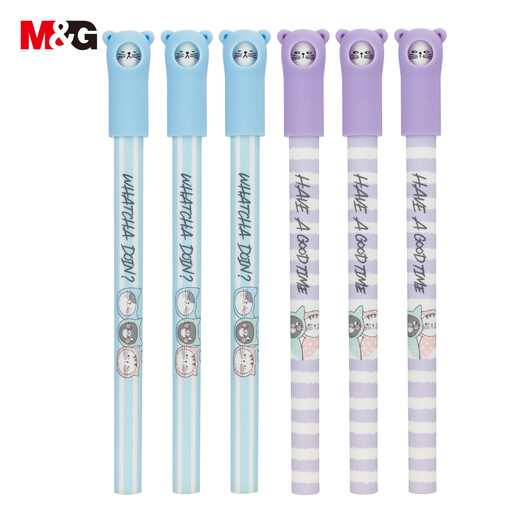
Why this choice suits this profile: With six blue gel pens in 0.7 mm, this pack offers a simple and affordable entry point into note-taking and creative stationery.
The 0.7 mm nib remains versatile, unlike a very broad nib, while the cap protects the nib between uses.
Six pens, blue ink, a 0.7 mm ballpoint nib and cat designs with a rotating head.
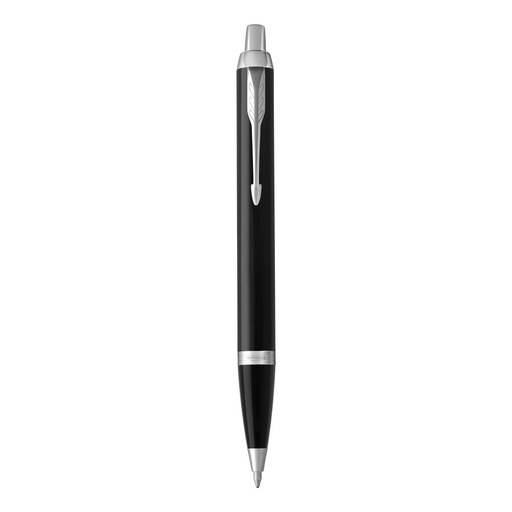
Why this choice suits this profile: Its black lacquered body, chrome details and gift box give it the standing expected for professional use or a thoughtful gift.
The product page specifies the nib type, ink colour and retractable mechanism – so the choice isn’t based solely on appearance.
Medium nib, blue ink, click-action retractable mechanism, indicated refill and gift box included.
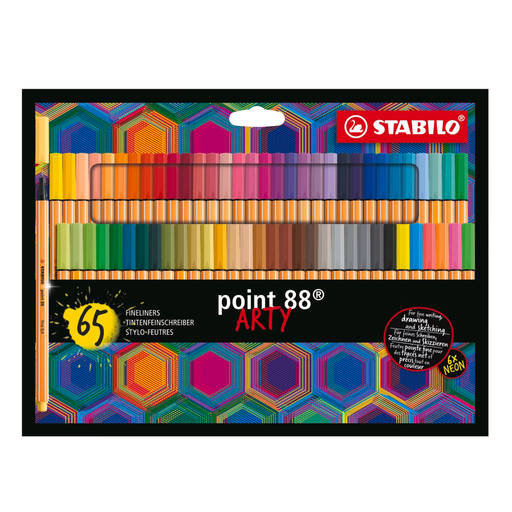
Why this choice suits this profile: This large assortment is aimed at those who move between detailed drawing, mandalas, pixel art, journaling or colour-coding.
The 0.4 mm metal-clad nib offers precise lines and protects the fibre during repeated use with a ruler.
65 colours, including six fluorescent ones, a nylon nib sheathed in metal and ISCC Plus certified bio-based plastic according to the product page.
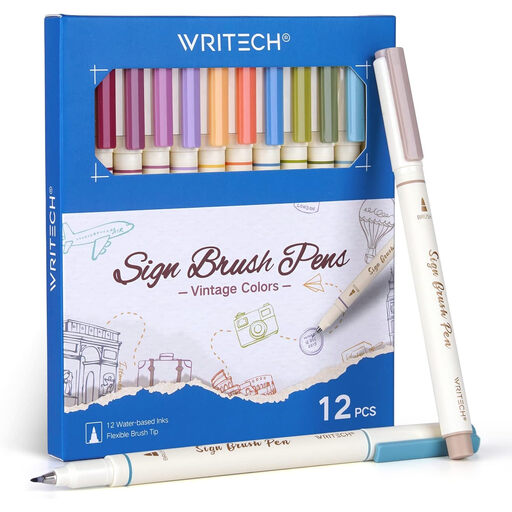
Why this choice suits this profile: Its soft brush tip allows you to get started with brush lettering, calligraphy and sketching, or to decorate the pages of a creative journal.
The product page mentions a flexible felt tip and water-based ink – two valuable pieces of information for anticipating line-width variation.
12 vintage shades, a pressure-sensitive nib and an ink that can be diluted with water to create different effects.
We’ve put together a comprehensive, real-time updated selection of products that meet these demanding criteria and European safety standards.
For outlines, headings and small annotations, go for fineliners of 0.3 to 0.4 mm. To add blocks of colour, decorative titles or calligraphy effects, complement your kit with brush pens. Remember to test the paper to minimise smudging and show-through on the reverse side.
No. They are mainly designed for exercises, diaries, planners and personal notes. Their thermosensitive ink is erased using the built-in eraser tip. For a document that needs to remain legible over time, choose a ballpoint pen with permanent ink or a model whose characteristics are clearly stated.
Put the caps back on pens as soon as you’ve finished using them, retract the nib on retractable models and avoid very hot places or direct sunlight. Keep sets in their case and never force a fine nib. These few habits help prevent drying out and maintain a consistent line.