
Livraison le jour même ou le lendemain

Qualité garantie

Débloquez vos offres de bienvenue: Livraison GRATUITE | Jusqu'à -80 % | 30 jours d'essai gratuits à JoyPlus
Téléchargez l'application
An assortment of creative pens and markers can be used for taking notes, decorating a bullet journal, trying your hand at lettering or creating illustrations. But a well-stocked set doesn't always mean comfortable use. A tip that dries out too quickly, ink that bleeds through the paper or colours that aren't suited to the surface – just a few details can turn an appealing purchase into disappointing kit.
This guide is aimed at students, families, teachers, professionals and craft enthusiasts who want to compare the truly useful criteria before placing an order.
A set of 100 shades might look tempting, but it won't necessarily meet your needs. For drawing and lettering, the shape of the tip often matters more than the number of colours available. Dual-tip markers usually combine a fine tip with a brush or chisel tip – handy for keeping the number of tools you need to carry to a minimum.
For taking notes, a few gel pens, some pastel highlighters and a precise black pen can prove far more useful than a large assortment of colours you rarely use.
Water-based ink can work perfectly well on a notebook, but it may show through on the reverse side of thin paper. Highly pigmented markers, especially acrylic markers, sometimes need a thicker or non-porous surface.
Before you choose, ask yourself what surface you'll be writing or drawing on:
An erasable pen usually uses heat-sensitive ink. This can disappear with friction, but it isn't suitable for documents that need to stay permanent, nor for receipts printed on thermal paper. Heat and cold can also affect how it looks.
For children, the washable markers label deserves a closer look: how washable they are depends on the fabric, how quickly you clean them and the surface that's been stained. Even when an ink is labelled non-toxic, adult supervision is still recommended.
A fine tip, for example between 0.4 and 0.8 mm, works well for annotations, outlines and details. A flexible brush tip lets you vary the line width depending on the pressure you apply. It's particularly well suited to brush pens, calligraphy and lettering.
A chisel tip is practical for highlighters: depending on the angle, it produces a fine or broad line. Models offering a width of 2 to 5 mm let you underline or highlight passages in just a few strokes.
Water-based ink is very common in school and office stationery. It's generally suitable for writing, colouring and blending on the right paper. Gel ink gives a smooth writing feel, while metallic or acrylic inks are more designed for decoration and specific surfaces.
Make sure you check the following details:
A case or box makes it easier to organise colours and reduces the chance of losing them. Spare tips are also a welcome feature for markers you use regularly. To preserve the ink, put the caps back on properly and avoid exposing the markers to extreme temperatures.
Bullet journal pens and colouring markers are worth testing on a dedicated page before you start decorating. That way you can check the finish, transparency and compatibility with the paper.
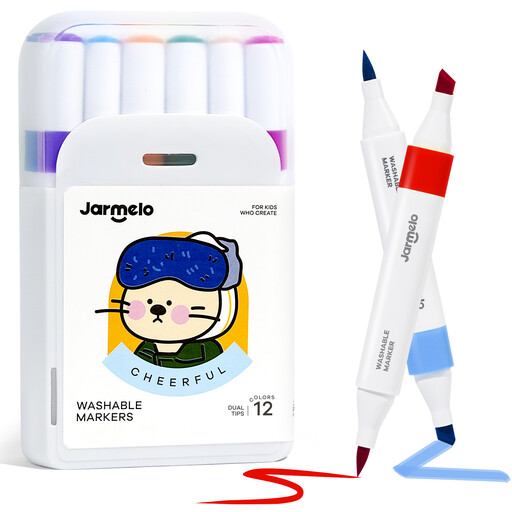
Why this choice suits this profile: This set brings together 12 colours, a brush tip and a chisel tip in a case with a handle. It's ideal for first colouring, drawing and lettering activities at home or at school.
The dual tip means you don't need to buy several types of markers separately. According to the product page, the water-based ink is 90% washable from skin and most fabrics.
12 colours, two tip shapes, storage case and ventilated caps. The product is recommended for children aged 3 and over, with supervision.
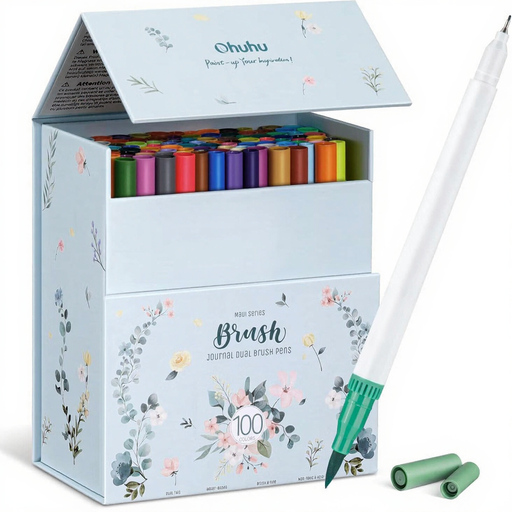
Why this choice suits this profile: This set is aimed at those looking for an extensive palette for illustration, calligraphy, journaling and creating gradients on suitable paper.
The 100 colours are numbered and come with a colour chart. Thanks to the dual tip, there's no need to buy multiple different references.
0.4 mm fineliner tip, flexible brush tip from 1 to 6 mm, water-based ink and five spare tips included.
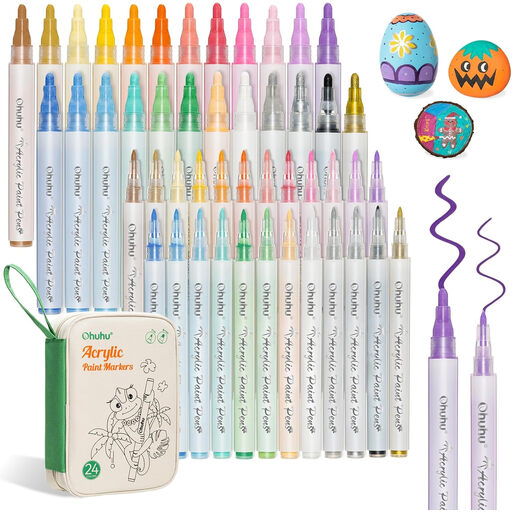
Why this choice suits this profile: This set is designed for projects on pebbles, wood, glass, ceramic, plastic, fabric or paper, where standard markers lack opacity or adhesion.
Several tip sizes are available: fine 0.7 mm, round 1.8 to 2 mm and chisel 4 mm. You can choose according to the level of precision you need.
24 coordinated colours in duplicate, water-based acrylic ink and reversible tips. Shake the marker, then prime the tip before first use.

Why this choice suits this profile: This pack is ideal for notebooks, diaries, homework and work documents that need regular corrections and a fine tip.
The built-in eraser means you don't need correction tape. However, the heat-sensitive ink isn't suitable for archives or documents that need to stay permanent.
0.5 mm needle tip, pack of 12 blue pens and friction erasing mechanism.
We've put together a comprehensive, real-time updated selection of products that meet these exacting criteria as well as European safety standards.
Combine a fine pen for outlines and writing, some pastel highlighters to organise information and a few brush pens for headings. Always test the ink on a page of your notebook to minimise the risk of show-through.
Put each cap back on properly after use, store the markers according to the manufacturer's recommendations and protect them from sunlight and extreme temperature changes. Brush pens and metallic ink pens in particular need to be kept from drying out at the tip.
Yes, they can be used on paper, although they really come into their own on wood, glass, ceramic or pebbles. Do a test first and let it dry according to the manufacturer's instructions to check the opacity and adhesion.