
Livraison le jour même ou le lendemain

Qualité garantie

Débloquez vos offres de bienvenue: Livraison GRATUITE | Jusqu'à -80 % | 30 jours d'essai gratuits à JoyPlus
Téléchargez l'application
Choosing creative pens and markers isn’t simply about counting how many colours come in a set. Between inks that bleed through paper, tips that flatten after a few uses, and markers marketed as versatile but struggling on smooth surfaces, some purchases can disappoint from the very first project.
Drawing, colouring, lettering, journaling or arts and crafts: three common pitfalls keep cropping up:
Here are the criteria to examine before buying acrylic markers, colouring pens or STABILO BOSS highlighters.
Markers for paper, glass, wood and fabric don’t all use the same formulation. A water-based ink is generally suitable for note-taking, drawing and colouring on paper. For decorating stone, metal, plastic or glass, an opaque acrylic ink will often be more appropriate.
In particular, check:
The term waterproof marker should therefore be taken in context: it describes a property claimed for certain conditions of use, but doesn’t guarantee identical resistance on every surface.
Fine-tip pens are used for outlining, writing small annotations and working on details. A medium tip is better suited to filling in and everyday drawing. For lettering, a chisel tip makes it easier to alternate between fine and broad strokes.
The measurements in millimetres are useful for comparing different options:
A dual-tip model can save you from buying several families of pens, provided both ends genuinely match your needs.
A well-organised set makes it easier to find shades and protects the tips during transport. A metal tin, a display stand or a compartmentalised case can be practical for students, amateur artists and anyone who takes their materials to a workshop.
Always replace each cap after use. The anti-dry-out systems claimed by manufacturers extend the time you can leave the cap off under the stated conditions, but they don’t replace careful storage. With children, small caps require extra vigilance: follow the age recommendations and warnings on the packaging.
The following options cover several uses: acrylic markers for various surfaces, highlighters for studying, and pens for drawing or colouring.
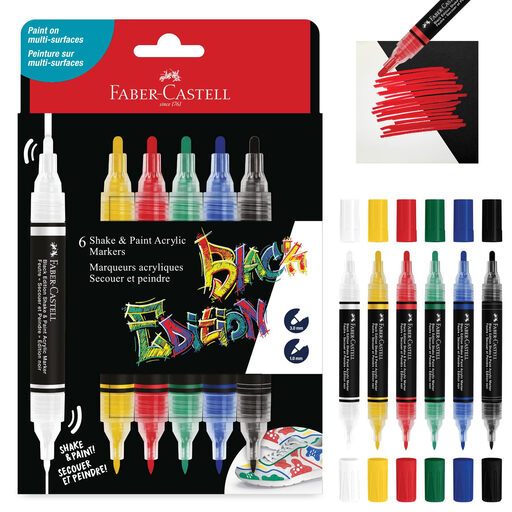
Why this choice suits this profile: with its six colours, this set lets you discover acrylic markers without buying too many options. It’s suitable for small drawing, decorating and personalisation projects.
The dual tip of 3 mm and 1 mm means you don’t have to choose a pen purely for its colour, only to find it’s limited to broad strokes.
An opaque acrylic ink claimed to be water-resistant, usable on paper, stone, glass, metal, plastic, wood and fabric.
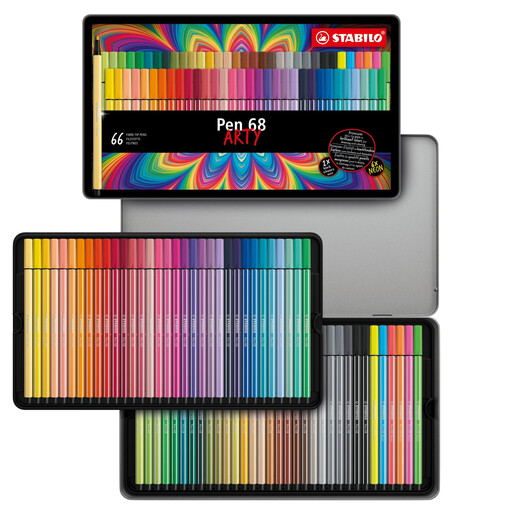
Why this choice suits this profile: colouring, drawing and journaling enthusiasts get a claimed assortment of 65 colours, stored in a practical metal tin for use in the studio or on the go.
The M tip of 1 mm has a clearly defined width, making it easier to control outlines and filling.
A water-based ink claimed to be odourless, a robust tip, a metal tin and ISCC PLUS-certified bio-based plastic, according to the product sheet.
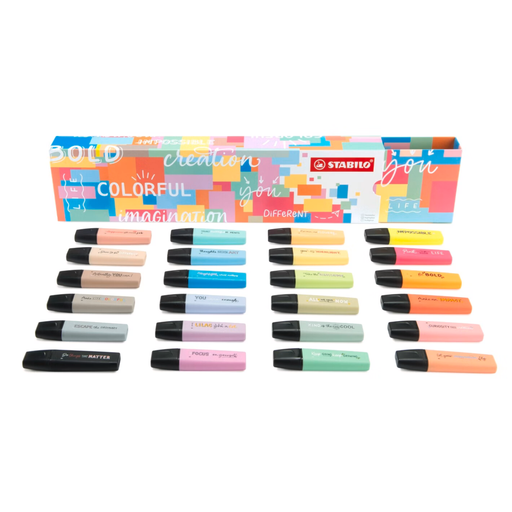
Why this choice suits this profile: this set meets the needs of students, professionals and journaling enthusiasts who regularly use STABILO BOSS highlighters to organise their notes.
The chisel tip of 2 to 5 mm lets you vary the stroke width, while the anti-dry-out technology is claimed to last up to 4 hours without the cap.
24 markers, four fluorescent colours, thirteen pastel shades, six natural tones, one black and a pen holder included.
We’ve put together a comprehensive list, updated in real time, of products that meet these strict selection criteria and the requirements of European safety regulations.
To keep your craft pens in good condition, a few simple habits are all it takes:
On non-porous surfaces, work in a well-ventilated area and avoid any contact with eyes and mouth. Inks are not intended to be ingested or applied to the skin.
For lettering, a chisel or flexible tip lets you vary the thickness of your strokes. For journaling, go for fine-tip pens for annotations and chisel-tip highlighters to structure your pages. Pastel shades can help create a softer visual hierarchy.
Some models are claimed to be compatible with glass and wood, like the Faber-Castell set featured here. Clean and dry the surface before applying, then check how the ink holds on an inconspicuous area. The final durability depends on the material, its preparation and the conditions it’s exposed to.
The lifespan depends on how often you use them, the storage conditions and whether the caps are closed properly. The anti-dry-out features claimed by STABILO offer some tolerance if you occasionally forget to cap them, but it’s still best to store pens away from heat and light.