
Livraison le jour même ou le lendemain

Qualité garantie

Débloquez vos offres de bienvenue: Livraison GRATUITE | Jusqu'à -80 % | 30 jours d'essai gratuits à JoyPlus
Téléchargez l'application
A collection of creative pens for drawing, calligraphy and note-taking can quickly take up space if every tool does more or less the same thing. With 0.5 mm gel pens renowned for their precision, brush pens available in a multitude of colours and dual-tip markers, there’s certainly no shortage of choice. However, a few simple criteria can help you avoid disappointing purchases.
A brightly coloured set isn’t necessarily suited to everyday note-taking. Pastel shades can lack contrast on certain sheets, while highly pigmented inks risk bleeding through thin paper. For a bullet journal or your studies, start by checking readability, then look at the variety of colours.
A line described as fine won’t always give the same result depending on the tip shape and paper type. 0.5 mm gel pens are generally suitable for precise annotations, small grids and sketch details. A brush tip, on the other hand, produces a line that varies in width depending on the pressure applied. It’s perfect for lettering and calligraphy, but requires a bit of practice.
Ink that dries quickly limits smudging, but the result also depends on the surface. Coated paper, a very smooth notebook or absorbent sheet – each reacts differently. Left-handed people would do well to test the drying time on their usual paper, especially with black ink pens and multi-coloured gel pens.
For writing small, organising a diary or annotating documents, a 0.5 mm tip offers a good balance between precision and comfort. Retractable pens prevent losing a cap at the bottom of your bag and protect the tip between uses.
For drawing, the choice depends mainly on the use:
A ribbed grip or a triangular body can improve stability during long writing or drawing sessions. This detail matters particularly for students, people who take a lot of notes and journaling enthusiasts. The body, often plastic with a few metal elements, should above all offer a consistent grip and withstand repeated transport.
Before filling a notebook, test on a page of the same type. Check the following points:
For watercolour effects, water-based inks can be diluted on suitable paper. On very thin office paper, the result will be far less convincing.
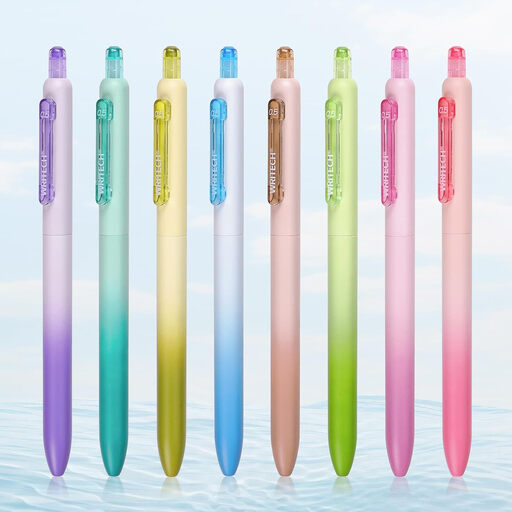
Why this choice suits this profile: this set brings together eight shades and fine tips for organising your studies, decorating a diary or getting started with bullet journaling without accumulating lots of different references.
The 0.5 mm tip prevents overcrowding the page, while the retractable mechanism stops the tip from drying out in the open air.
Eight coloured inks, a matte body with a ribbed grip and a click mechanism described as quiet.
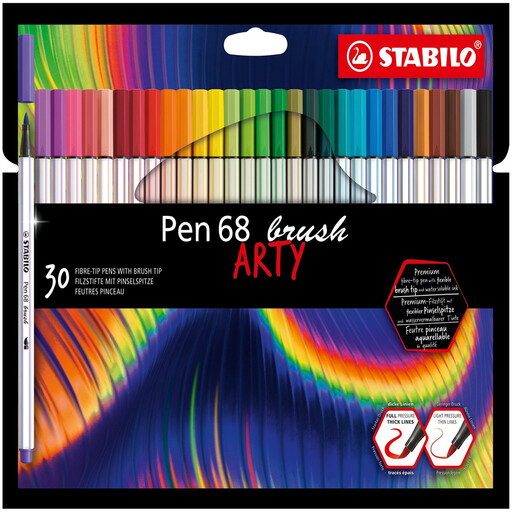
Why this choice suits this profile: its extensive palette is aimed at those who want to work on lettering, illustration and gradients with a coherent range.
The flexible brush tip allows you to vary the line width without needing a different pen for each thickness.
30 colours, water-based ink and a flexible tip for drawing, colouring and calligraphy.
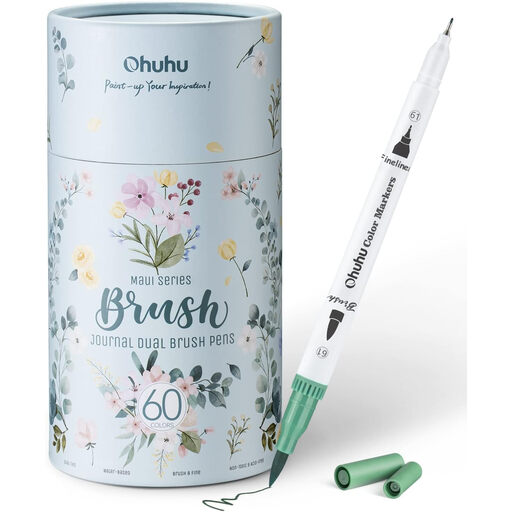
Why this choice suits this profile: artists and colouring enthusiasts benefit from a 0.4 mm fineliner tip and a brush tip ranging from 1 to 6 mm for moving from details to filling in areas.
The two tips mean you don’t have to buy separate pens for outlines and brush pens. A colour chart also helps you quickly identify the shades.
60 colours, five replacement tips and water-based ink described as blendable with water on suitable paper.
We’ve put together a comprehensive, real-time updated selection of products that meet these demanding criteria, as well as European safety standards.
Close brush pens and dual-tip markers carefully after each use. With retractable pens, retract the tip before storing them. Keep sets away from heat and direct light.
The lifespan depends on how often you use them, the pressure applied and the paper you choose. A tip that catches, an uneven line or a noticeably paler colour are usually signs that it’s time to replace the pen.
For professional or school use, a set of black ink pens can complement the colours. The Faber-Castell Grip 2010 set, with its fountain pen and ballpoint pen, is more suited to classic writing needs, while brush pens are aimed at creative activities.
Start with multi-coloured gel pens in 0.5 mm for headings, colour-coding tasks and small decorations. Then add a brush pen if you want to work on your headings in lettering. Always test the ink on a page of your notebook before committing to a full layout.
A soft brush tip allows you to practise variations in pressure and width. Water-based lettering pens are particularly practical for starting on paper, as long as you apply light pressure on the upstrokes and heavier pressure on the downstrokes.
Choose a quick-drying ink, wait a few seconds before running your hand over the line and use compatible paper. Left-handed people can also tilt the sheet slightly to reduce contact between their hand and the fresh ink.