
Livraison le jour même ou le lendemain

Qualité garantie

Débloquez vos offres de bienvenue: Livraison GRATUITE | Jusqu'à -80 % | 30 jours d'essai gratuits à JoyPlus
Téléchargez l'application
Craft glue can be used to stick paper together, fix a decoration, prepare a card or carry out a small repair around the house. But choosing the right product isn't just about finding one that promises "strong adhesion". The surface, format, quantity and conditions of use all play a decisive role in the final result.
Before placing an order, it's best to avoid a few classic mistakes and compare products based on concrete criteria.
A glue stick is best suited to paper, cardboard and certain porous surfaces. It applies directly, with no heating device required. Hot glue sticks, on the other hand, need a compatible glue gun. They are more suited to quick assemblies, decorations and certain small repairs.
Using a hot glue stick for a school workbook could create lumps. Conversely, a glue stick generally won't provide a strong enough fix on wood or plastic.
A glue described as versatile isn't necessarily suitable for all materials, nor in the same conditions. Wood, fabric, glass, metal and plastic all have very different surfaces. Always check the materials listed on the product page and, if possible, test it on an inconspicuous area first.
A small pack can be perfectly fine for occasional use, but it can become expensive for a class, a workshop or regular scrapbooking. Conversely, a pack of 100 sticks is only worthwhile if you own a glue gun that's compatible with the specified diameter.
Hot glue sticks are not all interchangeable. 7 mm sticks are suitable for certain compact glue guns, while 11 mm formats are common on standard devices. The length affects how often you need to replace them, but also compatibility with the feed mechanism.
The Tilswall glue gun shown below, for example, works with 7 × 140 mm sticks, while the WORKPRO pack contains 11 × 200 mm sticks. These two formats are therefore not interchangeable.
The solvent-free label can also be useful for school and creative activities. It describes the formulation as stated by the manufacturer, but it doesn't replace the need to follow usage instructions or supervise children.
A cordless glue gun offers greater freedom of movement, but its nozzle gets hot during use. A stable base, an automatic shut-off function and an anti-drip tip can reduce inconveniences, without eliminating the risk of burns.
With children, use must always be supervised by an adult. Sticks and small accessories should be stored out of reach of young children. After each activity, screw the cap back on a glue stick and store products in a dry place at room temperature.
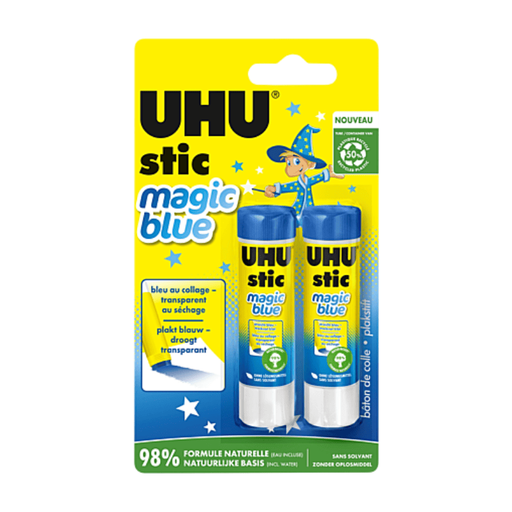
Why this choice suits this profile: this pack of two 8.2 g sticks is ideal for homework, paper collages and first craft activities. The visible blue trace when applied helps you see where you've glued, before it becomes transparent as it dries, according to the product page.
The clearly stated format means you won't pay for an unnecessary quantity. The solvent-free, cold-water-washable formula meets everyday school and paper-collage needs.
Two 8.2 g sticks, screw cap, formula stated as 98% ingredients of natural origin and washable in cold water.

Why this choice suits this profile: rechargeable via USB-C, this model is designed for those who want to work without a cable on a variety of creative projects. At 178 g and with a stated preheat time of 30 seconds, it remains easy to handle.
Compatibility with 7 × 140 mm sticks is clearly stated. The safety base, automatic shut-off after 5 minutes of inactivity and anti-drip nozzle fix several common flaws of impractical devices.
Rechargeable 2,000 mAh battery, stated runtime of up to 60 minutes, 30-second preheat and 20 sticks included.
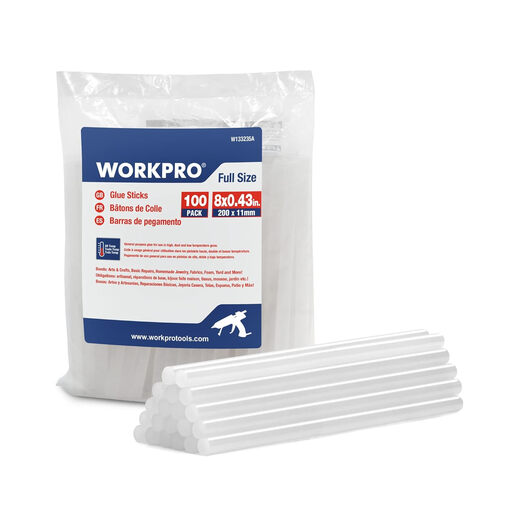
Why this choice suits this profile: this pack is aimed at workshops, schools and individuals who regularly use a glue gun compatible with 11 mm sticks.
The 11 mm diameter and 200 mm length are clearly stated. However, check your glue gun before buying: this pack is not suitable for 7 mm devices.
100 clear EVA sticks, stated compatibility with standard 11 mm glue guns and intended use on paper, cardboard, wood, cork, glass or certain plastics.

Why this choice suits this profile: this roller is ideal for cards, photo albums, creative journals and scrapbooking projects that need regular application with no drying time.
It avoids drips, wet marks and the waiting time associated with liquid glue. Keep the cap closed between uses to limit dust build-up.
Four dispensers, 8 metres of double-sided adhesive tape per roll and one-handed pressure application.
We've put together a comprehensive, real-time updated selection of products that meet these strict selection criteria as well as European safety requirements.
A glue stick for paper and cardboard is generally suitable for schoolwork, sticking photos and simple craft activities. For assembling items without liquid, a double-sided adhesive roller can be more practical, especially for scrapbooking.
The shelf life depends on storage and how well the product is sealed. A properly screwed-on or replaced cap limits drying out. Hot glue sticks should be stored in a dry place away from significant heat. Check their appearance before use and set aside any stick that shows visible signs of deterioration.
It can be worthwhile if you regularly do DIY projects or need to work away from a power socket. For just a few paper collages a year, a glue stick or adhesive roller is generally a simpler solution, with no recharging or preheating time needed.