
Livraison le jour même ou le lendemain

Qualité garantie

Débloquez vos offres de bienvenue: Livraison GRATUITE | Jusqu'à -80 % | 30 jours d'essai gratuits à JoyPlus
Téléchargez l'application
A countertop oven can complement or even replace a built-in oven in a studio flat, an apartment or a small kitchen. It lets you cook a pizza, a gratin, a tart or a roast without monopolising a large appliance. The trouble is that the spec sheets sometimes mix up capacity, power and number of functions, which could lead you to choose a model that doesn't really suit your needs.
Before buying a mini electric oven, keep three pitfalls in mind:
For a single person or a couple, a freestanding oven of 20 to 25 litres is usually enough for toast, small pizzas, roasted vegetables and everyday meals. The Taurus Horizon23, for example, offers 23 litres in a 46 × 27 × 39.4 cm format.
A 30-litre mini oven gives you more room for tarts, gratins and medium-sized poultry. Models of 45 to 60 litres are closer to a compact family oven, but they take up more space and need adequate ventilation.
Always measure:
Don't rely solely on the internal volume: also check the dimensions of the accessories supplied.
For everyday recipes, a range of around 100 to 230 °C covers gratins, baked goods, roasts and dishes to reheat. A thermostat that can go down to 40 °C can also be useful for keeping food warm or for gentle cooking.
A fan-assisted oven distributes heat using a fan. This technology promotes more even cooking, especially when you're preparing several dishes, but it doesn't mean you can ignore the temperatures and timings given in recipes.
Models with both top and bottom heating elements let you choose between top heat, bottom heat or a combination of the two. This setup suits cooks who want to control browning on top and cooking underneath.
Power should always be considered in relation to the cavity volume:
Where possible, plug the appliance into a wall socket that is properly earthed. For high-power models, check the manual and avoid using extension leads or multi-socket adaptors if the manufacturer advises against it.
A truly practical appliance should come with the accessories you'll actually use: a wire rack, baking tray, drip tray, rotisserie spit or baking stone. A removable crumb tray makes cleaning much easier.
Cool-touch walls and double-glazed doors can reduce the temperature of the outer surface, but they don't make the door or the cavity completely cool. The internal parts stay hot after cooking. Have oven gloves ready and always let the appliance cool down before cleaning it.
For an oven with a rotisserie, check the useful length of the spit and the space available around the meat. For a combined steam oven, look at the water tank capacity, whether it's removable and the descaling instructions. Steam adds versatility, but it also means an extra step in maintenance.
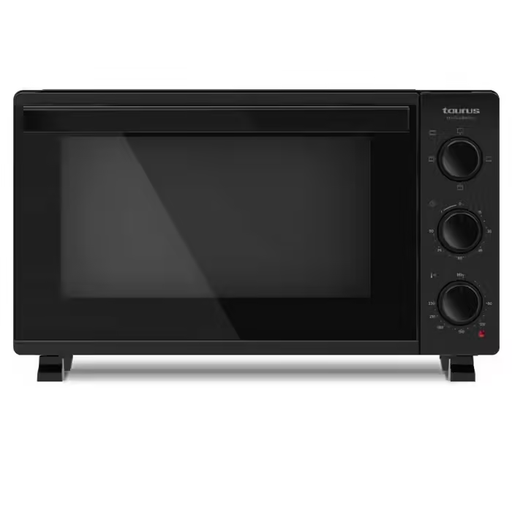
Why this model suits this profile: with its 23-litre capacity and mechanical controls, it's a sensible first purchase for a small kitchen. The settings are straightforward and more than adequate for everyday recipes.
The spec sheet clearly states the capacity, the 1,500 W power, the 40 to 230 °C temperature range and the three heating modes, without burying the essentials in an endless list of programmes.
90-minute timer with audible signal, interior light, keep-warm function, wire rack, baking tray and crumb tray included.
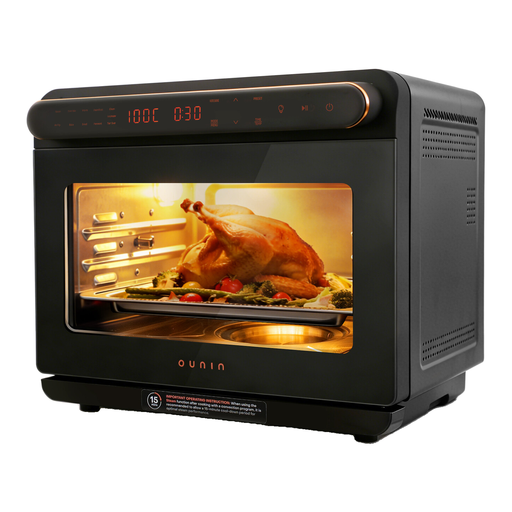
Why this model suits this profile: this combined steam oven is aimed at households that want to combine several functions in a single 24-litre countertop appliance.
The functions are clearly listed: steam, oven cooking, air frying, dehydrating, fermenting and rotisserie. The removable water tank is also specified, with a 1-litre capacity.
304 stainless steel interior, 360° automatic rotisserie and seven accessories included, among them a frying basket and a spit.
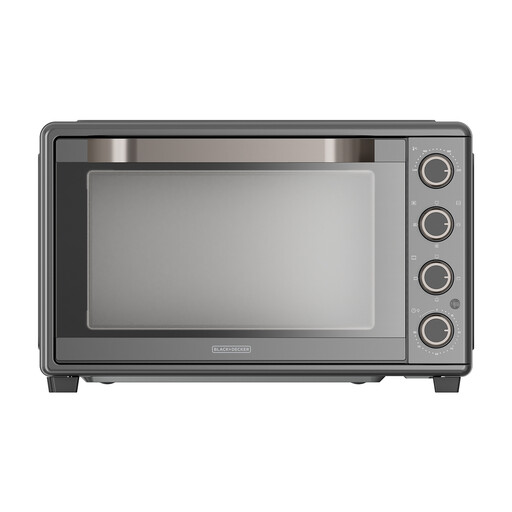
Why this model suits this profile: its 30 litres give you more room for family meals, roasts and certain dishes spread across several shelves.
The 30-litre capacity, the adjustable temperature from 100 to 230 °C and the 90-minute timer are clearly distinguished from the convenience features.
Rotisserie, double-glazed door, exterior designed to stay cooler and a removable crumb tray.
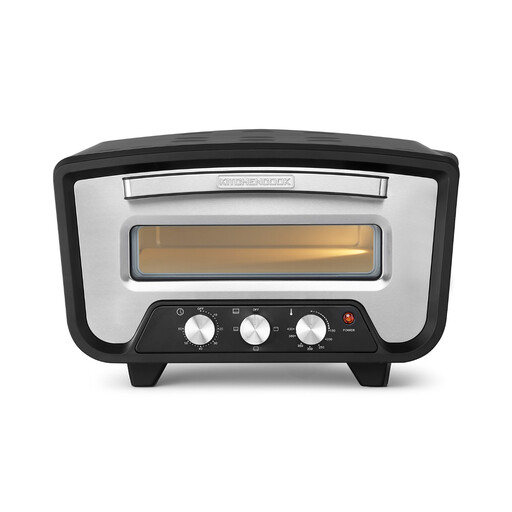
Why this model suits this profile: this pizza oven focuses on very high temperatures and is aimed at people who regularly make homemade pizzas.
The stated maximum temperature reaches 430 °C and compatibility is specified up to 30.5 cm. So it's a specialist appliance, not a multi-purpose oven trying to do everything.
2,200 W power, ceramic stone, 1 to 60-minute timer and manual available in French.
We've put together a comprehensive, real-time updated selection of products that meet these demanding criteria as well as European safety standards.
It all depends on the manufacturer's instructions. If no specific guidance is given, leave a clear space around the vents, keep the appliance away from flammable materials and avoid placing it under a heat-sensitive cupboard. Set it on a flat, stable, heat-resistant surface.
This varies depending on how often you use it, how well you maintain it, the quality of the accessories and whether you follow the electrical instructions. Remove crumbs regularly, don't use abrasive cleaners inside the cavity and avoid running the appliance empty for a long time. Before you buy, also check the warranty terms and the availability of spare parts.
The consumption depends on the power, the preheating time, the temperature you choose and the insulation. A 1,500 W appliance used for one hour theoretically consumes 1.5 kWh at full power, but its heating elements don't necessarily run continuously. To estimate the cost, multiply the energy used in kWh by the rate on your electricity contract.