Single person or couple with a moderate amount of daily washing-up
A compact model can reduce hand washing without installing a standard dishwasher, provided your plates, glasses, cutlery and smaller items genuinely fit in the basket.


Start by choosing according to what you can realistically install: a plumbed-in 6-place-setting model is suitable if a water supply, drainage and enough countertop space are available. A model with a water tank removes the need for a fixed water connection, but its drainage and capacity must be checked before purchase. For a household with lots of dishes or saucepans, some hand washing may still be necessary.
A compact model can reduce hand washing without installing a standard dishwasher, provided your plates, glasses, cutlery and smaller items genuinely fit in the basket.
An appliance with an integrated tank may be more suitable when permanent plumbing is difficult to install. However, make sure you have a suitable route for draining the waste water and check the installation requirements.
Noise deserves particular attention when the appliance is near your living space. UFC-Que Choisir includes sound level and perceived disturbance in its dishwasher assessment criteria. Compare the dB ratings and, where possible, tests carried out using a common methodology.
Choose this if: a water supply, suitable drainage and around 55 cm of width and 50 cm of depth are available near the worktop.
Allow for: the hoses, power socket, door clearance and available height are all part of the installation, beyond the appliance body dimensions alone.
Choose this if: no fixed water connection is easily accessible and filling the tank before each cycle is acceptable.
Compromise: the tank makes supplying water easier, but you still need to plan for waste-water drainage and check how much the basket can really hold.
Consider this if: the water supply, drainage or worktop stability cannot be guaranteed, or if large utensils regularly build up.
Compromise: you avoid an undersized appliance, but retain a greater proportion of the washing-up.
| Priority | What to check | Your needs |
|---|---|---|
| Installation | Locate the water supply, accessible drainage, power socket and hose route. A tank also requires a safe way to discharge waste water. | I want to install the appliance without modifying plumbing that is incompatible with my home. |
| Actual capacity | Compare the basket and loading layout with your plates, mugs, saucepans, frying pans and serving dishes. The number of place settings does not describe every bulky item. | My daily dishes need to fit in a useful load, not just within the stated capacity. |
| Size and noise | Measure the width, depth and height, leaving room for connections, ventilation and the door to open. Also check the sound level in dB. | With limited worktop space or an open-plan kitchen, I want to avoid an appliance that is difficult to position or disruptive during a cycle. |
| Washing and consumption | Compare the Eco programme, water and electricity use, washing and drying performance on a like-for-like basis. A short cycle time does not sum up these criteria. | I want to reduce hand washing without choosing solely on the promise of speed. |
An appliance placed on the worktop may still require a water supply, drain hose and power socket. The Bosch SKS62E32EU manual distinguishes between waste-water, drinking-water and electrical connections; Candy states that its CP 6E51LW connects directly to the water supply.
Take photographs and measure the space, then identify the water supply, accessible drainage and power socket before choosing a model. For an appliance with a tank, check the drainage procedure separately.
A capacity of 6 place settings does not guarantee that your large serving dishes and saucepans will fit in the basket. UFC-Que Choisir’s tests include serving dishes, saucepans and plastic containers among their reference loads.
Compare your largest items with the dimensions and loading diagram in the manual for the exact model. If you regularly use them for meals, do not assume a compact appliance will eliminate all hand washing.
Candy advertises a 35-minute washing and drying cycle, while Daan Tech advertises 20 minutes for Bob. These claims do not provide an independent comparison of washing, drying, water and energy use under the same conditions.
Examine the Eco programme, drying, noise and consumption using comparable data. UFC-Que Choisir assesses these criteria separately using representative loads.
Visible ratings may be based on only a small number of reviews or on uses that are difficult to compare. They are not enough to establish a brand’s durability or a model’s performance.
Use reviews to identify specific questions, then check the manual, technical specifications, warranty terms and, where possible, a test carried out using a common methodology.
Candy’s CP 6E51LW is a countertop dishwasher with 6 place settings, advertised at 550 × 501 × 443 mm and rated E, with freestanding installation and a direct water connection according to Candy France.
The Bosch SKS62E32EU is listed as a compact 6-place-setting model with a conventional connection. Darty states 49 dB and 8.0 L per cycle for this reference.
Daan Tech presents Bob as a freestanding mini countertop dishwasher that can be used with a tank or a conventional water connection.
Midea is available on Joybuy France with the MDWTT0602MW-WE, advertised with 6 place settings, dimensions of 55 × 50 × 44 cm, 47 dB and 6.5 L per cycle.
These Joybuy options cover compact-capacity countertop dishwashers, including plumbed-in models and others that can operate with a water tank.
 Image unavailable
Plumbed-in model for a small household with accessible water supply and drainage.
6 place settings, 6.5 L per cycle, advertised at 47 dB, seven programmes, delay start, water softener and automatic door-opening drying.
Check the external dimensions, door clearance, worktop stability and drain-hose route.
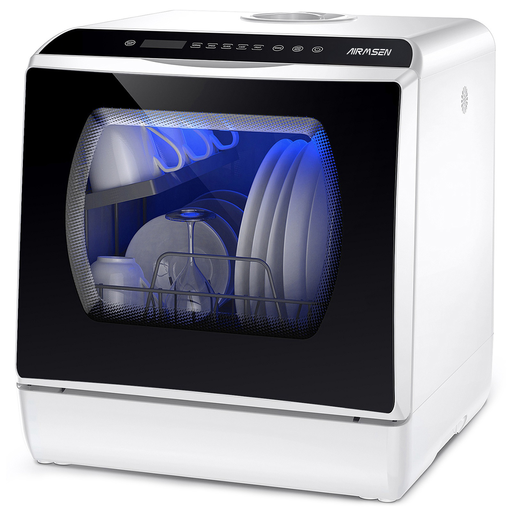 Image unavailable
An option for a single person or couple who can fill a tank when connecting to the tap is impractical.
4 place settings, integrated 5 L tank or tap connection, five programmes and advertised dimensions of 45.8 × 42.8 × 42.5 cm.
Check that plates up to 26 cm and your bulky utensils will fit, then secure drainage to a sink or container.
 Image unavailable
A compact format for a small household with limited worktop space, offering a choice between a tank and tap connection.
Advertised dimensions of 420 × 435 × 435 mm, 5 L tank, six programmes, dishes up to 250 mm in diameter and rating D.
The number of place settings is not stated; check the basket, your dishes and the position of the drain hose before buying.
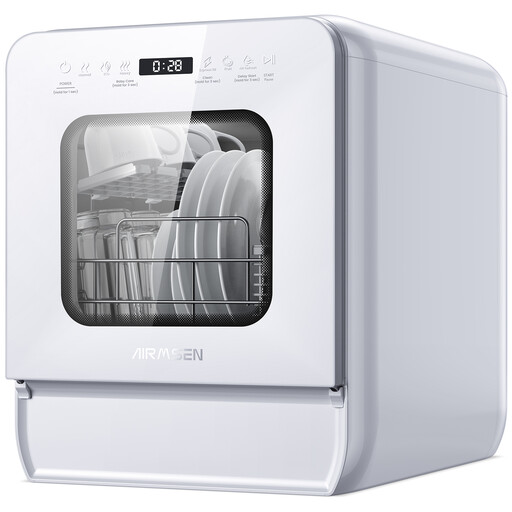 Image unavailable
A narrower option for a small household that is happy to fill the tank when the tap is too far away.
Advertised width of 37 cm, depth of 51 cm, 4 place settings, 5 L tank, nine programmes and rating D.
Check the drainage procedure, loading space for large dishes and noise level if your kitchen is open-plan.
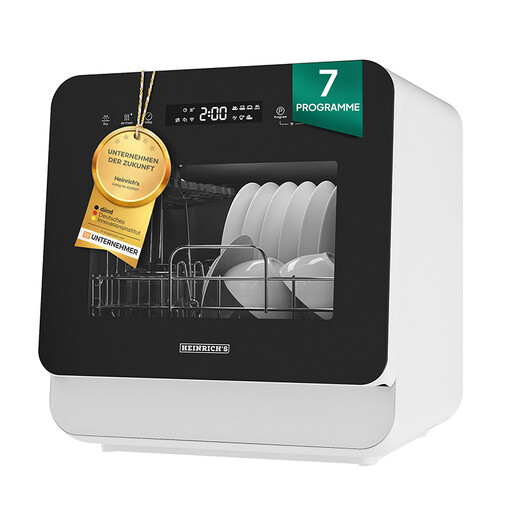 Image unavailable
Worth considering for a very limited load when both space and the amount of washing-up are restricted.
3 place settings, 5 L tank or tap connection, seven programmes, 4.2 L per cycle, advertised at 56.3 dB and rating C.
Not well suited if saucepans, serving dishes or several meals build up; also check the dimensions, hoses and door clearance.
No. Candy states that the CP 6E51LW connects directly to the water supply, while Daan Tech says Bob can operate using its integrated 3.9 L tank or a conventional water connection. A tank does not automatically solve waste-water drainage: check the model’s manual and your installation space before ordering.
Use this capacity as a starting point, not as a guarantee of what will fit. Check the size of your plates, glasses, mugs, saucepans, serving dishes and containers; UFC-Que Choisir uses these everyday items in its tests. If you often cook with large dishes or want to leave longer between cycles, a compact model may still leave a significant amount of hand washing.
Measure the width, depth and height, then allow enough room for the connections and the door to open. Also check the sound level in dB; UFC-Que Choisir measures noise with a sound meter and assesses disturbance caused in particular by vibrations and beeps.
No. They can highlight user-related problems, but they do not replace checking the installation requirements, dimensions and capacity. Use them to prepare specific questions, then consult the technical specifications, manual, warranty terms and, where available, a test carried out using a common methodology.