
Livraison le jour même ou le lendemain

Qualité garantie

Débloquez vos offres de bienvenue: Livraison GRATUITE | Jusqu'à -80 % | 30 jours d'essai gratuits à JoyPlus
Téléchargez l'application
Buying a cotton fitted sheet might seem straightforward. Yet the wrong size, a too-shallow pocket or a fabric that’s tricky to care for can quickly turn a practical purchase into a nasty surprise. For a double or king-size bed, just a few checks are enough to avoid wrinkles, corners that come loose during the night and complicated washing routines.
A fitted sheet should be chosen based on the width and length of the mattress, not the overall size of the bed base. A model labelled as a fitted sheet 140x190 is suitable for a mattress measuring 140 × 190 cm. However, it won’t fit a 140 × 200 cm mattress, even if the difference seems small.
The pocket refers to the depth of the part that wraps around the mattress. A fitted sheet with a 23 cm pocket works for a mattress no thicker than this measurement, including any mattress topper you might use. For a deeper mattress, a fitted sheet with a 30 cm pocket gives you more leeway.
A pocket that’s too shallow risks riding up during the night. On the other hand, a pocket that’s too deep can leave excess fabric bunching under the mattress.
It’s worth looking closely at the composition. A 100% cotton fitted sheet is made from a natural fibre, but comfort also depends on the weave, density and finish. The 57 threads/cm² stated on some models in this selection gives an indication of fabric density. However, on its own it’s not enough to predict how the sheet will feel or how it will hold up after repeated washes.
Cotton is valued for its soft feel and breathability. It can be used all year round, with a different look depending on the weave and finish.
To compare two options, make sure you check:
Washed cotton generally feels softer and has a less uniform appearance, while classic cotton has a smoother surface. The choice really comes down to your personal preference and how you like to care for your bedding.
Measure your mattress thickness, then add the thickness of any mattress topper you use. For a standard mattress, a 23 cm pocket may be enough. For a deep mattress or one with a topper, a 30 cm depth will often be more suitable.
This check is especially important when buying a fitted sheet for a thick mattress. The length and width must also match your bed dimensions exactly.
A cotton fitted sheet that can be washed at 60 °C can easily fit into a regular laundry routine, as long as you follow the manufacturer’s instructions. Before ordering, also check the recommendations for drying and ironing.
The colour also helps set the mood in your bedroom. A peacock-coloured fitted sheet adds a rich, decorative touch. A dune colour pairs easily with natural tones. A gold fitted sheet can warm up a more understated bedding set. To avoid colour mismatches, try to choose items from the same collection wherever possible.
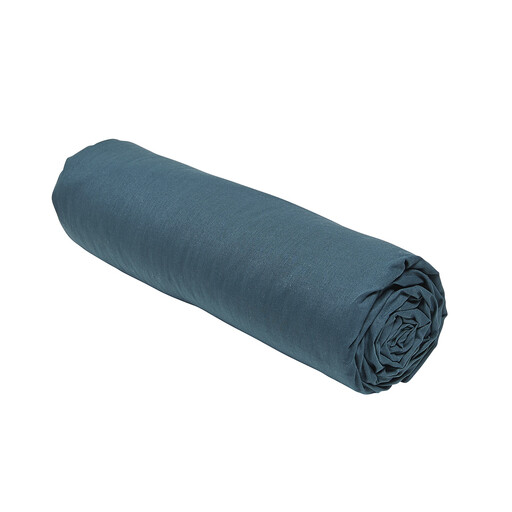
Why this choice suits this profile: This model fits a 140 × 190 cm bed and has a clear 100% cotton composition. Its peacock colour adds a decorative touch without needing to change your whole bedding set.
The 140 × 190 cm dimensions and 23 cm pocket are clearly stated. This reduces the risk of picking the wrong size by guesswork.
100% cotton, stated density of 57 threads/cm² and machine washable at 60 °C.
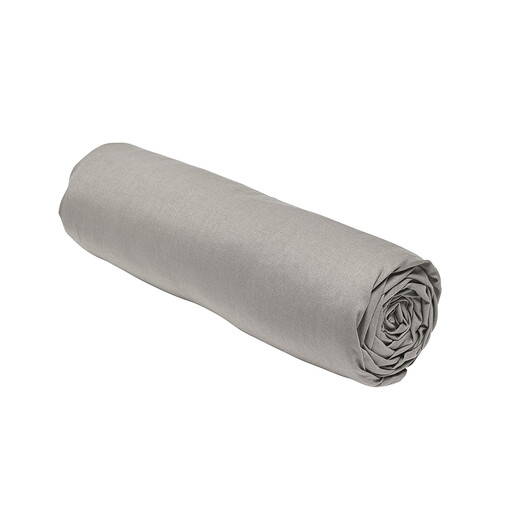
Why this choice suits this profile: Its dune colour blends easily into a family bedroom. The 60 °C wash and 140 × 190 cm format are ideal for bedding that gets used frequently.
The 23 cm depth is explicitly stated: you can check compatibility before buying, without relying solely on the “double bed” label.
100% cotton, 57 threads/cm², washable at 60 °C and a plain colour that’s easy to match.
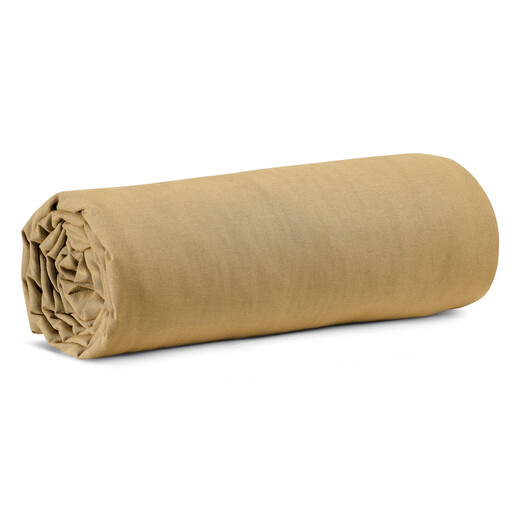
Why this choice suits this profile: This 180 × 200 cm fitted sheet is designed for king-size beds and for those who want a washed cotton finish, along with a bold gold colour.
The 30 cm pocket is listed alongside the dimensions: a valuable reference for thick mattresses and mattress toppers.
100% washed cotton, 180 × 200 cm size, 30 cm pocket and machine washable.
We’ve put together a complete selection, updated in real time, of products that meet these exacting criteria as well as European safety standards.
Start by checking your mattress dimensions and the pocket depth. Fit two opposite corners first, then gently pull the fabric over the other two. If you use a mattress topper, make sure to include its thickness in your calculation.
It depends on how often you wash it, the wash temperature, drying method and overall quality of manufacture. Following the care label, avoiding overloading the drum and rotating several sheets can all help preserve the shape and feel of the fabric.
Some models are specifically designed for a 60 °C machine wash, like the ones in this selection that state this. Always follow the instructions on the care label, especially for drying and ironing.