
Same-day & Next-day Delivery

Quality Guaranteed

Unlock Your Welcome Offers: FREE Delivery | Up to 80% OFF | Free 30-day JoyPlus trial
Download the APP
An unused corner in your living room or bedroom? That's an opportunity. Whether you're looking to create a functional workspace or add extra storage, corner furniture stands out as a smart solution. However, choosing the right model can often feel like an uphill battle. Between promises of modularity that turn out to be disappointing and materials that don't live up to their claims, it's easy to regret a purchase. This guide is here to help you avoid common pitfalls and select the piece that will truly fit into your home.
Marketing is great at highlighting attractive features. Unfortunately, the reality is sometimes less impressive. Here are the three most common issues that can turn a great design idea into a real headache.
Many corner desks are sold as "reversible," letting you choose whether to place the return on the left or right. The catch? A design that was only truly engineered for one side. Once reversed, you might find yourself with drawers that block your legroom or storage access that has become almost unusable. A poorly designed L-shaped desk loses all its ergonomic value.
A shelf or desk that looks robust in photos can quickly show signs of weakness. The main culprit is often a particle board of insufficient density or thickness, which sags under the weight of a few books or a monitor. A corner bookshelf with shelves that bend after six months isn't a space optimization solution, but a source of future trouble.
Some corner furniture takes up considerable floor space without offering much usable storage volume. Bulky designs, thick frames, or poorly arranged compartments can cause you to lose precious square footage. For a small space layout, make sure every nook and cranny of the furniture has a clear and accessible function.
To avoid falling into these traps, focus on a few objective technical specifications. They are your best benchmarks for judging the quality and functionality of corner furniture.
The longevity of your furniture depends directly on its composition. For a desk or shelf, opt for high-quality composite wood panels, such as E1 grade particle board, which adhere to strict emissions standards and offer good density. The thickness of the surfaces is also a good indicator: a desk top of 15 mm or more will resist bending much better. for added strength, a metal frame is often a guarantee of stability, especially for a corner desk intended to support heavy computer equipment.
Don't just rely on the overall dimensions (length x width x height). Examine the furniture's diagram or schematic to visualize the actual workspace and storage configuration. For a desk with storage, check that the drawers or shelves are positioned so they don't impede your movement. If the unit is advertised as reversible, ensure the design allows for perfect symmetry, without compromising on ergonomics, whether the return is on the left or right.
This information is often overlooked, yet it's crucial, especially for a corner shelf. The maximum load per shelf must be clearly stated. A capacity of 5 to 10 kg per shelf is a reasonable standard for books, decorative items, or small plants. For a desk, the total load capacity of the main surface is just as critical, especially if you plan to set up multiple monitors or a computer tower.
Because every home is different and every need is specific, here are a few options that cater to distinct user profiles, based on the quality and functionality criteria we've defined.
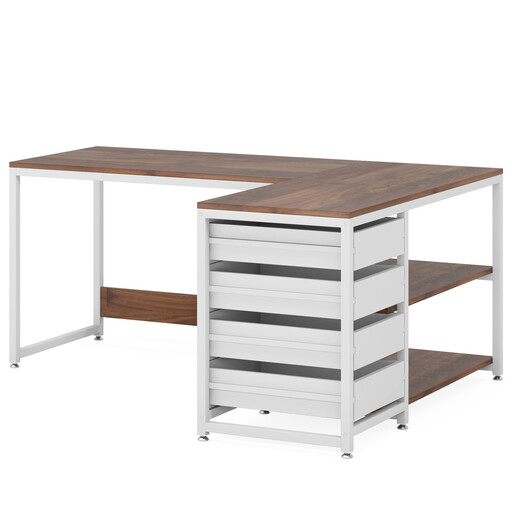
Who is it for? For those who want a true home workstation, with enough space for multiple monitors and direct access to their files and supplies.
Its reversible design is genuinely engineered to keep the drawers and shelves practical on either side, sidestepping the false modularity trap.
Ample storage capacity: 4 integrated drawers and 2 shelves. Sturdy construction: E1 particle board and a metal frame for enhanced stability.
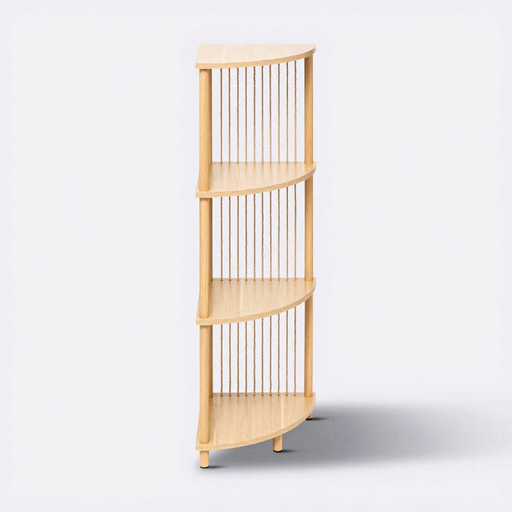
Who is it for? The perfect solution for anyone looking to furnish a dead corner simply, affordably, and quickly, whether in a living room, entryway, or bedroom.
No empty promises about sturdiness. Its spec sheet clearly states a maximum load of 10 kg per shelf, which prevents the disappointment of a sagging unit.
Quick assembly: Estimated 15-minute assembly time for one person. Minimal footprint: Dimensions of 34 x 34 cm on the floor for 4 tiers of storage.
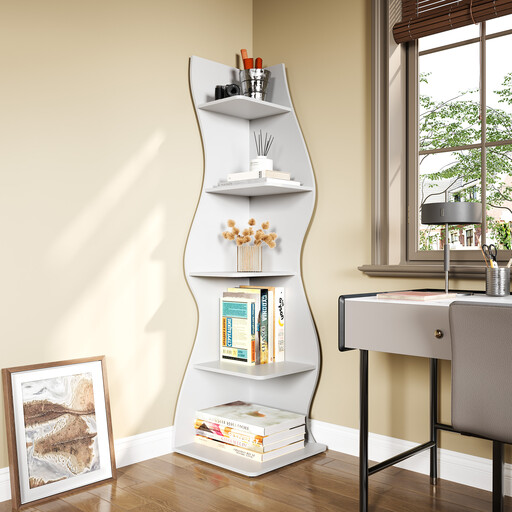
Who is it for? For those who see furniture as a decorative piece in its own right and are looking for a unique design to showcase objects or houseplants.
It avoids the trap of unnecessary bulk thanks to its open and airy structure, which optimizes vertical space without visually cluttering the room.
Distinctive design: Its unique shape and solid white finish make it a decorative object. Versatility: Fits equally well in a living room, office, or bedroom.
Explore our full selection of products that meet our standards for quality, practicality, and safety.
Most flat-pack corner furniture is designed for self-assembly. The assembly time varies with complexity: a simple shelf might take 15 to 30 minutes, while a desk with storage could require one to two hours. Always check if tools are included and if the instructions are clear, with well-numbered parts.
Consult the assembly diagrams or photos of the product assembled in both configurations. A truly reversible model will have symmetrical attachment points and a design that ensures legroom and access to storage remain optimal, regardless of which side is chosen for the return.
There is no single standard; this information must be provided by the manufacturer. For everyday use (books, decor), a capacity of 5 to 10 kg per shelf is generally sufficient. For heavier items, like encyclopedias or hi-fi equipment, look for models specifying a load capacity greater than 15 kg and featuring a reinforced structure.