
Livraison le jour même ou le lendemain

Qualité garantie

Débloquez vos offres de bienvenue: Livraison GRATUITE | Jusqu'à -80 % | 30 jours d'essai gratuits à JoyPlus
Téléchargez l'application
Turning a corner of a room into a functional workspace is often a challenging puzzle. The corner desk with storage emerges as the magic bullet for optimising every square foot without sacrificing tidiness. But be warned: the market is flooded with models that make tempting promises, often hiding major design flaws. Before you pull out your credit card, it's crucial to know how to spot the most common traps to make a truly informed and lasting choice.
The desire for a clean and organised setup often leads to an impulse buy. To prevent the dream from turning into a nightmare, here are the 3 traps you absolutely must know.
To avoid these disappointments, you need to focus on technical criteria—the only things that don't lie. They are the true guarantors of the quality and durability of your future workspace.
The frame is the skeleton of your desk. Opt for a powder-coated steel frame: it's a guarantee of sturdiness and rust resistance. Take a look at the thickness of the legs: square sections of 5 cm x 5 cm, for example, are a good indicator of a serious and durable design.
The load capacity is a non-negotiable spec, especially if your setup includes multiple monitors or heavy equipment. Aim for a minimum of 50 kg for standard use, but the sturdiest models can support much more. Finally, don't underestimate adjustable feet. It's the small detail that makes all the difference in ensuring perfect stability, even on an old wooden floor or an uneven surface.
A true reversible corner desk worthy of the name is designed from the outset to be assembled on both sides. In practical terms, this means that the desktops and the structure must have pre-drilled holes for both left- and right-hand assembly. The assembly instructions should clearly illustrate both options. This symmetry is the only guarantee of identical rigidity, no matter which configuration you choose. This is a crucial point for a flexible home office workstation that can evolve as you move flats or change rooms.
Forget the number of compartments shown on the box: it's the usable dimensions that matter for a desk with shelves and drawers.
Enough theory, let's get practical. Here is our selection of models that tick all the right boxes, for different profiles and budgets.
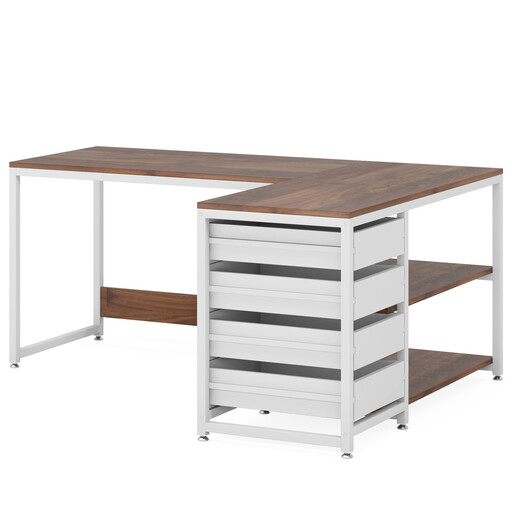
Why we love it: It's the perfect all-in-one solution to make use of a dead corner. This L-shaped desk with drawers and shelves combines a large work surface with maximum storage for an always-immaculate setup.
Its design is truly reversible: the 4 drawers and 2 shelves can be mounted on the left or right, without compromising on stability. Its sturdy metal frame prevents the desktop from sagging.
It combines a true corner work surface with impressive storage capacity (4 drawers + 2 shelves), a hard-to-find combination.
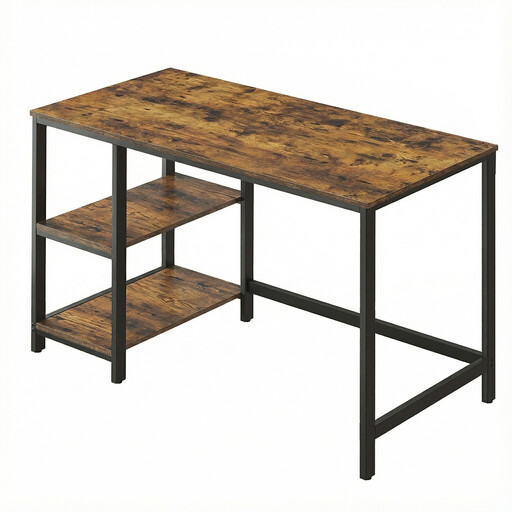
Why we love it: The perfect solution for a studio or a small bedroom. It's not a corner desk in the strictest sense, but its smart vertical storage helps optimise floor space without making the room feel cramped.
It avoids the "gimmicky storage" trap thanks to its 2 removable shelves. You can install them on whichever side you prefer, and even remove one to slide in a PC tower.
Maximum flexibility with a minimal footprint. Its steel frame and adjustable feet ensure flawless stability.
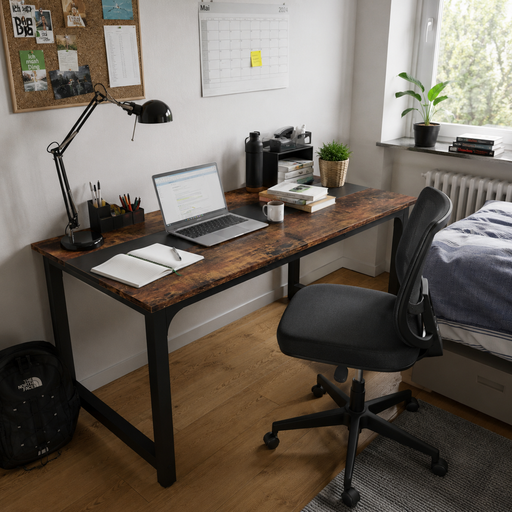
Why we love it: Designed for pros and enthusiasts (developers, creatives, gamers) who need a massive work surface and rock-solid stability for their heavy equipment. Here, space takes priority over the L-shape.
It shatters the "fake sturdiness" trap. With its reinforced steel frame, it boasts a load capacity of up to 400 kg. Needless to say, sagging isn't even a concern.
A giant 160 x 80 cm desktop and rock-solid sturdiness to support the heaviest setups without the slightest vibration.
Explore our full selection of desks that meet our strict standards for quality and durability.
It all depends on the quality. An entry-level model made of lightweight particle board will show signs of wear (sagging) within 1 to 2 years. Conversely, a desk with a dense panel (E1 standard, for example) and a solid steel frame can last more than 5 years without any issues, even with heavy use.
Yes, if it has been well-designed from the start. A good reversible model has symmetrical attachment points and reinforcements that guarantee the same rigidity on both sides. If the instructions ask you to drill your own holes or if the parts fit together poorly, avoid it: the stability won't be there.
Cable management is the key to a clean setup. Ideally, choose a desk with built-in cable grommets in the desktop. If it doesn't have any, don't panic: adhesive cable sleeves to stick under the desk, Velcro cable ties, or a cable management box to hide the power strip will do the job perfectly.