
Livraison le jour même ou le lendemain

Qualité garantie

Débloquez vos offres de bienvenue: Livraison GRATUITE | Jusqu'à -80 % | 30 jours d'essai gratuits à JoyPlus
Téléchargez l'application
Washing a car in a driveway without an electrical socket, rinsing a bike after a muddy ride or cleaning a patio without dragging around a bulky appliance: a cordless pressure washer is suitable for a wide range of household tasks. The problem is that product specifications sometimes combine maximum pressure, theoretical flow rate and battery life, making comparisons difficult.
Before you buy, three common pitfalls are worth bearing in mind:
Pressure, measured in bars or PSI, refers to the force exerted by the jet. Flow rate, stated in litres per hour, indicates the amount of water projected. For washing a car, bike, garden furniture or balcony, a compact model may be more than sufficient. However, ingrained dirt on a patio or wall requires a higher flow rate, as well as a suitable nozzle.
As a guide, the Yard Force, rated at 45 bars, or 665 PSI, and 360 l/h, is positioned as a mobile appliance for car washing and everyday outdoor tasks. With 24 bars and 180 l/h, the Greenworks is better suited to light to medium-duty cleaning, while using less water.
The values stated by manufacturers generally represent maximum performance. The pressure actually achieved also depends on the length of the hose, the battery charge level, the nozzle being used and the height difference between the water source and the appliance.
A cordless electric pressure washer should first be assessed according to its power supply:
The Yard Force operates with a rechargeable 20 V 4,000 mAh battery and features several stated safety protections, including protection against overcharging, overheating and short circuits. For the Greenworks, check the pack contents carefully: the product details state that it is compatible with Greenworks 24 V batteries, while the title specifies that the battery and charger may be sold separately.
A portable pressure washer with a self-priming system can operate from a bucket, clean water reservoir or tap. This is particularly practical when camping, on a parking area or in a garden without a direct water connection.
The nozzle matters just as much as the motor. A rotary nozzle or one with several settings allows you to switch from a concentrated jet to a wider spray. For bodywork, keep a reasonable distance and choose a gentler jet. On a patio, a more targeted jet can be useful, but use it carefully to avoid damaging joints or painted surfaces.
A car pressure washer with foam bottle includes a convenient detergent bottle for applying the product before rinsing. It does not remove the need for the usual precautions: only use detergent that is compatible with the appliance and follow the instructions in its manual.
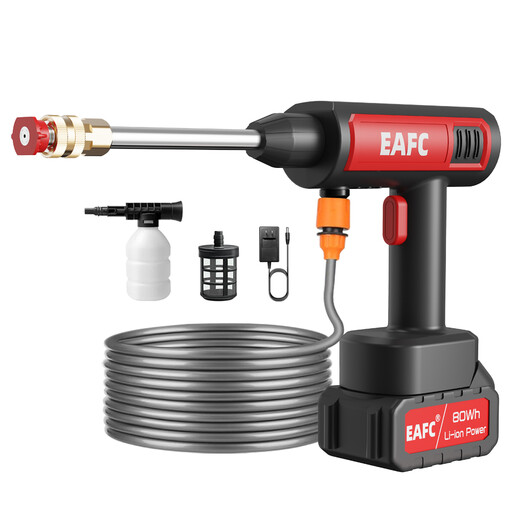
Why this choice suits this profile : Its compact design and battery power let you wash a car, bike or outdoor furniture using a bucket, tap or any other clean water source.
The product details explain what to do if there is air in the system, the hose is kinked or the battery is low — points that are often overlooked when buying your first appliance.
Cordless power, draws water from a bucket or tap, foam bottle, and designed for use on cars, motorbikes, bikes and outdoor equipment.
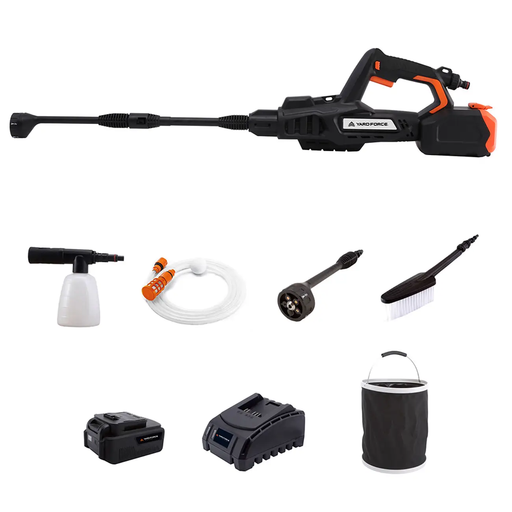
Why this choice suits this profile : It combines a 20 V, 4,000 mAh battery with a stated pressure of 665 PSI, alongside a range of accessories designed for regular cleaning.
The 5-in-1 nozzle means you are not limited to just one type of jet. You can choose a 0°, 25° or 40° angle, shower mode or foam spray.
Stated flow rate of 360 l/h, quick-connect hose, foam bottle, cleaning brush and folding bucket included.
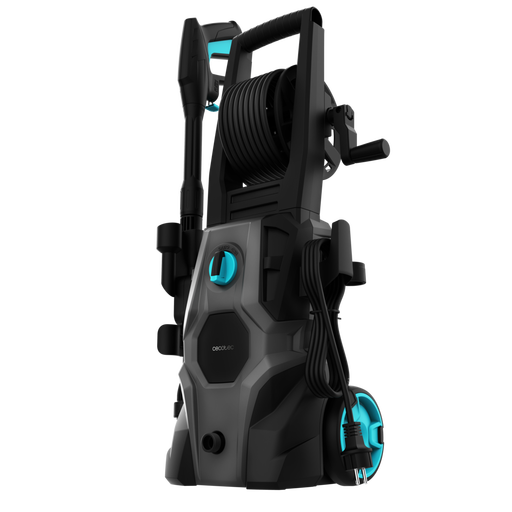
Why this choice suits this profile : This corded 2,000 W model is aimed at those who prioritise longer sessions and a stated pressure of 150 bars over the mobility of a battery-powered appliance.
Its product details clearly distinguish mains power, the 450 l/h flow rate and the stated operating range. It should therefore not be confused with a cordless pressure washer.
Aluminium pump, high-pressure hose, dirt filter, adjustable soap bottle and accessories for floors, wheels and corners.
We have put together a complete, real-time updated selection of products that meet these strict criteria, as well as European safety regulations.
To protect the pump and maintain a consistent jet:
A cordless appliance makes it easier to move around, but its running costs depend on recharging, any eventual battery replacement and water consumption. For small, regular jobs, this mobility may prove more convenient than a corded model. For long sessions over a large area, a mains-powered appliance such as the Cecotec will probably be better suited.
Yes, some models feature a self-priming function. However, you must use a clean water source, position the suction hose correctly and follow the priming procedure. The Yard Force and EAFC product details state that they can be used with a bucket or another suitable water source.
When washing a car, maximum pressure is not the only factor to consider. A consistent flow rate, adjustable nozzle and foam bottle are just as useful. Avoid using a highly concentrated jet at close range and follow the recommendations provided by the vehicle or surface manufacturer.
The cost includes the electricity required for recharging, the water used and, eventually, battery replacement. To estimate it, check the battery capacity in Wh, the stated number of cycles where provided and the price of a compatible battery. A removable battery makes replacement easier, provided it remains compatible with the model concerned.