
Livraison le jour même ou le lendemain

Qualité garantie

Débloquez vos offres de bienvenue: Livraison GRATUITE | Jusqu'à -80 % | 30 jours d'essai gratuits à JoyPlus
Téléchargez l'application
A cordless vacuum cleaner is ideal for quick clean-ups, but not all models are created equal depending on how you use them. With power figures that are hard to compare, battery life quoted in eco mode, and accessories you never touch, a bad decision can quickly prove costly.
This guide helps you sort through the features that really matter, whether you live in a flat, a house, have pets, or also want to clean your car.
A motor boasting several hundred watts doesn’t, on its own, guarantee effective suction. The design of the airflow path, the brush, the filter and the seals all play a part. When the spec sheet mentions a value in kPa or Airwatts, make sure you check whether this applies to a particular mode and under what conditions it was measured.
A cordless stick vacuum with multiple modes can offer very different battery life depending on the power setting you choose. For everyday crumbs and dust, eco mode is usually sufficient. However, thick carpets and pet hair more often require boost mode.
A battery life of 45 or 60 minutes typically refers to the lowest power setting, sometimes without a motorised brush. In turbo mode, the run time can drop sharply. If you need to clean a large area, go for a vacuum with a long-lasting battery, a removable battery, or a model that’s particularly convenient to recharge.
A clogged filter gradually reduces airflow and can cause the motor to overheat. Hair and fur also tend to wrap around the brush if it doesn’t have an anti-tangle system.
Before you place an order, check the availability of replacement filters, how easy it is to empty the dustbin, and the washing instructions. A washable filter must be completely dry before you put it back in.
For a small home or occasional cleaning, a rechargeable vacuum offering around 20 to 30 minutes of run time may be enough. For a family house, it’s better to look for a removable battery, an accurate charge indicator, and multiple suction levels.
Weight is especially noticeable on stairs, when cleaning ceilings, or reaching high furniture. The ability to convert it into a cordless handheld vacuum is handy for the car, the sofa and skirting boards. A flexible or telescopic tube also makes it easier to reach under beds and low furniture.
A vacuum with a HEPA filter, or one with multiple stages of filtration, can trap a significant proportion of fine dust, depending on the manufacturer’s design. This isn’t a medical guarantee of air quality, but it’s a useful feature for reducing dust emissions during use.
A dustbin of 0.45 to 0.56 litres is generally fine for everyday cleaning. A capacity of at least 1 litre reduces how often you need to empty it, which can be a real plus if you have pets. A bagless vacuum saves you buying consumables, but its dustbin and filters need regular cleaning.
For versatile use, choose a vacuum for carpets and hard floors fitted with a brush suitable for both surfaces. An LED light on the cleaning head can help you spot dust under furniture, though it doesn’t replace a thorough pass.
The accessories that are genuinely useful are usually:
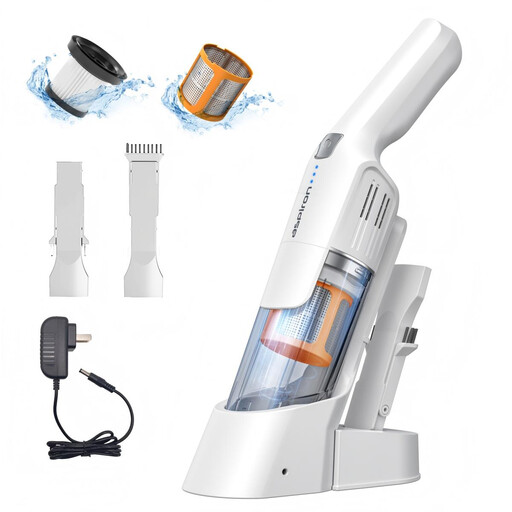
Why this choice suits this profile: Its compact size is perfect for crumbs, furniture, car seats and everyday small tasks.
The spec sheet mentions two suction levels, a 500 ml dustbin and a washable filter, making maintenance easy to understand.
Up to 15 kPa according to the description, a claimed run time of 13 to 25 minutes, a charging station and 2-in-1 accessories.
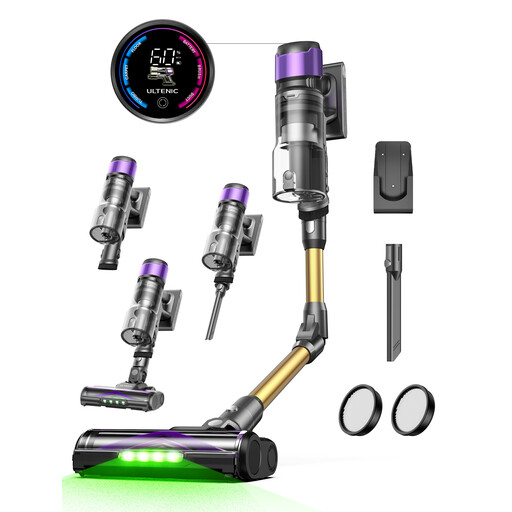
Why this choice suits this profile: It’s ideal for households looking for a versatile appliance, a large dustbin and a more comfortable everyday experience.
The display shows remaining battery life and the 1.5-litre dustbin cuts down on interruptions during long cleaning sessions.
The spec sheet mentions three modes, up to 60 minutes of run time, a removable battery and a brush designed to reduce hair tangling.
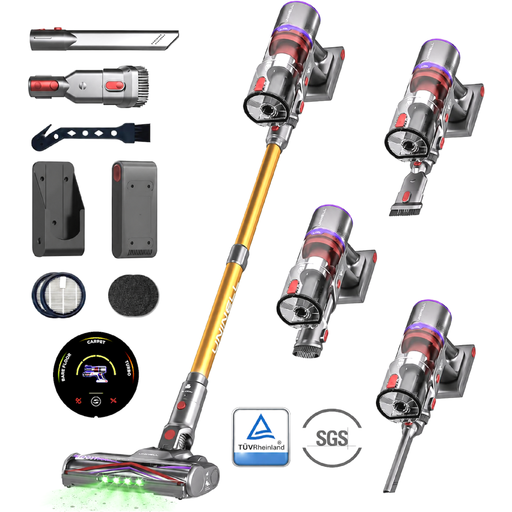
Why this choice suits this profile: Its claimed run time and cordless design make it ideal for large areas, carpets and homes with pets.
The detachable battery and touchscreen let you track the mode in use and remaining battery life, rather than relying on a general estimate.
The spec sheet claims up to 65 minutes of run time, suction that can reach 60 kPa, seven-stage filtration and an anti-tangle brush.
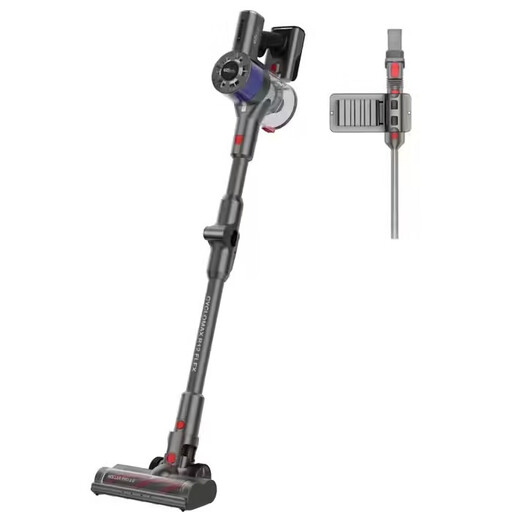
Why this choice suits this profile: Its 2-in-1 design lets you switch from floors to stairs, furniture and car seats without changing appliance.
At a claimed 1.6 kg and with its flexible tube, it reduces strain during quick clean-ups and reaching under furniture.
Up to 30 minutes of claimed run time, two speeds, a light-up nozzle for crevices and a wall mount that also serves as a charging station.
We’ve put together a comprehensive, real-time updated list of products that fully meet these strict selection criteria and European safety regulations.
To keep your cordless vacuum performing well, empty the dustbin before it’s completely full. Remove hair from the brush, clean the filter according to the instructions and let it dry thoroughly. Never vacuum liquids with an appliance designed for dry cleaning.
Recharge the battery using the supplied charger and store it away from heat and moisture. If the model has a removable battery, check before you buy that a replacement part is available. This will make it easier to maintain the appliance with heavy use.
Yes, for everyday cleaning in a flat or house, provided you choose a model with suitable battery life and brush. However, a cylinder vacuum is still more practical for very large areas or long cleaning sessions without interruption.
Allow around 20 to 30 minutes for occasional or spot cleaning. For a family house, go for a model claiming 45 to 60 minutes in eco mode, with a removable battery if possible. In turbo mode, the run time will generally be much shorter.
Even if it’s washable, a filter should be inspected regularly and replaced if it’s deformed, damaged, or remains clogged after cleaning. Check the instructions for the recommended frequency and verify the availability of spare parts before you buy.