
Livraison le jour même ou le lendemain

Qualité garantie

Débloquez vos offres de bienvenue: Livraison GRATUITE | Jusqu'à -80 % | 30 jours d'essai gratuits à JoyPlus
Téléchargez l'application
A cordless vacuum cleaner can make daily cleaning much simpler, whether you live in a flat, a multi-storey house, or with pets. But you still need to know how to read between the lines of the spec sheets. A battery life measured in eco mode, power expressed in watts, or a filter described as "high efficiency" are not enough on their own to judge a machine.
Before comparing stick vacuums and rechargeable models, here are three pitfalls to avoid.
A motor with a high wattage doesn't necessarily suck better on every surface. The design of the brush head, the airflow, the seal of the air path, and the condition of the filter all matter just as much. If you're looking for a powerful vacuum cleaner, look at several data points, particularly the suction power in airwatts or kPa, and don't forget the accessories included.
The advertised battery life usually refers to the least power-hungry mode and doesn't always account for using a motorised brush head. In turbo mode, it often disappears like snow in the sun. In a home with carpets, pet hair, and stairs, a removable battery can prove more useful than a high theoretical battery life.
A clogged filter reduces airflow and can put extra strain on the motor. Long hair and pet fur tend to wrap around the roller. An anti-tangle vacuum cleaner makes maintenance easier, but it doesn't let you off checking the ends of the brush head regularly.
A vacuum cleaner with a HEPA filter can trap a large proportion of fine particles, provided the filter is correctly installed and air cannot bypass the system. The simple mention of "HEPA" therefore deserves to be examined in light of the measurement method stated by the manufacturer: particle size, percentage retained, and the configuration of the air path.
In the product sheets presented here, the filtration performance corresponds to the data provided by the brands. They do not in any way constitute a medical guarantee. People sensitive to dust would also do well to choose:
If your home has a mix of wooden floors, tiles, and carpets, opt for a motorised brush head with a setting adapted to each floor type. An anti-tangle brush head limits the build-up of hair, while a front light makes it easier to spot dust under furniture and in dark corners.
A vacuum cleaner for carpets and hard floors also needs to remain manoeuvrable when you move from one surface to another. The different power modes let you adjust the suction to the task, rather than running at maximum all the time.
A lightweight machine is particularly handy on stairs, for ceilings, or for cleaning the inside of a car. On the other hand, very compact models sometimes come with a small dustbin. In a household with several pets, a capacity of at least 0.8 litres reduces the number of stops to empty it.
Also remember to check:
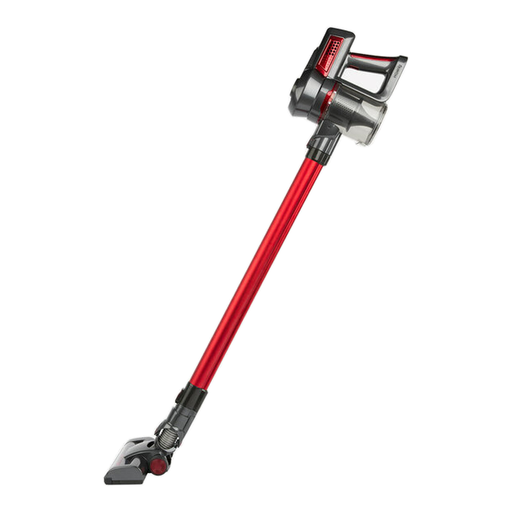
Why this choice suits this profile: Its compact format is ideal for small spaces and quick cleans. It also lets you easily switch from stick mode to handheld mode for furniture or the car.
The advertised battery life reaches 30 minutes and two speeds are available. However, the spec sheet notes a charging time of around 4 hours, a factor to consider before buying.
2-in-1 format, stated weight of 1.165 kg, 0.8-litre dustbin, cyclonic technology, and wall mount included.
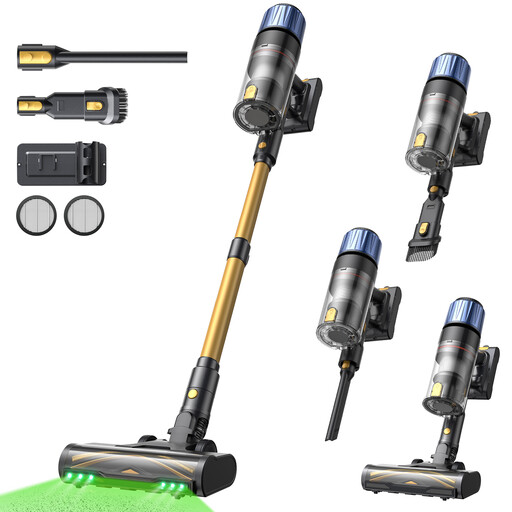
Why this choice suits this profile: Households looking for a large dustbin, generous battery life, and a display of settings will find a useful ally for regular cleaning of various surfaces.
The advertised battery life of 70 minutes corresponds to low mode. The three modes allow you to adjust the suction, but intensive use can significantly reduce this duration.
Motor stated at 600 W, suction power stated at 55 kPa, 1.2-litre dustbin, six-level HEPA filtration, and green front light.
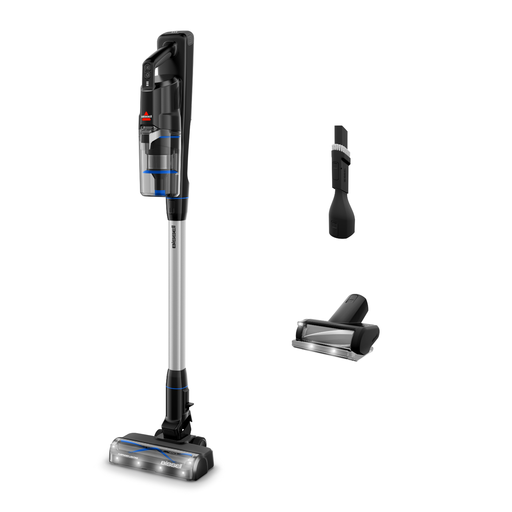
Why this choice suits this profile: Dog or cat owners can turn to this model designed for pet hair, with a motorised brush head dedicated to stairs and accessories suited to fabrics.
The FurGuard technology and anti-tangle roller are designed to limit hair build-up. You will still need to empty the 0.4-litre dustbin and clean the filters regularly.
Removable 25.2 V battery, advertised battery life of up to 50 minutes, three modes, FurFinder light, and HEPA filtration stated at 99.97% of allergens.
If you need a large capacity or extended use, a cylinder vacuum cleaner remains an option worth considering. The Electrolux EB61C2GRN and EB61C4OG models have, according to their respective spec sheets, a 3.5-litre bag, an advertised reach of 12 metres, and HEPA filtration. They are less convenient to move around than a stick vacuum, but they avoid having to recharge the machine between rooms.
We have compiled a complete, real-time updated list of products that fully meet these strict selection criteria and European safety regulations.
For a quick clean-up, 20 to 30 minutes can be enough. For several rooms, carpets, and pet hair, it's better to aim for an advertised battery life of at least 40 minutes or choose a removable battery. Bear in mind, however, that turbo mode uses significantly more power.
It depends on the model. Some filters are washable, but they must be completely dry before being put back in place. The manual may also specify replacement at regular intervals. A clean filter helps maintain good airflow, but it doesn't turn the vacuum cleaner into a medical device.
Recharging generally uses very little electricity. However, the cost of use is not limited to the energy bill: you also need to budget for filters, rollers, and the battery when it reaches the end of its life. Before buying, check the availability of these spare parts as well as the warranty conditions, particularly for the battery.