
Livraison le jour même ou le lendemain

Qualité garantie

Débloquez vos offres de bienvenue: Livraison GRATUITE | Jusqu'à -80 % | 30 jours d'essai gratuits à JoyPlus
Téléchargez l'application
An underinflated tire isn't just an inconvenience?— it's a genuine safety risk and a drain on your fuel economy. In response, the cordless tire inflator has become an essential accessory for total peace of mind, whether for regular maintenance at home or as an emergency kit on the road. The problem?is that the market is flooded with models making tempting promises that often fall flat. This guide is here to help you sidestep the marketing traps and choose a device that won't let you down.
The 3 Common Pitfalls of Portable Air Compressors?:
To choose an electric air pump for your car that's a reliable ally, not a useless gadget, ignore the marketing hype and focus on these key technical specifications.
For a cordless device, battery life is the critical factor. The battery's capacity, expressed in milliampere-hours (mAh), is the first indicator to examine.
A good battery-powered mini compressor must be able to handle at least one full emergency inflation or several consecutive top-offs.
This is the duo that defines your inflator's power and speed.
A good digital tire inflator should, above all, simplify your life and ensure your safety.
Rather than an endless list, we've selected models that cater to clear user profiles, strictly applying the reliability criteria we've just discussed.
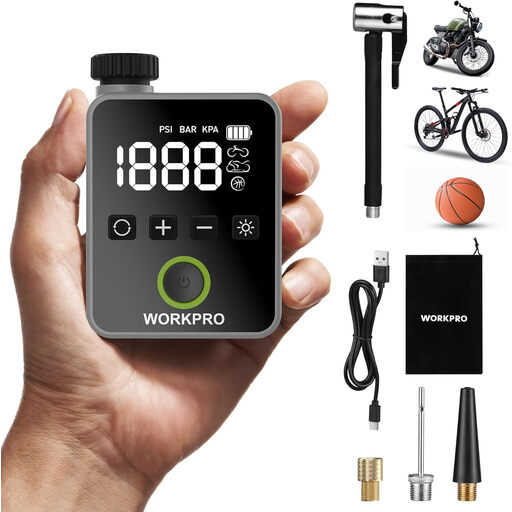
Why we recommend it : Ideal for those who want a "just-in-case" solution that's ultra-compact enough to slip into a glove box or backpack. Perfect for quick top-offs on a car, motorcycle, or bike. Its feather-light weight (270g) and simplicity make it the ultimate top-off tool.
This model is refreshingly honest: it doesn't promise F1-level performance but focuses entirely on portability and precision for small adjustments. Its LED screen and automatic shutoff ensure a reliable reading, unlike many entry-level models with unreliable gauges.
Ultra-portable : Lighter than a smartphone, it fits anywhere.
Convenient : Integrated LED light and a backup power bank function.
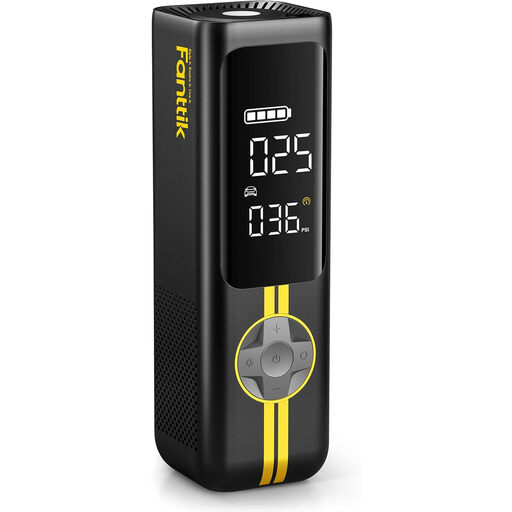
Why we recommend it : For those who manage multiple vehicles or simply refuse to wait. Its speed and cooling system allow for back-to-back inflations without overheating or forced pauses.
It brilliantly overcomes the slowness trap. Fanttik claims a 5 PSI top-off (from 28 to 33) in under a minute. Its key advantage is its cooling system, which enables continuous use where competitors would throw in the towel after just one tire.
Speed and Endurance : Express inflation and the ability to handle multiple tires in a row.
Reliability : Accurate gauge and flawless automatic shutoff.
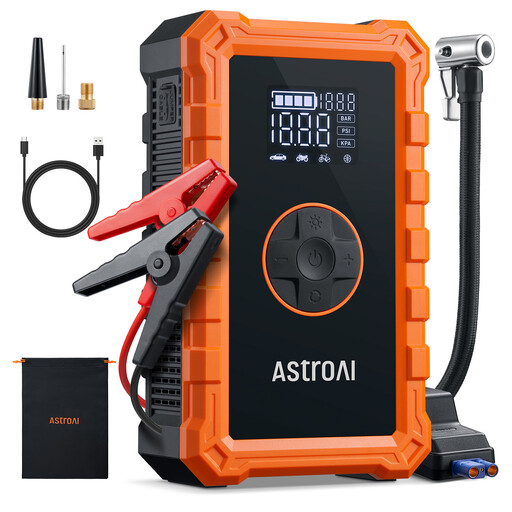
Why we recommend it : Far more than just an inflator, this is the Swiss Army knife of roadside safety. It combines a powerful battery booster (1500A), an efficient air compressor, a flashlight, and a power bank. The ultimate tool for those who want to be prepared for any eventuality.
It justifies its size and price by being a true all-in-one solution. Far from a gimmick, it stands out as a credible emergency tool, featuring a high-performance compressor (25 L/min flow rate) and a booster capable of reviving gas engines up to 6.0L.
All-in-One Solution : Battery booster, inflator, power bank, and light.
Raw Power : Starts large engines and inflates tires without delay.
These three models are just a preview. Discover other inflators that have passed our tests and meet our criteria for reliability and safety.
A lithium-ion battery is designed to last for 300 to 500 full charge cycles. To maximize its longevity, avoid letting it fully discharge and store the device away from moisture and extreme temperatures. The best practice is to give it a quick charge every 3 to 6 months, even when not in use, to preserve its cells.
That's a very bad idea. Lithium-ion batteries hate extreme temperatures. Leaving your inflator in a car under the hot summer sun or in freezing winter cold can irreversibly damage its cells, drastically reducing its battery life and overall lifespan. The ideal approach is to store it at room temperature and only bring it with you on your trips.
Absolutely not. A car tire's pressure rarely exceeds 45 PSI (about 3 bar). So, why the high number? Think of it as an indicator of the motor's robustness. Most importantly, it ensures total versatility: you can effortlessly inflate road bike tires (which sometimes require over 100 PSI) or any sports ball.