
Livraison le jour même ou le lendemain

Qualité garantie

Débloquez vos offres de bienvenue: Livraison GRATUITE | Jusqu'à -80 % | 30 jours d'essai gratuits à JoyPlus
Téléchargez l'application
A cordless vacuum cleaner is ideal for quick clean-ups, but not every model is suited to the same jobs. Between claims of record-breaking suction, battery life measured in Eco mode and bundles packed with accessories, it’s easy to compare figures that don’t mean much in everyday use.
Before you place an order, focus on three things: the battery life you can realistically expect, the design of the brush and how easy the vacuum is to maintain. The right choice depends mainly on your day-to-day needs: a flat with hard floors, a house with carpets, a car, stairs or pets.
Power, measured in watts, mainly indicates electricity consumption or motor output. It isn’t enough to tell you how well a vacuum will pick up dust and debris. Figures in Pa, kPa or AW aren’t always measured under the same conditions. You’ll need to consider them alongside the brush supplied, airflow, mode and floor type.
A very powerful vacuum can become less effective if its filter is clogged or its brush is tangled with hair. The stated power is a useful indicator, but it certainly doesn’t guarantee the same results on every surface.
A battery life of 60 or 90 minutes usually refers to the most energy-efficient mode, sometimes with a non-motorised or low-power accessory. In Turbo mode, it can run down much faster. If you have a family home, check the battery life in Standard mode, how long it lasts at maximum power and how long the battery takes to recharge.
A removable battery can be useful if you’re thinking of buying a second one or want to replace the original more easily. Bear in mind, though, that this doesn’t mean an extra battery comes with the vacuum.
A large dust container doesn’t mean you can skip emptying the vacuum regularly. Filters should be easy to access and washable where the instructions say they are. If a filter isn’t properly maintained, airflow will gradually reduce and dust may be blown back into the room.
If you’re sensitive to dust or share your home with pets, look for multi-layer filtration or a HEPA filter. Check the stated filtration level, the conditions it applies to and whether replacement filters are available.
For a cordless vacuum that needs to clean both carpets and hard floors, the main brush matters just as much as the motor. A motorised brush makes it easier to lift fibres and pet hair from carpets, while a softer roller is better suited to wooden floors and delicate surfaces.
If you have a cat or dog, an anti-tangle brush could be a good choice. You’ll still need to remove hair that builds up around the roller regularly, even if the manufacturer claims to reduce tangling.
A cordless stick vacuum should still be easy to handle once the tube and brush are attached. Check the weight of the complete set-up you’ll actually use, rather than just the motor unit. A self-standing function, a display showing the vacuum’s status or a joint that lets you clean under furniture can also make a real difference day to day.
For quick clean-ups, a lightweight, compact cordless handheld vacuum is often more convenient than a full-size model. Those with a USB-C port or a built-in rechargeable battery are particularly handy at the office, on the stairs and in the car.
A dust container with a capacity of 0.5 to 1.2 litres can suit a wide range of needs. A larger capacity means you won’t have to empty it halfway through cleaning, but it can make the motor unit heavier. Also check how the container opens and whether the vacuum comes with a crevice tool, an upholstery brush and a nozzle for awkward corners.
Vacuuming and blowing functions are useful in the car, for cleaning a keyboard or for dusting window tracks. They’re no substitute for wet cleaning. Unless the instructions specifically say otherwise, these vacuums shouldn’t be used to pick up liquids.
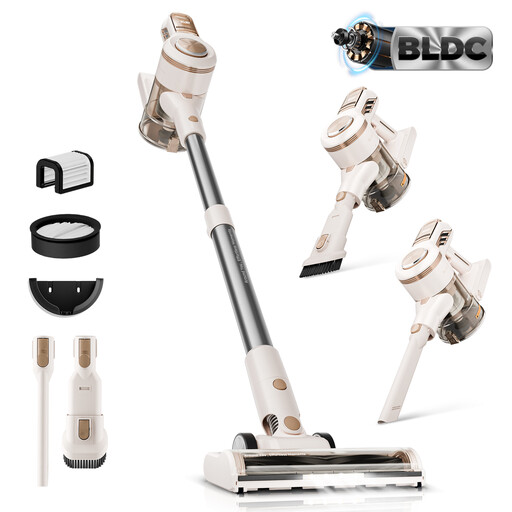
Why it’s a good choice for you: This model is suitable for everyday cleaning in a flat, from hard floors and carpets to furniture. It has two modes and a removable 2,200 mAh battery.
The LED display, 0.5-litre dust container and removable battery make the vacuum easier to use and monitor than a model whose battery life is hard to gauge.
Claimed suction power of up to 45 kPa, a brushless motor, six-stage filtration and eight accessories.
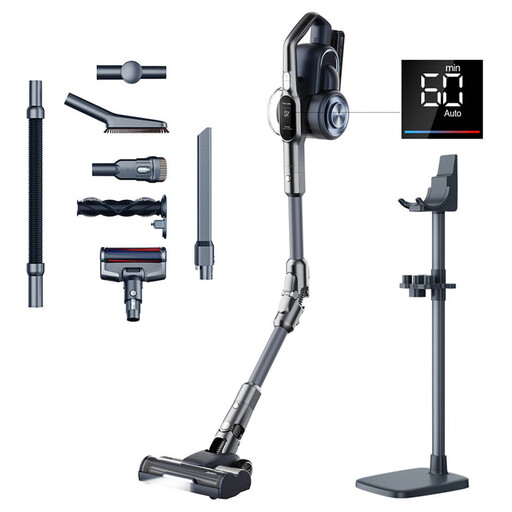
Why it’s a good choice for you: It’s designed for households looking for a versatile vacuum for carpets, hard floors and longer cleaning sessions.
The four modes let you save Turbo for when you need it, while the two rollers supplied are designed separately for carpets and hard floors.
Claimed suction power of 260 AW, stated battery life of up to 90 minutes and a removable 3,000 mAh battery.
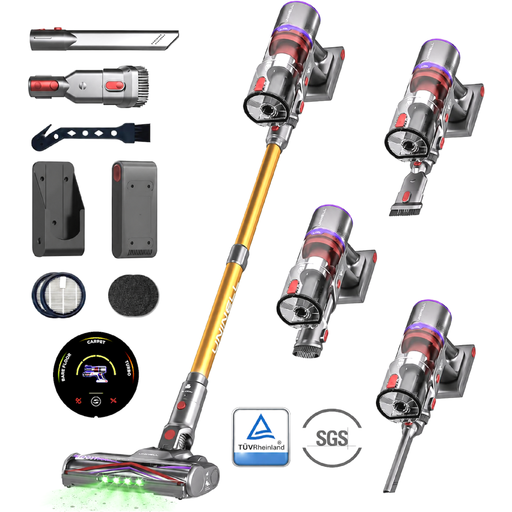
Why it’s a good choice for you: It’s designed for longer cleaning sessions and homes with pets, carpets, low furniture or lots of hard-to-reach corners.
The touchscreen displays the battery level and maintenance alerts, helping you spot a blocked filter or tangled brush.
Claimed suction power of up to 60 kPa, battery life of up to 65 minutes and seven-stage filtration, according to the product listing.
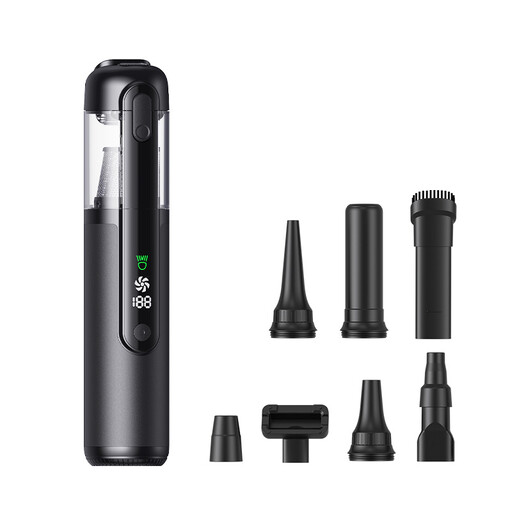
Why it’s a good choice for you: This compact model is easy to store in your car and is suitable for crumbs, dust, floor mats and gaps between seats.
The two speeds and blowing function let you adapt the vacuum to corners, air vents and cluttered surfaces.
120 W brushless motor, claimed suction power of 16,500 Pa and a built-in battery offering around 26 minutes of use.
We’ve put together a comprehensive, regularly updated list of products that meet these demanding selection criteria and European safety regulations.
For a flat, a stated battery life of 30 to 45 minutes in Standard mode may be enough for regular cleaning. A house, several carpets or pets may make a removable battery, a compatible spare battery or a model with clearly stated battery life in Normal mode a better choice.
Yes, provided the brush and modes are suited to both types of surface. Look for a motorised brush, adjustable power and, if possible, separate rollers for carpets and hard floors. Don’t rely on the stated suction pressure alone.
Recharging usually uses very little electricity, but long-term running costs depend mainly on the battery’s lifespan and the price of replacement filters and rollers. Before you buy, check whether spare parts are available, the stated warranty period and the charging instructions. Regular maintenance also helps to keep airflow steady.