
Livraison le jour même ou le lendemain

Qualité garantie

Débloquez vos offres de bienvenue: Livraison GRATUITE | Jusqu'à -80 % | 30 jours d'essai gratuits à JoyPlus
Téléchargez l'application
A flawless lawn without ever lifting a finger? This is no longer an impossible dream, thanks to the cordless robotic lawnmower. Say goodbye to the tedious perimeter wire you have to bury; these newcomers promise an effortless installation and complete autonomy. But be warned: the market is flooded with marketing promises that often hide disappointment. As the head of buyer's guides at Joybuy, my mission is to guide you through this tech jungle so that your purchase is a source of peace of mind, not a headache.
The "100% Wireless" Myth: Many models, marketed as being free of a perimeter wire, actually require you to install an RTK antenna (or beacon) in a completely clear corner of your garden. If your property has many trees or is surrounded by buildings, the signal can become unstable, rendering the robot ineffective. The promise of simplicity then turns into a technical headache.
So-Called "Smart" Navigation That Sees Nothing: Systems based solely on a camera can perform well in broad daylight but struggle as soon as the light fades, in shaded areas, or during overcast weather. A robot that stops or gets lost at dusk isn't truly autonomous.
The Inability to Handle Real-World Gardens: A spec sheet might boast about a robot's climbing ability without detailing the type of wheels or drive system. A robotic mower for steep slopes must have impeccable grip; otherwise, it will slip on wet grass and prematurely wear out its motors by straining to climb the smallest hill.
To avoid these setbacks, focus on the features that truly make a difference for your garden.
The guidance system is the heart of the machine. There is no single miracle technology, but rather several, often combined for unwavering reliability.
Don't blindly trust the advertised maximum area. Two points need to be checked:
A connected mower worthy of the name should offer more than just remote start. A well-designed mobile app is essential for:
Here are a few models that meet specific needs, taking into account our performance and reliability criteria.
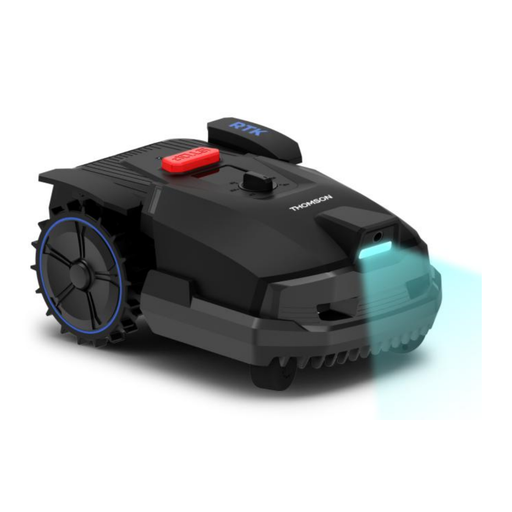
Why it stands out: Perfect for medium-sized gardens (up to 800 m?) dotted with trees, flowerbeds, or furniture. Its AI camera autonomously identifies and navigates around obstacles, while RTK navigation ensures methodical, parallel-stripe mowing.
It fuses two technologies (camera + RTK) for ultra-reliable navigation. If the GPS signal weakens under a tree, the camera takes over. The result: the robot never gets stuck or misses a spot.
Effortless setup (no perimeter wire) and full control via the MowMate app to manage zones and schedules with your fingertips.
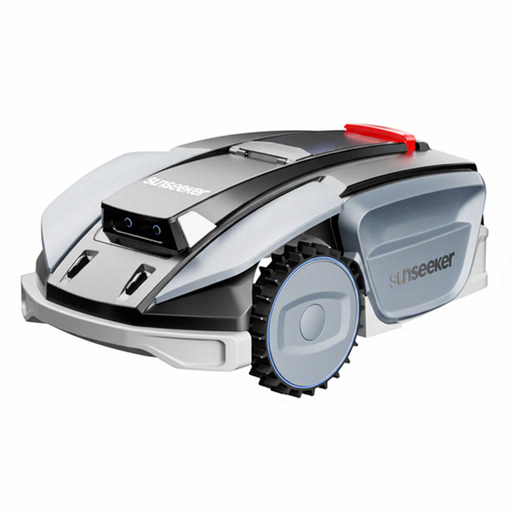
Why it stands out: Built for large properties (up to 1600 m?) and the most challenging terrains. Its all-wheel drive (AWD) system allows it to tackle slopes up to 60%, where most competitors give up.
It tackles the slope problem head-on. While other robots slip on wet grass or struggle uphill, its AWD system ensures constant, secure traction.
Slopes up to 60% and hybrid navigation (RTK + Vision AI) for flawless coverage of very large areas, even the most rugged ones.
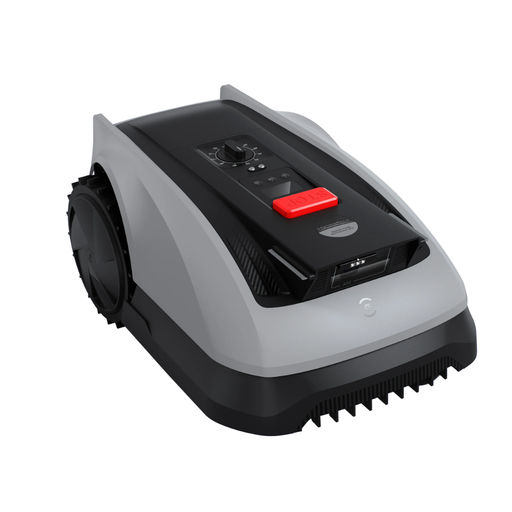
Why it stands out: For technophiles seeking a perfect finish on manicured lawns up to 600 m?. It is distinguished by its quiet operation and surgical precision, especially along edges.
It doesn't overpromise and delivers on its claim of precision. The combination of RTK + AIVI camera ensures fine-tuned obstacle detection and mowing right up to the edges.
Ultra-quiet operation (rated at 50 dB(A)) and millimetre-perfect navigation for clean edges and an impeccable lawn.
We have curated a full range of products that meet our strict selection criteria and current safety standards.
The term "cordless" refers to the absence of a perimeter wire to bury. However, most models, particularly those based on RTK technology, require the installation of a charging station and a reference antenna. The installation is therefore greatly simplified, but an initial setup via the app is still required to map your garden.
A lithium-ion battery typically lasts between 3 and 5 years, depending on the frequency of use and charging conditions. Its replacement cost varies significantly from one brand to another, ranging from €100 to over €300. Remember to check this information before purchasing to anticipate maintenance costs.
The reliability of a camera-guided robotic mower depends on the quality of its sensors and algorithms. Entry-level models may struggle in low-light conditions. However, more sophisticated devices often combine vision with other sensors (infrared, LiDAR) or are equipped with headlights to mow effectively even at night. Most robots include a rain sensor and automatically return to their base at the first sign of rain, both to protect their components and to avoid damaging the lawn.