
Livraison le jour même ou le lendemain

Qualité garantie

Débloquez vos offres de bienvenue: Livraison GRATUITE | Jusqu'à -80 % | 30 jours d'essai gratuits à JoyPlus
Téléchargez l'application
A cordless robotic lawnmower can make lawn care much easier, especially when it does away with the need for a boundary wire. But marketing promises alone aren't enough to find the right model for a British garden. The actual mowing area, slopes, obstacles, connectivity and maintenance are all factors to consider before placing your order.
A robotic lawnmower advertised for 800 or 1,000 m² won't necessarily cover that entire area on a single charge. The stated capacity usually refers to a recommended mowing area, calculated based on the terrain layout, operating frequency and the time needed for recharging.
A garden with flower beds, narrow pathways or multiple zones requires more travel than an open lawn. It's therefore wise to leave some margin between your garden's size and the figure quoted on the spec sheet.
A cordless robotic lawnmower still requires some initial setup. The charging station needs to be placed on a stable surface, with protected power supply and enough space for manoeuvring. The automatic mapping then needs to be checked, particularly around trees, borders, ponds and play areas.
RTK navigation, LiDAR or AI vision can reduce the need for a boundary wire, but their accuracy also depends on the environment. High walls, dense vegetation or covered areas can disrupt signal reception or obstacle detection.
Having a camera or sensors doesn't mean you can leave toys, hoses, branches and small objects on the lawn before mowing. AI vision helps recognise certain obstacles, but it doesn't guarantee detection of every object, regardless of lighting conditions.
For safe use, children and pets should stay away from the working area during mowing and maintenance operations.
For a small space, an autonomous mower designed for gardens up to 300 m² can be perfectly adequate. For a home with a larger lawn, compare the recommended area, battery life per charge and charging time.
A multi-zone management feature is particularly useful when the lawn is separated by a driveway or patio. Also check whether the app allows you to schedule different times and modify mapped zones.
Not all technologies suit the same needs:
A connected mower can be controlled via Wi-Fi or Bluetooth. Before buying, check its compatibility with Android and iOS, the availability of updates and which features are actually accessible from the app.
For a robotic mower intended for sloping ground, the stated gradient should be interpreted with caution. Some manufacturers distinguish between the maximum slope allowed in the working area and the slope the machine can climb near boundaries. Wet ground can also reduce traction.
The cutting height and width, as well as the protection rating, are also worth your attention. The THOMSON THOM 8, for example, offers a cutting height of 20 to 70 mm, a cutting width of 180 mm and an IPX5 rating for the mower. These details make it easier to compare models, though they don't guarantee the same results on every type of ground.
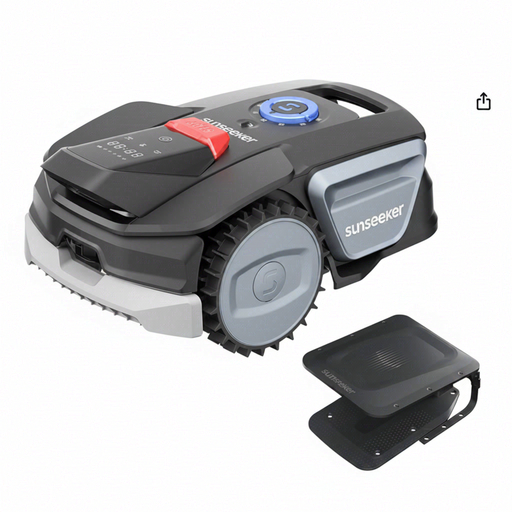
Why this choice suits this profile: This model is designed for small gardens up to 300 m². It combines cordless operation, AI vision, obstacle avoidance and app control.
Its stated coverage area reduces the risk of choosing an oversized machine for a small lawn. The cordless setup also avoids installation work.
Garage included, AI vision, app control and stated ability to handle slopes up to 27%.
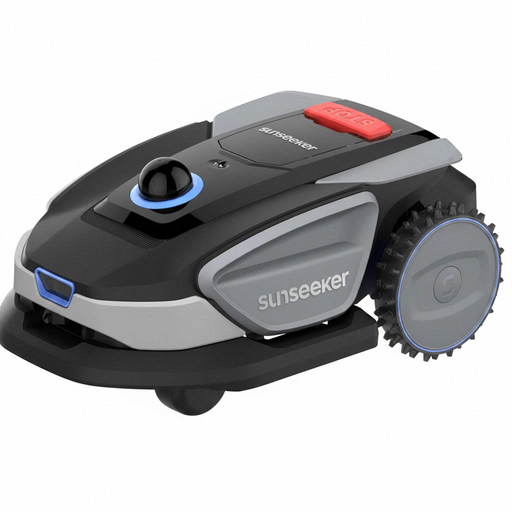
Why this choice suits this profile: It's aimed at owners of gardens up to 1,000 m² who want to combine advanced mapping, automation and mobile control.
The stated inclusion of 360° LiDAR and AI vision lets you verify the technical specifications, rather than relying solely on the word 'smart'.
360° LiDAR, AI vision, automatic mapping, multi-zone management and app control.
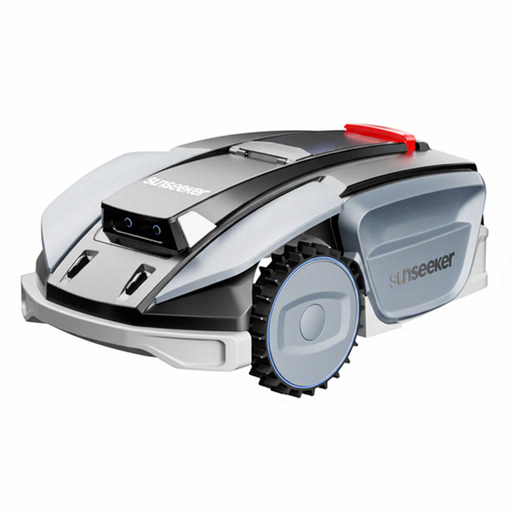
Why this choice suits this profile: This robotic mower, designed for 1,600 m², targets large properties and gardens with steep slopes or multiple mowing zones.
The stated all-wheel drive and ability to handle slopes up to 60% address a specific need, though this should be confirmed based on soil type and moisture levels.
AWD transmission, RTK navigation, AI vision, automatic mapping, multi-zone management and app control.
We've put together a comprehensive, real-time updated selection of products that meet these demanding criteria and European safety standards.
A connection may be needed for setup, updates and remote control. Some models also offer Bluetooth for making adjustments nearby. Check which features are still available when Wi-Fi doesn't reach the garden.
Power consumption depends on the machine's power, mowing frequency, lawn size and charging time. You also need to factor in blade wear, cleaning, eventual battery replacement and protecting the station during winter. Regular mowing can reduce the amount of grass cut per cycle, but it doesn't eliminate the need for routine maintenance.
Compare the stated maximum slope, traction, tip-over sensors and the ability to handle multiple zones. For an uneven lawn, it's still worth inspecting the terrain and measuring narrow passages before ordering.