
Livraison le jour même ou le lendemain

Qualité garantie

Débloquez vos offres de bienvenue: Livraison GRATUITE | Jusqu'à -80 % | 30 jours d'essai gratuits à JoyPlus
Téléchargez l'application
A cordless robotic lawnmower saves you from having to lay a buried or surface-fixed wire. Virtual mapping, RTK navigation, LiDAR sensors, cameras and a mobile app have made installation far simpler. However, these technologies aren't suited to every lawn.
Before you place your order, assess the actual usable area, the slopes, any narrow passages and the quality of your network coverage. Here are the main pitfalls to avoid, along with a selection of models suited to different needs.
The surface area quoted by a brand usually refers to a theoretical maximum capacity. A lawn broken up by pathways, bordered by flower beds or spread across several zones will require more running time.
To stop your mower from running constantly, leave a margin between your garden's size and the stated capacity. A robotic mower rated for 600 m² can suit a lawn of a similar size, but a complex garden will often benefit from a model designed for a larger area.
RTK systems, camera vision, LiDAR and distance sensors don't offer the same performance or come with the same limitations.
A slope quoted at 45% equates to roughly 24 degrees, not a 45-degree angle. Also check whether this figure applies to the whole area or only the surface that's actually mapped.
The quality of the cut along walls and edges also deserves your attention. Depending on the model, you may still need to trim manually around a patio, pond or flower bed.
For a simple garden, a camera and virtual mapping may be enough. For a large plot or multiple sections, go for a multi-zone robotic mower that can create separate maps, set up no-go zones and customise routes.
A robotic mower with RTK navigation will suit users who want precise, consistent cutting patterns. In a garden bordered by trees, high walls or shaded areas, check the conditions needed to maintain the signal.
Compare the battery life, charging time and the mower's ability to resume mowing where it stopped. A generous battery doesn't guarantee effective coverage on its own if the machine has to make lots of manoeuvres.
The details you should look at include:
A water protection rating such as IPX5 or IPX6 corresponds to a defined level of resistance under specific conditions. It doesn't mean the station can be submerged or that jet-washing is always allowed.
Also check for lift sensors, automatic blade stop, an anti-theft code and any instructions regarding children and pets. Before any maintenance, switch off the mower and follow the manufacturer's recommendations.
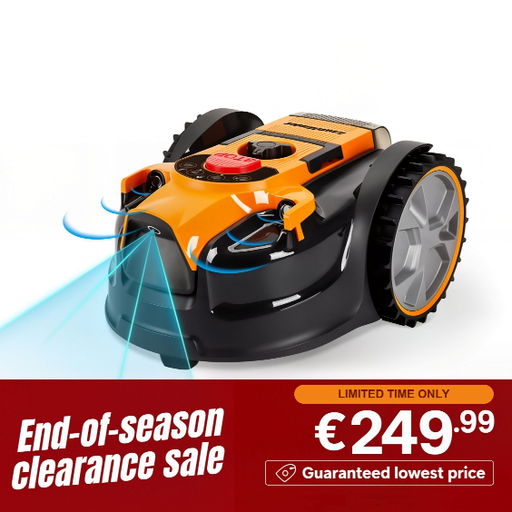
Why this suits this profile: With a stated capacity of 150 m² and cordless operation, this model targets small lawns where quick installation matters most.
Its clearly limited capacity stops you from over-specifying for a small garden. However, obstacles must still be compatible with its navigation system.
Automatic mowing, obstacle detection and stated cordless operation.
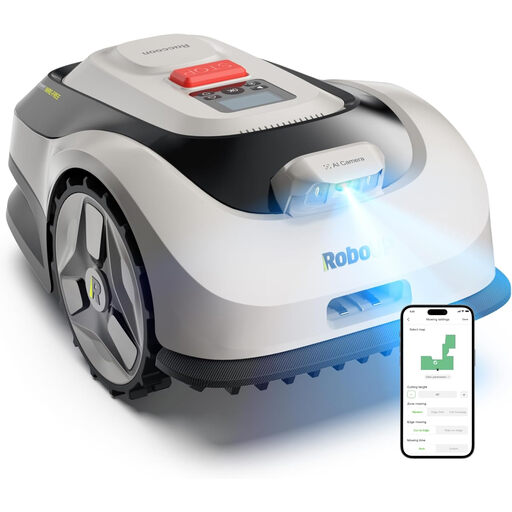
Why this suits this profile: It's designed for gardens up to 600 m², with start-up from a button, an app, management of three zones and the ability to handle slopes stated at up to 20°.
The lack of an RTK antenna and the ability to start directly from the device reduce the installation steps in a well-defined garden.
Up to 150 minutes of stated battery life, three-zone management and a noise level of 56 dB(A) according to the product sheet.
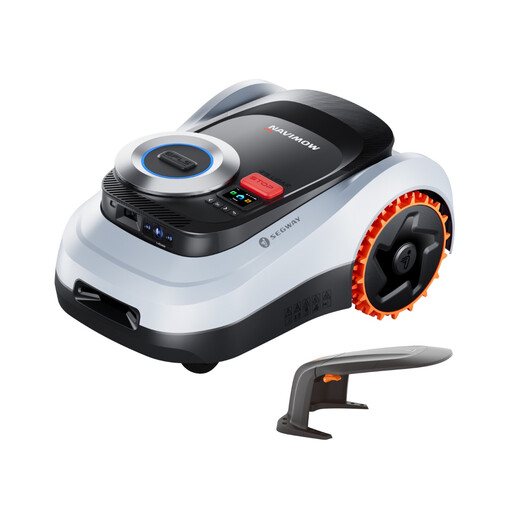
Why this suits this profile: Stated for an area of 1,500 m², this model combines LiDAR, vision, automatic mapping, voice control and management of 20 zones.
The dual perception via LiDAR and camera is presented as an alternative to satellite navigation. It's still essential to check the automatically generated map.
Stated slope capability up to 45%, control via the app or a voice assistant and stated detection of 200 types of obstacles.
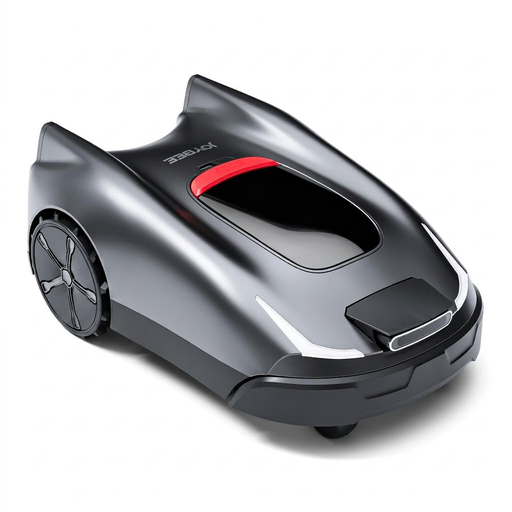
Why this suits this profile: With a stated area of 3,000 m², vision-assisted RTK navigation and multi-zone management, this model targets large estates and varied terrain.
The area, slope and cutting width are listed separately, making it easier to compare with your garden's actual characteristics.
Stated cutting width of 22 cm, slope capability up to 45% and IPX6 protection according to the product sheet.
We've put together a comprehensive, real-time updated selection of products that meet these demanding criteria and European safety standards.
Not necessarily. Some models rely on a camera or LiDAR, while RTK models may need a reference station. Check the manual and verify the reception quality in your garden before installation.
Clean the underside of the machine, the sensors and the wheels regularly, following the manufacturer's recommendations. Check the condition of the blades, remove debris and store the station or mower according to the stated protection level. An app update may also be needed.
It depends on the model and its protection level. A rain sensor may tell the mower to return to its station, but that doesn't replace the manufacturer's instructions. Avoid handling the machine when it's wet and check its usage limits before scheduling a mow.