
Livraison le jour même ou le lendemain

Qualité garantie

Débloquez vos offres de bienvenue: Livraison GRATUITE | Jusqu'à -80 % | 30 jours d'essai gratuits à JoyPlus
Téléchargez l'application
A cordless robotic lawnmower can save you a good deal of the hassle of mowing, but not every model suits every need. The actual workable area, the terrain, connectivity and the layout of your garden all directly affect the results. Take the time to look at the technical specifications – you’ll avoid paying for a feature you don’t need, or choosing a machine that’s underpowered for your lawn.
A robot advertised for 800 m² won’t necessarily suit a lawn of 800 m² that’s heavily divided, sloping or cluttered. Flowerbeds, patios, trees, narrow passages and no-go zones all reduce the area the mower can actually reach.
To keep a working margin, compare your lawn’s size with the manufacturer’s recommended area, rather than the total plot size.
A cable-free robotic lawnmower usually requires an initial mapping, a correctly positioned charging station and a sufficiently stable connection, depending on the system used. RTK navigation, in particular, may need good satellite signal reception.
Cameras or LiDAR don’t let you skip preparing the ground either: toys, branches, hoses and low-lying objects must be removed before you start the robot.
The term ‘AI’ refers to a detection or image-processing feature, but it tells you nothing about battery life, charging time, cutting width or the maximum slope it can handle. Always check the published figures: recommended area, cutting height, run time, IP rating and app compatibility.
A robotic lawnmower with RTK navigation uses corrected positioning data to organise its movements. This solution can be useful in open gardens with regular layouts, provided you have adequate signal reception.
A robotic lawnmower with an AI camera relies on vision to detect certain obstacles and distinguish different elements of the terrain. Where fitted, LiDAR measures distances around the robot to help with mapping.
These technologies aren’t interchangeable. In a garden made up of several zones, narrow passages or separate lawns, look for a multi-zone management function and check exactly how the boundaries are set up.
For a small lawn, a 300 m² capacity may be enough. Models rated for 800 m² or a 1000 m² robotic lawnmower give you more headroom for typical residential gardens. Beyond that, compare the figures quoted for 1600 m², 2500 m² or another area, taking into account how often you mow and the terrain.
Battery life should always be considered alongside charging time. A machine that returns automatically to its station can resume its schedule once recharged, but the time needed varies with the weather, the slope, the grass height and the garden layout.
A connected robotic lawnmower or a robotic lawnmower with a mobile app usually lets you schedule mowing times, check the machine’s status and adjust the work zones. Before you buy, check compatibility with Android or iOS, the type of connection required and whether updates are available.
On the safety side, choose models with lift, tilt, rain or obstacle sensors when these features are listed in the spec sheet. The IP rating shows the level of resistance to water and dust under specific conditions – it doesn’t mean you can ignore the storage and cleaning instructions.
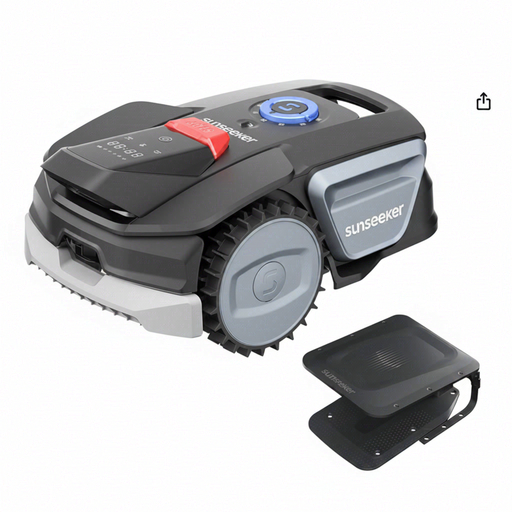
Why this model suits this profile: Its advertised capacity of 300 m² targets small gardens, while the included garage makes storing the machine simple.
The advertised area reduces the risk of overspending on a machine that’s too big for a small lawn. The cable-free navigation also avoids having to lay a boundary wire.
AI vision, intelligent obstacle avoidance, slope up to 27% and app control.
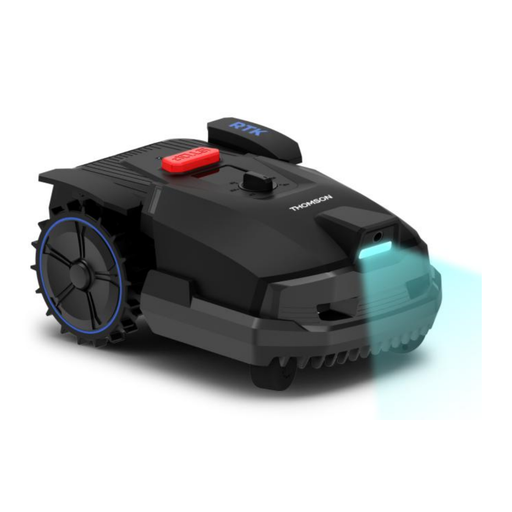
Why this model suits this profile: Designed for areas up to 800 m², it combines mobile scheduling, Wi-Fi and Bluetooth.
The spec sheet clearly states a cutting width of 180 mm, a claimed battery life of 100 minutes and a charging time of 180 minutes.
AI camera, RTK navigation, rain sensor, automatic return to station and adjustable cutting height from 20 to 70 mm.
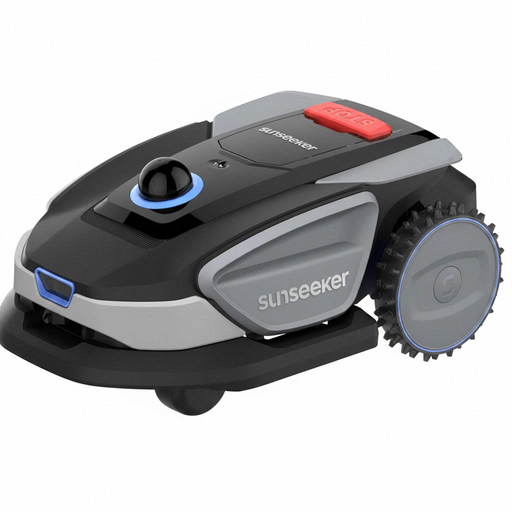
Why this model suits this profile: Its advertised capacity of 1,000 m² and its combination of 360° LiDAR and AI vision meet the expectations of users looking for more comprehensive cable-free mapping.
The spec sheet clearly mentions automatic mapping, multi-zone management and obstacle avoidance, rather than just promising connectivity.
360° LiDAR, AI camera, automatic mapping, multi-zone operation and app control.
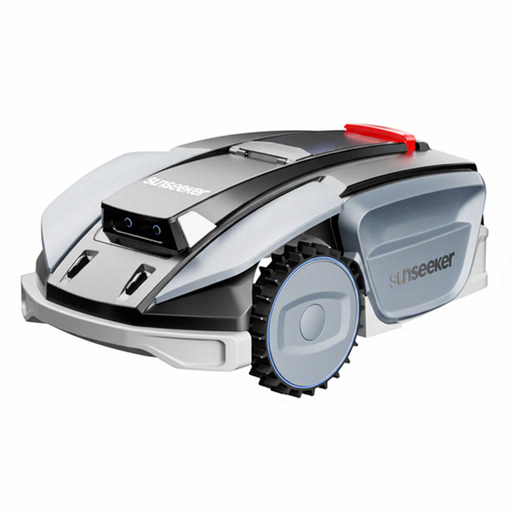
Why this model suits this profile: Its AWD system is designed for gardens up to 1,600 m² and for terrain where traction and slope handling are a priority.
The advertised all-wheel drive addresses a real need related to the terrain, rather than just stacking up connected features.
RTK navigation, AI vision, multi-zone management, automatic mapping and an advertised capacity of 1,600 m².
Before the first mow, remove any movable objects, check the edges and install the charging station on a stable surface, close to a protected power socket. If your lawn has several zones, map each area following the instructions in the app.
Clean the underside of the chassis regularly, check the condition of the blades and switch off the robot before any maintenance. In the UK, also remember to follow local rules on mowing times and noise levels, especially in built-up areas.
The main running costs are electricity, replacement blades and, depending on the model, any connection services. To estimate them, look at the charger’s power rating, how often it recharges and the price per kilowatt-hour in your area. Regular mowing can also prevent long sessions, although actual consumption varies with the terrain.
No universal lifespan can be guaranteed. It depends on the battery, weather conditions, the terrain, how well you maintain it and whether you follow the usage instructions. Store the robot and its charging station according to the manufacturer’s recommendations, avoid standing water and replace the blades as soon as they become worn.
It depends on the model. Bluetooth can be used for local setup, while Wi-Fi makes remote control and software updates easier. Before ordering, check the manual for which features work offline and whether the app is compatible with your device.