
Livraison le jour même ou le lendemain

Qualité garantie

Débloquez vos offres de bienvenue: Livraison GRATUITE | Jusqu'à -80 % | 30 jours d'essai gratuits à JoyPlus
Téléchargez l'application
Maintaining an 800 m² lawn with a traditional mower takes time, requires storage space and demands regular attention. A cordless robot mower for 800 m² can significantly ease these constraints, provided you choose navigation suited to your garden and a capacity that matches the area you can actually mow.
Marketing promises don't tell the whole story. Some "boundary-wire-free" models require a more complex network setup than expected, while others perform best in simple, open gardens. Here are the points to consider before placing your order.
A capacity of 800 m² doesn't guarantee the robot will effectively cover a plot of that size if it includes flower beds, a slope, narrow passages or several separate zones. You need to distinguish between:
If your garden is close to the stated limit, choosing a model with a bit of headroom can prevent it from returning to the charging station too often.
A robot mower without a boundary wire can rely on RTK positioning, LiDAR, a camera or a combination of these technologies. They avoid laying a wire around the garden, but often require an initial mapping, a station positioned correctly and a compatible app.
Before ordering, check how the robot defines boundaries, the quality of network or signal coverage, and whether you can modify the map once installation is complete.
Intelligent obstacle detection doesn't mean you can skip clearing the garden before starting the robot. Small toys, hoses, thin branches or objects lying in the grass can be difficult to spot depending on the light and their position. The figures quoted in product specs sometimes come from very specific test conditions – they don't guarantee the same results in every British garden.
An RTK robot mower uses a corrected satellite signal to follow a map with claimed accuracy superior to that of a random-navigation model. This technology is particularly useful on large, open areas, but trees, walls and buildings can disrupt reception.
AI vision and LiDAR provide additional environmental awareness. LiDAR measures distances, while the camera analyses visible objects. An AI vision robot mower can therefore navigate around certain obstacles more effectively, but check the manual for detection limits and the conditions in which it actually works.
Automatic mapping should let you define boundaries, passages and no-go zones from the app. If your garden includes a patio, a vegetable patch and several grassy areas, look for a genuine multi-zone management function.
Also check how many maps the robot can store, whether you can draw a zone manually, and how it reaches separate areas. A map saved in the cloud doesn't replace following the safety instructions and the manual's guidance.
The maximum slope is usually given as a percentage or in degrees. These two units are not interchangeable: 45% is roughly 24°, while 45° indicates a much steeper incline. Compare your garden's slope with the value permitted in the working area, not just the one stated for borders.
Also check the IP rating of the robot and its station, the cutting height and width, and the recommended storage conditions. In the UK, make sure the product has UKCA marking, clear safety instructions and the contact details of the responsible party established in the United Kingdom.
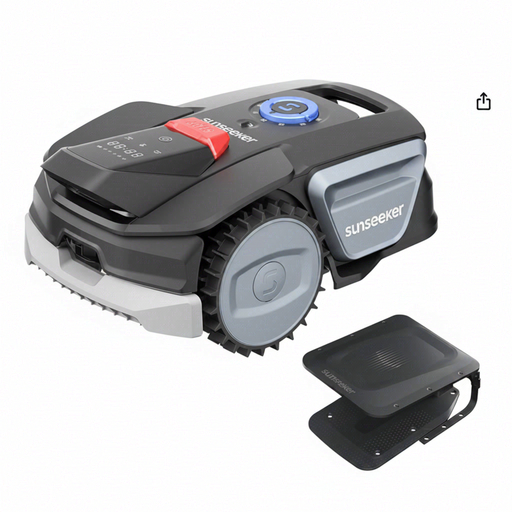
Why this choice suits this profile: advertised for 300 m², this model is better suited to a small, simple garden than an 800 m² lawn. It offers an interesting entry point for discovering autonomous mowing and app control.
Its clearly stated capacity reduces the risk of unknowingly choosing an undersized model – you shouldn't consider it a solution for 800 m².
Garage included as per the name, AI vision, boundary-wire-free delimitation and a stated slope of up to 27%.
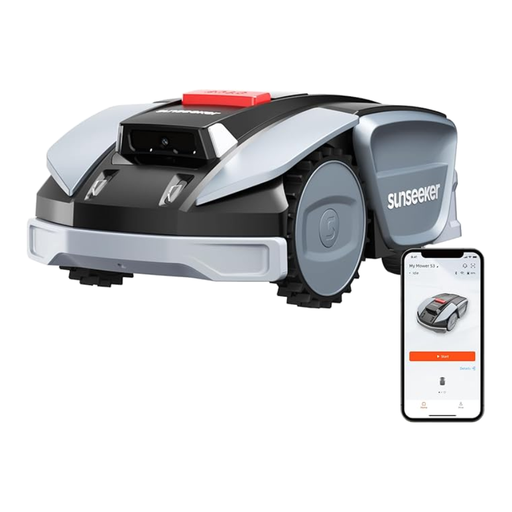
Why this choice suits this profile: its equipment covers the main requirements for this area: RTK navigation, AI vision, automatic mapping, multi-zone management and app control.
The stated coverage matches the initial requirement. You still need to check the RTK configuration, any obstacles and the specific limits of your garden.
Advertised capacity of 800 m², RTK navigation, vision-based obstacle detection and connected control.
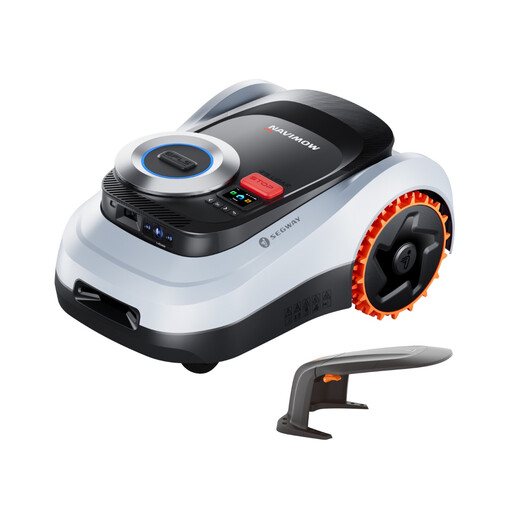
Why this choice suits this profile: its capacity provides comfortable headroom for an 800 m² garden. It targets users who want to make the most of LiDAR, vision and multi-zone management from the app.
The spec sheet advertises satellite-free navigation thanks to the combination of LiDAR and vision. However, it's still best to check this solution's compatibility with your garden's layout.
Advertised area of 1,500 m², detection of over 200 obstacles according to the spec sheet, support for 20 zones and a stated slope of up to 45%.
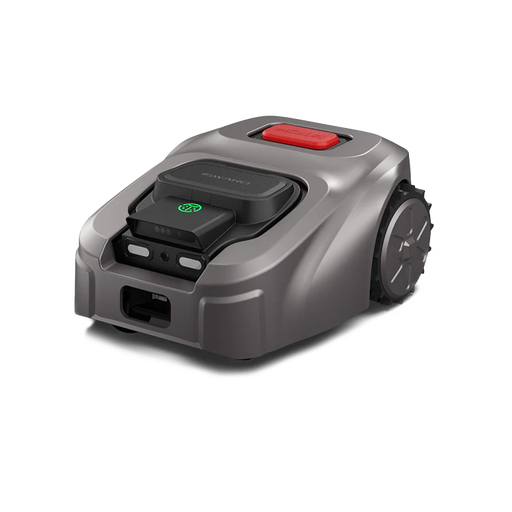
Why this choice suits this profile: its spec sheet advertises a capacity of 2,500 m² and a LiFePO4 battery. That's enough to interest owners of large plots or particularly demanding gardens.
The detailed information on area, battery life and slope allows for a more concrete comparison than a simple promise of autonomy.
Advertised recommended area of 2,500 m², typical battery life of around 160 minutes, 20 savable maps and a stated maximum slope of 57% in the working area.
We've put together a comprehensive, real-time updated selection of products that meet these demanding criteria and UK safety regulations.
Not necessarily. Boundary-wire-free models can work with RTK, LiDAR or vision. An initial mapping and setup are usually still required. How simple the installation is will depend on the shape of your garden, the presence of trees and walls, and the number of separate zones.
It varies depending on mowing frequency, winter storage, blade maintenance, battery condition and the availability of spare parts. Before buying, check the warranty period, the battery replacement terms and access to after-sales service from the UK. Clean the wheels, housing and sensors regularly following the manual's recommendations.
A single charge generally uses little electricity, but the total cost also includes blades, possible battery replacement, maintenance and, depending on the navigation system, an additional connection or antenna. Compare these expenses with the advertised coverage and the number of charges needed for your garden.