
Livraison le jour même ou le lendemain

Qualité garantie

Débloquez vos offres de bienvenue: Livraison GRATUITE | Jusqu'à -80 % | 30 jours d'essai gratuits à JoyPlus
Téléchargez l'application
Washing your car on the driveway, rinsing a muddy bike after a ride, or cleaning a patio without a power socket – all of this calls for a bit of freedom of movement. A cordless pressure washer can perfectly meet these needs, provided you don't just rely on the headline figure on the box.
Between the advertised maximum pressure, the real-world battery life, and accessories that can sometimes be impractical, there are plenty of pitfalls. A portable device can quickly turn into a disappointing purchase. Here are the criteria to examine before choosing a battery-powered pressure washer for your car, garden, or outdoor maintenance.
A value expressed in bar or PSI usually refers to a maximum pressure measured under specific conditions. It doesn't necessarily reflect the power maintained throughout the entire cleaning session.
A machine advertised at 150 bar will be most at home tackling stubborn dirt on a patio or outdoor floor. For a car, a bike, or garden furniture, a more modest model can be more than sufficient. To compare machines, also look at the flow rate in litres per hour and the type of nozzle supplied.
A portable pressure washer runs without a mains cable, but its runtime varies depending on the battery capacity, the pressure selected, and how often you pause. Be sure to check:
A product listing might state compatibility with a range of batteries without automatically including the battery itself. It's best to check this before placing your order.
A pressure washer with a tank or a self-priming function offers great freedom, but it shouldn't be fed with water containing sand or debris. According to the manufacturer's recommendations, a clean bucket, a properly filtered water butt, or a tap can all be suitable.
The length of the hose, the sturdiness of the connections, and how easy it is to prime also directly affect the user experience. A powerful machine that's a hassle to get started might end up gathering dust at the back of a cupboard.
Pressure indicates the force of the jet, while flow rate refers to the volume of water delivered. For a cordless car pressure washer, a jet that's too aggressive can damage delicate paintwork, seals, or other sensitive parts. Opt for a wide nozzle and keep a reasonable distance from the surface.
For a patio, a wall, or paving slabs, a high flow rate can speed up rinsing. Powerful corded models, such as those boasting 150 bar and 450 l/h, are better suited to large areas and stubborn dirt. The trade-off is that they require a power socket and a water connection.
An adjustable nozzle or a 5-in-1 nozzle lets you switch from a concentrated jet to a wider spray, or even a foam mode. This versatility is handy for tackling several tasks:
The most concentrated jet should be reserved for tough surfaces and used with care.
Weight, the handle, hose length, and the quick-connect system matter just as much as pressure. For occasional use, a compact pressure washer gun will often be easier to carry around. For a patio or driveway, wheels, a lance, and a sufficiently long power cable can prove more practical.
After each use, rinse the hose, drain any remaining water, clean the filter, and store the battery in a dry place at a moderate temperature. Never point the jet at a person, an animal, a power socket, or the battery.
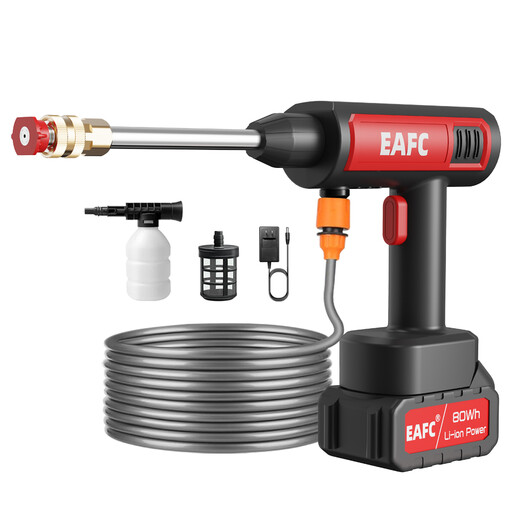
Why this model suits this profile: its cordless format and ability to draw water from a bucket or tap make it ideal for occasional car or bike washes, or light watering in places without a power socket.
The listing specifies compatible water sources and provides priming instructions for when there's no mains water flow, so you can plan the setup in advance.
Cordless lithium battery, self-priming from a bucket, and a foam bottle according to the product listing.
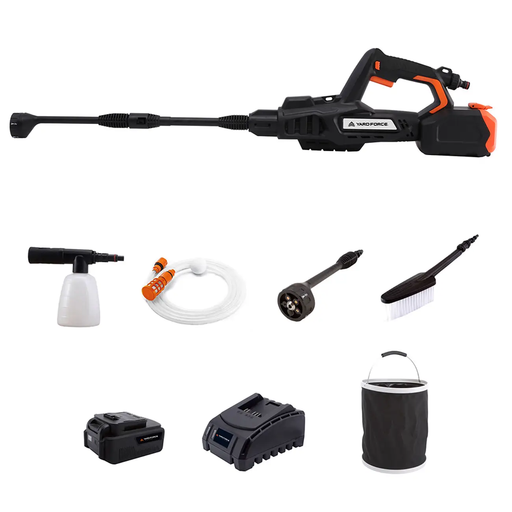
Why this model suits this profile: its portable format is ideal for car, motorbike, or bike owners who want to clean near a garage, in a garden, or on a driveway without a direct water connection.
The advertised pressure of 45 bar / 665 PSI is accompanied by a flow rate of 360 l/h and a five-mode nozzle – two figures that should be considered together.
5-in-1 nozzle, foam bottle, quick-connect hose, brush, and collapsible bucket as listed in the contents.
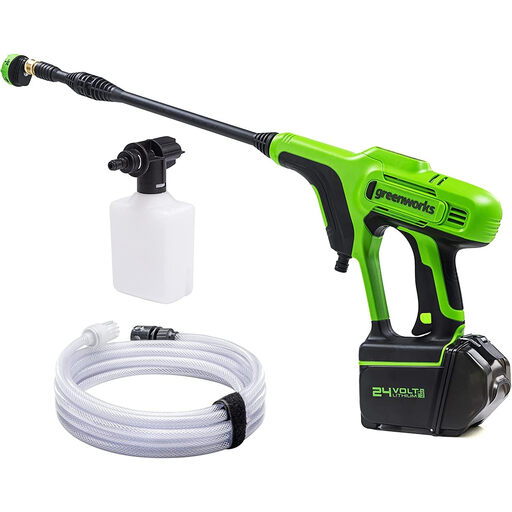
Why this model suits this profile: it's aimed at users who already own Greenworks 24 V batteries and are looking for a machine for the balcony, furniture, the barbecue, the bike, or small outdoor areas.
With its 24 bar of pressure and 180 l/h flow rate, the machine is clearly intended for routine maintenance rather than heavy-duty stripping.
5-in-1 nozzle, 6 m suction hose, foam bottle, and stated compatibility with Greenworks 24 V batteries.
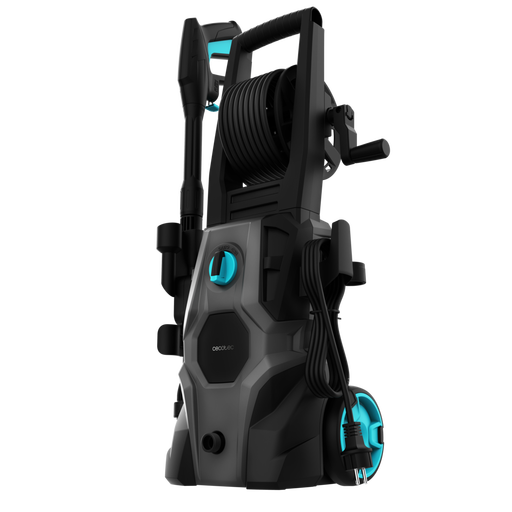
Why this model suits this profile: this corded outdoor pressure washer is for users who have access to a power socket and a tap and want to regularly maintain patios, balconies, pool surrounds, or walls.
Its listing clearly distinguishes the 2,000 W power, the maximum pressure of 150 bar, and the flow rate of 450 l/h, rather than just highlighting the pressure.
Aluminium pump, stated 9 m working radius, anti-dirt filter, adjustable soap bottle, and accessories for floors and wheel rims.
For a flat with a balcony, a portable pressure washer fed from a bucket reduces the hassle of connecting to a water supply. For a house with a patio and garden furniture, go for an adjustable nozzle, a sufficiently long hose, and an easily accessible filter. If you need to clean large areas, a corded model with a high flow rate will often be more suitable than a battery-powered one.
Cordless machines don't always replace mains-powered models. Their main advantage lies in how easy they are to transport and their ability to work away from a socket. The right choice therefore depends on the volume of work, how often you'll use it, and your access to water.
We've put together an up-to-date selection of machines suitable for car cleaning and outdoor surface maintenance in the UK.
Yes, some models have a self-priming function and a suction hose. Use clean water, position the hose correctly, and follow the priming procedure provided. If the flow rate is low, check the connections, any kinks in the hose, and the battery charge level.
A moderate pressure combined with a wide spray is generally easier to control on bodywork. Avoid holding a concentrated jet in one spot and keep a sufficient distance from the surface. Foam helps to loosen dirt, but it doesn't replace a thorough rinse.
The cost mainly depends on the electricity used for charging, the number of cycles, and any eventual battery replacement. To keep it down, charge the battery according to the manufacturer's recommendations, avoid leaving it completely discharged for long periods, and clean the filter regularly to keep the pump working properly.