
Livraison le jour même ou le lendemain

Qualité garantie

Débloquez vos offres de bienvenue: Livraison GRATUITE | Jusqu'à -80 % | 30 jours d'essai gratuits à JoyPlus
Téléchargez l'application
An underinflated tyre first thing in the morning, or a slow leak far from any service station? The cordless portable air compressor has become an indispensable companion for many drivers, motorcyclists, and cyclists. The problem: the market is saturated with models making enticing promises that often fall flat.
As a product expert at Joybuy, my mission is to help you separate the wheat from the chaff. Before you make a decision, let's review the 3 most common pitfalls to avoid.
To avoid falling into these traps, focus on the technical specifications that define the real-world performance of a battery-powered portable compressor.
Battery capacity, measured in milliampere-hours (mAh), is the crucial factor. For automotive use, aim for a capacity of at least 4000?mAh—that's the minimum required to top up all four tyres or even fully reinflate one wheel. For charging, a USB-C port is now a practical and universal standard. Finally, corded models that plug into your vehicle's 12V socket remain a reliable option for those who never want to worry about battery life.
These two values are inseparable.
A good mini air compressor should be able to do it all, or close to it.
Rather than an endless list, we've matched specific models to clear user profiles, based on the performance criteria defined above.

Why we chose it: Designed for quick and reliable top-ups on car tyres, its 4000 mAh battery and 17 L/min airflow rate provide true peace of mind, whether for long journeys or regular maintenance at home.
It tackles the anaemic airflow trap. Where many devices run out of steam, this one takes a tyre from 30 to 36 PSI in just 90 seconds. That's tangible performance that makes all the difference on the roadside.
Its "TrueGauge" screen ensures a reliable pressure reading, and the auto-shutoff feature prevents any risk of over-inflation.
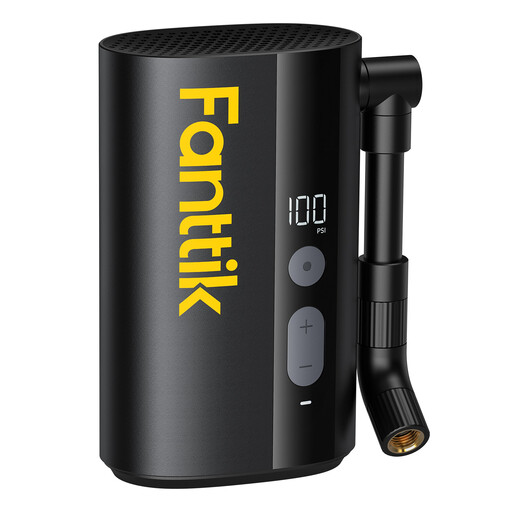
Why we chose it: Ultra-compact and feather-light, it slips into a backpack or mounts to your frame. Its secret? An integrated hose with rotating Presta and Schrader nozzles, making it incredibly practical for all types of bikes, including high-pressure road models.
It puts an end to the adapter headache. Its all-in-one rotating valve system eliminates the need for small nozzles that always get lost—a well-known nightmare for cyclists who switch between multiple bikes.
A stunningly fast inflation speed for its size (a road tyre reinflated in 32s) and a 5000 mAh battery capable of handling up to 8 inflations.
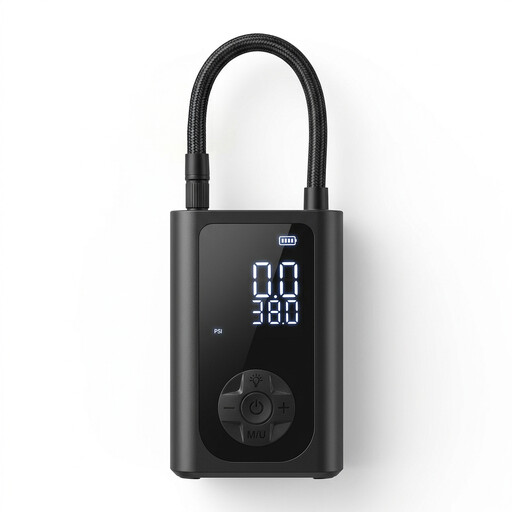
Why we chose it: With its 5 preset modes (car, motorcycle, bike, ball, custom), it's the ideal Swiss Army knife for the whole family. It effortlessly switches from topping up an SUV tyre to inflating a football or an electric bike.
It combats the overstated battery life trap. Its spec sheet is transparent and upfront: it can fully reinflate 2 empty car tyres (size 195) on a single charge. A clear promise that prevents nasty surprises.
Its power bank function via the USB port and its LED light with an SOS mode make it a true roadside survival kit.
We've put together a complete selection of products that meet our performance criteria and current safety standards.
Its longevity primarily depends on the lithium-ion battery. Generally, it's designed to withstand several hundred charge/discharge cycles. To preserve it, avoid letting it drain completely and store the device in a dry place, away from extreme temperatures (not in a car in direct sunlight or in freezing cold).
No, the recommended pressure for a passenger car tyre is between 30 and 40 PSI (2 to 2.8 bar). However, a high maximum pressure (up to 150 PSI) is often a sign of a more robust motor, capable of generating better airflow and therefore inflating your tyres faster.
For a corded model that plugs into a 12V socket, you must unplug it after use. For a cordless model, it's best to avoid storing it in the car's cabin. Extreme temperature fluctuations (heatwaves, frost) can damage the battery and drastically reduce its lifespan. The ideal solution is to store it at home and put it in your boot before a long trip.