
Livraison le jour même ou le lendemain

Qualité garantie

Débloquez vos offres de bienvenue: Livraison GRATUITE | Jusqu'à -80 % | 30 jours d'essai gratuits à JoyPlus
Téléchargez l'application
An underinflated tyre isn't just an inconvenience—it's a genuine safety risk and a drain on your fuel. To solve this problem, the cordless portable air compressor has emerged as the ideal solution, whether for regular maintenance or roadside emergencies. The problem? The market is flooded with marketing promises that often lead to purchases you'll bitterly regret.
Before you fall for a particular model, learn how to avoid the common traps that turn a useful inflator into a useless gadget after just a few months:
This guide breaks down the features that truly matter so you can make an informed and lasting choice.
To ensure you make the right choice, forget the marketing jargon and focus on a few key technical specs. These are the true measures of an electric tyre inflator's performance and durability.
Maximum pressure, displayed in PSI (Pounds per Square Inch) or bar, indicates the force the compressor can generate. While a value of 150 PSI is often highlighted, it's actually overkill for a standard car tyre, which only requires between 30 and 40 PSI (or 2 to 2.8 bar).
The metric that truly makes a difference in speed is the air flow rate, measured in litres per minute (L/min). This determines the volume of air the device can actually push into the tyre in a given amount of time.
For a cordless portable air compressor, the battery is the crucial element. Its capacity, expressed in milliampere-hours (mAh), is critical. A battery of 4000 mAh or more is a good starting point for comfortable autonomy, allowing for several inflations.
But don't rely on this number alone. Look for concrete data from the manufacturer, such as "capable of reinflating X tyres of size Y, from Z to W PSI, on a single charge." This is the only reliable indicator. The presence of a USB-C port is also a big plus, signifying fast and universal charging.
A good portable mini compressor should be simple and safe. Two functions particularly stand out:
Here is a selection of models that check all the boxes for performance and reliability, catering to different uses and budgets.
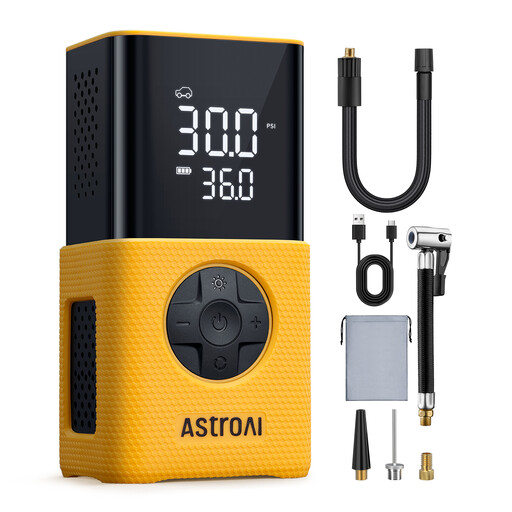
Why we love it: Perfect for regular maintenance of car, motorcycle, and bicycle tyres. Its cordless design and feather-light weight (460g) mean you can slip it into the glove box or a backpack to have it always on hand.
Its 4000 mAh battery offers real, verified autonomy (up to 8 tyres reinflated from 30 to 36 PSI), which sidesteps the pitfall of misleading battery life. Its digital display is renowned for its accuracy, preventing any nasty surprises.
Its great versatility, with 5 preset modes (car, motorcycle, bicycle, ball, custom), and its power bank function via its USB port to charge a dead smartphone.
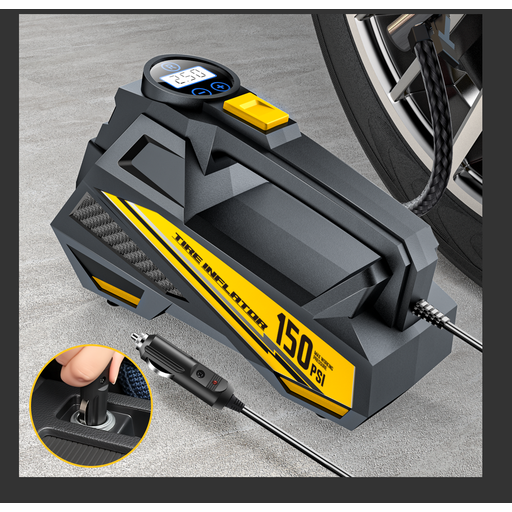
Why we love it: This is the quintessential simple and effective tool to keep in your boot for any emergency. No battery to charge: as long as the car starts, it's ready to go.
It completely dodges the battery trap. Plugged directly into the 12V cigarette lighter socket, it delivers constant, reliable power without ever depending on an internal battery that could fail you.
Rock-solid reliability and simplicity. Its 12V motor ensures pressure up to 150 PSI, more than enough for most vehicles. An economical and hassle-free solution to drive with peace of mind.
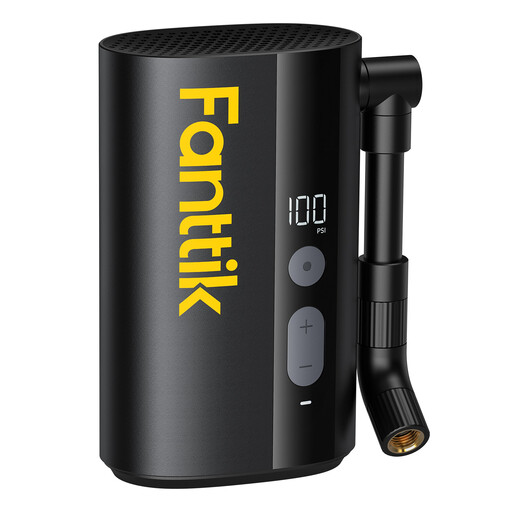
Why we love it: Tailor-made for bicycle tyres (road, MTB, e-bike) that demand high pressure and lightning-fast inflation. Its ultra-compact size and all-in-one design make it the perfect companion for all your rides.
It shatters the slow-inflation trap with a 10 L/min flow rate and a high-performance motor, capable of reinflating a road bike tyre in just 32 seconds. Its 5000 mAh battery and cooling system allow for up to 25 minutes of continuous use.
Its all-in-one design integrates the hose and Presta/Schrader valve adapters for maximum portability. The automatic shut-off function ensures safe inflation by stopping the device right at the desired pressure.
Discover our complete and up-to-date selection of products that meet our demanding selection criteria and current safety standards.
Its longevity primarily depends on the quality of its battery and construction. To care for the battery, avoid letting it fully discharge and remember to recharge it at least once every 3 months, even when not in use. Storing it in a dry place, away from extreme temperatures (both hot and cold), will also help extend its lifespan.
For a corded model (12V socket), only use it when the engine is running to avoid draining the car's battery, and always unplug it after use. As for cordless models, it's not recommended to leave them constantly charging in the cabin: extreme temperature fluctuations are the sworn enemy of lithium-ion batteries.
No, it's more of a marketing gimmick than a real necessity. Most car tyres require a pressure between 30 and 40 PSI. However, a high maximum capacity can be an indicator: it suggests the motor is robust enough to reach and maintain lower pressures efficiently. Think of it as reserve power, but don't forget that the air flow rate (L/min) remains the number one criterion for judging inflation speed.