
Livraison le jour même ou le lendemain

Qualité garantie

Débloquez vos offres de bienvenue: Livraison GRATUITE | Jusqu'à -80 % | 30 jours d'essai gratuits à JoyPlus
Téléchargez l'application
A cordless pool robot can make pool maintenance easier, but not all models are in the same league. Some only tackle the surface, while others clean the floor, walls and waterline. Before getting your bank card out, it is therefore worth looking beyond claims about battery life and built-in intelligence.
A pool skimmer robot moves across the surface to collect leaves, insects, pollen and other floating debris. It does not necessarily replace a cleaning robot capable of climbing walls or scrubbing the waterline.
To find out what the device actually covers, check the areas it is designed to clean:
A claim such as “24 hours a day” may simply refer to a recurring maintenance programme. It does not necessarily mean that the battery allows uninterrupted operation. With a solar pool robot, usage time depends in particular on sunlight, the season, panel orientation and the amount of debris to be collected.
Also check whether the device can be recharged using a mains adapter. This option can prove invaluable on overcast days or in regions with limited sunshine.
A very fine filter captures more dust, but it also becomes clogged more quickly. A basket that is easy to remove and rinse with water prevents every cleaning session from becoming a chore. Check the stated filtration fineness in microns, the availability of replacement filters and whether an anti-return system is included.
The promise of a pool robot for the floor, walls and waterline describes a device designed to clean several surfaces. However, this should be confirmed in the technical specifications. Sensors, tracks and route management play a key role in preventing areas from being missed.
Models equipped with an app may offer remote start, scheduling, session tracking and alerts in the event of a blockage. However, an app does not guarantee that all functions will be available on your phone or in every configuration. Check Wi-Fi or Bluetooth compatibility, as well as the terms of use.
For a pool that is used regularly, compare the following:
Solar charging reduces the need for cables, but it cannot eliminate the uncertainties of the weather. For occasional and more intensive cleaning, conventional charging or a corded solution may still be particularly convenient.
An ultra-fine pool filter rated at 3 µm is designed to capture very fine particles. By contrast, a 150 or 180 µm filter is better suited to visible debris and larger particles of dust. These figures alone are not enough to assess the robot’s overall quality: above all, they indicate the stated filtration fineness.
After each cycle, rinse the basket or cartridge in accordance with the manufacturer’s instructions. Do not use any chemical product unless it is specifically intended for this purpose, and follow the guidance relating to the battery, moving parts and use in water.
The recommendations below are based on the functions listed in the product specifications. Performance may vary depending on the shape of the pool, water temperature, amount of debris and condition of the surfaces.
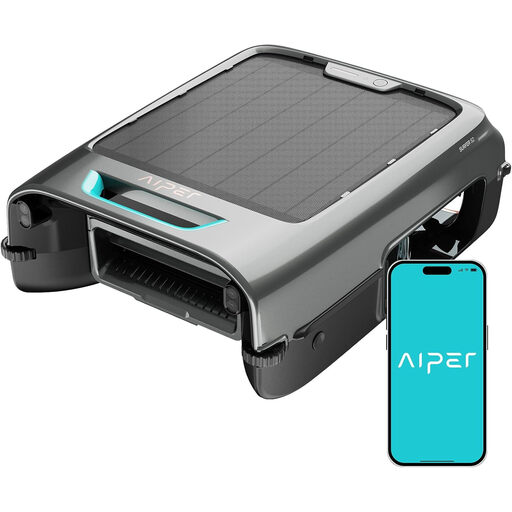
Why this choice suits this profile : This skimmer robot focuses on the surface. It is ideal for anyone looking to start automating the collection of leaves and floating particles.
The product details clearly state that this is a surface cleaner. You therefore cannot mistake it for a device designed to clean walls and the floor.
Stated solar charging, battery life of up to 35 hours according to the product details, 150 µm filter, Wi-Fi/Bluetooth app and removable basket.
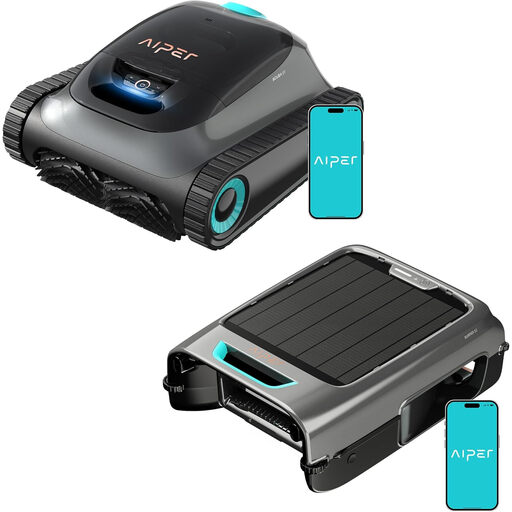
Why this choice suits this profile : This pack combines a pool robot with a surface robot. It covers several areas without expecting a single device to do everything.
The stated functions distinguish between cleaning the floor, walls, waterline and surface. The pack therefore does not present a simple skimmer as an all-purpose solution.
The product details mention a 3 µm ultra-fine filter, a standard 180 µm filter, five modes, an app and stated battery life of up to 240–270 minutes in Eco mode.
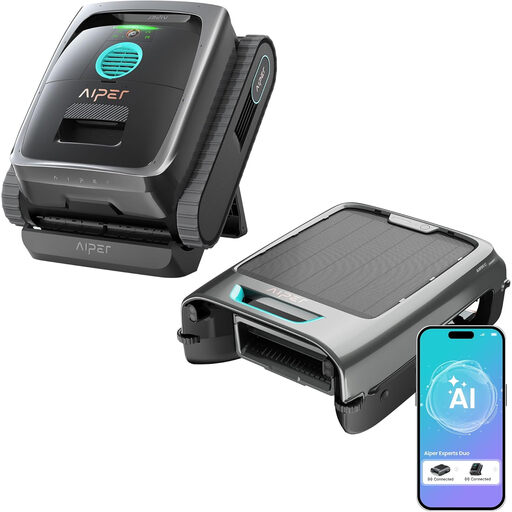
Why this choice suits this profile : This duo is aimed at owners who want to schedule surface and pool maintenance while also benefiting from remote controls and notifications.
The product details explain the role of each device and their filtration systems. This allows you to check that you really need complete coverage, from the surface to the floor.
App with notifications, stated continuous surface cleaning, 180 and 3 µm filters for the Scuba V3, and a 150 µm basket for the EcoSurfer S2.
We have brought together a complete, real-time updated selection of products that meet these demanding criteria, as well as European safety regulations.
It depends on the model and its programming mode. An automatic cleaning function can run several cycles in succession, but you must follow the manufacturer’s instructions, monitor how full the basket is and remove the device from the water when recommended in the manual. With a solar model, the “24 hours a day” claim also depends on the available light.
The main costs are the electricity needed for charging, replacement filters and any wear parts. A solar-powered device can reduce reliance on mains electricity, but it does not eliminate maintenance. Pay particular attention to the stated battery lifespan, the availability of consumables and the length of the warranty.
No. An app makes programming and monitoring easier, while a system described as artificial intelligence may assist with navigation or obstacle detection. These functions do not remove the need to check actual cleaning coverage, filtration fineness and compatibility with your pool. To make the right choice, start by considering your pool’s dimensions, shape and level of dirt.