
Livraison le jour même ou le lendemain

Qualité garantie

Débloquez vos offres de bienvenue: Livraison GRATUITE | Jusqu'à -80 % | 30 jours d'essai gratuits à JoyPlus
Téléchargez l'application
When changing a wheel, tackling a seized nut or working on a commercial vehicle, a high-power cordless impact wrench gives you welcome freedom compared to a corded or pneumatic model. But you need to know how to read between the lines of a spec sheet: the numbers printed on the box don't always tell the full story.
Torque expressed in newton-metres, 'long-life' batteries or brushless motors can mean very different things in practice. Here are the criteria to examine before you buy, along with a selection suited to different needs.
A model might display 1,000 Nm of breakaway torque while offering a lower tightening torque. These two values correspond to different operations. Breakaway often requires significant power, especially with a rusted or stuck nut. Tightening, on the other hand, needs to be controlled to avoid damaging the thread or the wheel rim.
For car wheels, always finish tightening with a torque wrench set to the manufacturer's specifications. An impact wrench for wheel nuts makes removal and initial fitting easier, but it doesn't replace that control tool.
A 21V impact wrench isn't necessarily more powerful than an 18V or 20V model. The motor's efficiency, the battery's capacity in Ah, the protection electronics and the hammer mechanism all affect the runtime and the power actually available.
Check in particular:
A second battery can prove far more useful than a high voltage highlighted on the spec sheet.
The 1/2-inch square drive is generally suitable for common automotive work and wheel nuts. The more compact 3/8-inch size squeezes into tight spaces more easily, but it's intended for lower torque applications.
Also look at the sockets supplied. Sizes 17, 19, 21, 22 or 24 mm cover many jobs, but make sure they match the nuts on your vehicle. For heavy use, choose sockets specifically designed for impact tools rather than standard sockets.
A 1,000 Nm impact wrench is aimed at demanding tasks: lorry wheels, metal structures, machinery or particularly stubborn nuts. For routine car maintenance, a more moderate torque often gives you better control, with a lighter, more manoeuvrable tool.
The different speed settings let you adapt the tool's behaviour to the task. A lower speed is suitable for starting a nut or working on a delicate fixing, while a higher speed speeds up removal. Also consider the number of impacts per minute, which affects how quickly the blows are delivered.
A brushless impact wrench has fewer wearing parts than a traditional motor. It may therefore require less maintenance, but this technology alone doesn't guarantee exceptional longevity. The quality of the hammer mechanism, the cooling system and the battery storage conditions all matter just as much.
In a garage, on a building site or for regular maintenance work, a 4.0 Ah battery paired with a fast charger minimises interruptions. For occasional use, a more compact kit will often be easier to transport and store.
Before you head to the checkout, check for a clear instruction manual, manufacturer information, contact details for a responsible party established in the European Union, and CE marking where applicable. Wear safety glasses, use suitable gloves and fit the tool with sockets compatible with impact wrenches.
Remove the battery before changing a socket or cleaning the tool. After initial tightening, check the torque with a torque wrench whenever the application requires it.
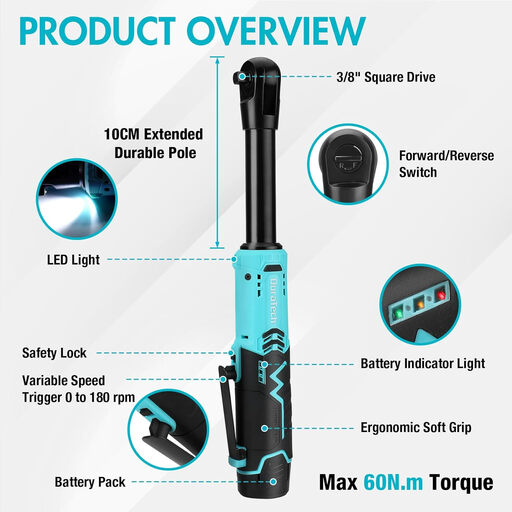
Why this choice suits this profile: Its compact format lends itself to occasional car work, assembling equipment and reaching awkward spots.
The spec states a maximum torque of 65 N·m. So don't confuse it with an impact wrench designed to tackle badly seized nuts. Its 3/8-inch format clearly targets tight spaces.
Two 2.0 Ah batteries, variable speed up to 180 rpm, LED light, charge indicator and carry case included.
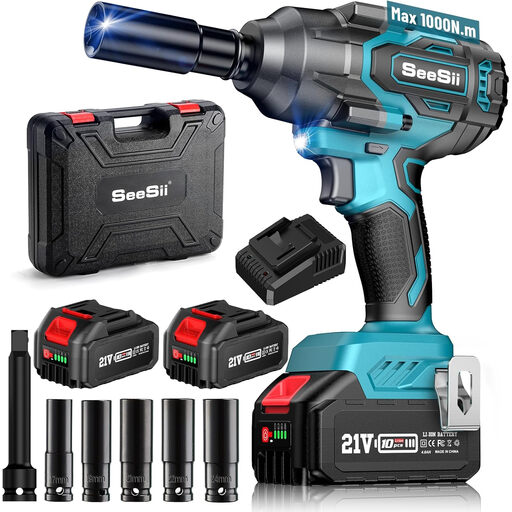
Why this choice suits this profile: This 21V kit targets demanding fastening work, from lorry repairs to jobs on site or in the workshop.
The breakaway and tightening torques are clearly distinguished: 1,000 Nm breakaway and 800 Nm tightening, according to the product spec. The three speed settings also let you avoid working at full power all the time.
Two 21V 4.0 Ah batteries, claimed charge to 80% in 30 minutes, 1/2-inch square drive, five sockets and an extension bar included.
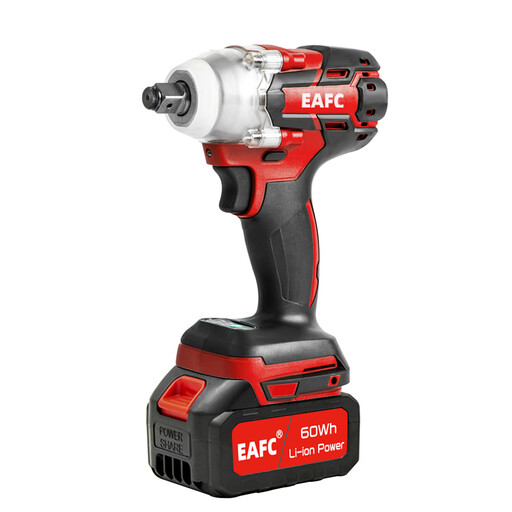
Why this choice suits this profile: Its intermediate power and rechargeable power source make it a tool suited to car maintenance, wheel removal and mobile jobs.
The spec states the battery capacity, 60 Wh, along with progressive speed adjustment, multiple protections against charging incidents and an integrated light.
Stated torque of 200 N·m, brushless motor, rubberised grip handle, USB charging cable and battery included.
We've put together a comprehensive, real-time updated selection of products that meet these demanding criteria, while taking European safety regulations into account.
Yes, provided its torque, drive size and sockets are suited to the vehicle. It's mainly used to loosen nuts and run them on quickly. The final tightening must always be done with a torque wrench, following the values specified by the manufacturer.
It all depends on the torque demanded, the frequency of impacts, the capacity in Ah, the temperature and the battery's condition. Two batteries let you alternate between use and charging. For regular use, it's better to check the availability of extra batteries and their charging time rather than relying on a single stated runtime.
The 12V electric ratchet is more compact and practical in an engine bay or for moderately tight fixings. A 21V impact wrench generally offers more torque for wheel nuts, heavy assemblies and maintaining larger vehicles. The choice therefore depends mainly on the workspace and the force needed, not just the voltage displayed.