
Same-day & Next-day Delivery

Quality Guaranteed

Unlock Your Welcome Offers: FREE Delivery | Up to 80% OFF | Free 30-day JoyPlus trial
Download the APP
Choosing a cordless impact wrench can quickly become a headache. Between spec sheets promising astronomical torque figures and kits overflowing with accessories, the risk of making a poor investment is very real. As a product expert at Joybuy, my mission is to help you see things more clearly. This guide gets straight to the point, focusing on the essential criteria for finding the right tool for your actual needs, whether you're a passionate mechanic or a seasoned DIYer.
Marketers love to highlight eye-catching features that, in practice, often prove disappointing. Here are the three most common mistakes when buying an impact wrench.
To choose a powerful impact wrench that won't let you down, here are the three technical aspects to scrutinise closely.
Torque is the rotational force that the tool can apply. Be careful not to confuse the two key values:
A brushless impact wrench is a guarantee of longevity and performance. Unlike conventional brushed motors, brushless motors have no friction parts. The benefits are numerous:
The endurance of your impact wrench depends on two indicators:
Also, consider whether the kit includes one or two batteries and a fast charger: these are essential assets for working without interruption.
Rather than looking for a one-size-fits-all model, it's better to choose a tool that matches your usage profile. Here are our recommendations for 2026, tailored for specific needs.
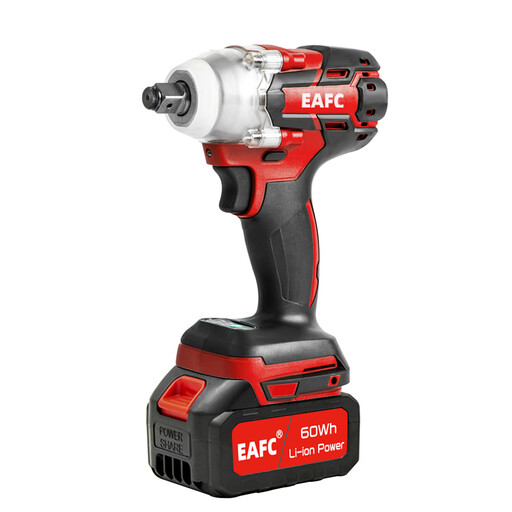
Why this model? Ideal for routine car maintenance, like seasonal tyre changes or minor mechanical repairs. Its 200 Nm of torque is well-balanced for tightening wheel nuts without risking damage, while being more than sufficient for most common fastening tasks.
This model advertises a realistic working torque, perfectly calibrated for its intended use. Delivered as a complete kit (battery and charger), it's ready to use out of the box without tying you to a closed ecosystem.
Brushless motor for better durability and optimised runtime. The auto-stop system and variable speed provide precise control to prevent over-tightening.
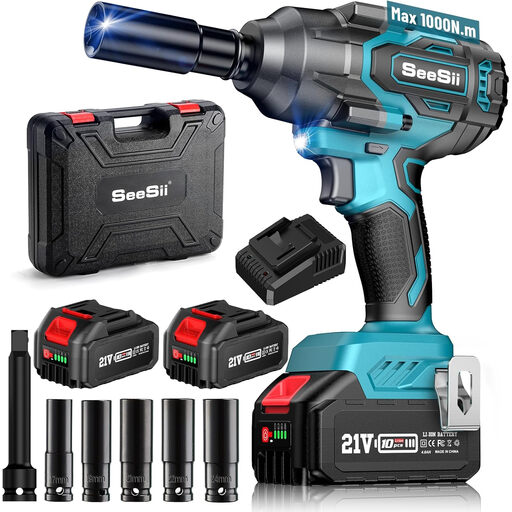
Why this model? Built for heavy-duty tasks. With 1000 Nm of breakaway torque and 800 Nm of fastening torque, it tackles the most stubborn truck bolts, structural framework, or suspension nuts.
This kit provides clear information on both fastening and breakaway torque. It includes two 4.0 Ah batteries and a fast charger, allowing you to work through jobs without interruption or extra cost.
The complete kit with a case, 5 sockets, and an extension lets you get to work right away. Its 3 adjustable speeds offer great versatility, switching from delicate tasks to high-power operations with surprising ease.
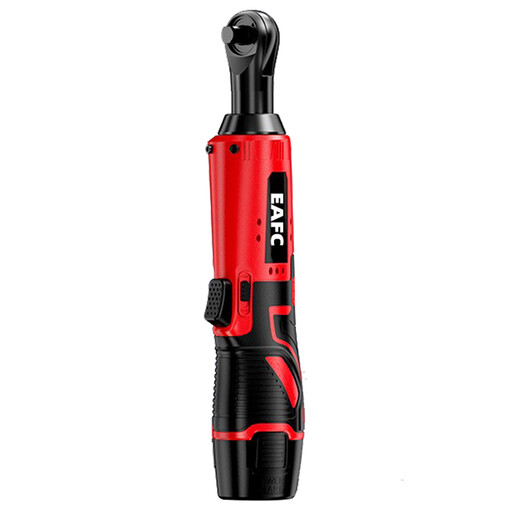
Why this model? Note: this is not an impact wrench, but an electric ratchet. It's perfect for mechanics working in cramped areas (engine bays, under a vehicle) where a conventional impact wrench is too bulky. Its 45 Nm of torque is designed to speed up fastening/unfastening, not for breaking bolts loose.
This tool doesn't pretend to be something it's not. Its positioning is clear: precision and finishing work. There's no confusing it with high-power impact wrenches.
Its ultra-slim 3 cm head fits anywhere. Its feather-light weight (0.78 kg) and variable-speed trigger ensure comfortable and precise work, even in the most inaccessible corners.
The lifespan of a lithium-ion battery is measured in charge cycles (typically between 500 and 1000). In practice, with regular use, a good quality battery can last 3 to 5 years. To extend its life, avoid complete discharges and store it in a cool, dry place, away from moisture.
No, an impact wrench is a high-torque tool designed for large-diameter bolts and nuts. Using it on small screws or fragile materials (plastic, thin aluminium) risks damaging them or stripping the threads. For precision work, an electric ratchet or a standard drill/driver is much more suitable.
Not necessarily. Excessive torque can be dangerous and counterproductive. For tightening car wheels, for example, it's crucial to respect the manufacturer's recommended torque (usually between 110 and 140 Nm). Overtightening can warp the rims or make the next removal a nightmare. Pro tip: always finish tightening with a torque wrench to ensure accuracy and safety.