
Livraison le jour même ou le lendemain

Qualité garantie

Débloquez vos offres de bienvenue: Livraison GRATUITE | Jusqu'à -80 % | 30 jours d'essai gratuits à JoyPlus
Téléchargez l'application
A cordless handheld vacuum cleaner is ideal for everyday quick clean-ups: crumbs on the table, dust in seat rails, pet hair on the sofa or debris around the keyboard. The problem is that product specifications can sometimes list figures that are difficult to compare. High suction power does not necessarily guarantee an appliance that is pleasant to use day after day.
Before buying, it is worth checking the actual battery life, filtration system, dust container capacity and supplied accessories. Here are the key criteria to consider, followed by a selection of models suited to different needs.
Figures expressed in Pa or kPa refer to advertised suction pressure. However, they are not enough to predict performance on carpet, car seats or pet hair. An appliance that looks very powerful on paper can lose effectiveness if its filter becomes clogged quickly or if the nozzle is not suited to the surface.
When assessing a model, consider all of the following:
A rechargeable vacuum cleaner may be perfectly suitable for cleaning a car or a few surfaces without being up to the demands of a long cleaning session. Depending on the selected mode, some models run for around 15 to 30 minutes, while recharging can take several hours.
For regular use, check whether the battery is removable, whether a charging station is included and whether the cable uses a convenient format such as USB-C. A high-capacity battery can make the appliance heavier, however, so the key is to find the right balance between endurance and manoeuvrability.
A vacuum cleaner with a HEPA filter or a dual-filtration system can capture some fine dust, depending on its design and the specifications provided by the manufacturer. This is neither a medical guarantee nor a promise regarding indoor air quality.
The important thing is for the filter to remain easy to access, to be washable where specified by the manufacturer and to be completely dry before being put back in place. If it is poorly maintained, it can reduce airflow and make the motor work harder.
For crumbs and light dust, the eco mode is generally sufficient. Car seats, rugs and pet hair, on the other hand, call for a second power level. A capacity of 150 to 500 ml is suitable for most quick clean-ups; a larger container simply means you will not have to empty it as often.
Models advertised at 15,000 Pa, 18,000 Pa or more can tackle embedded debris, provided you use the right nozzle. The phrase “15,000 Pa car vacuum cleaner” should therefore be viewed as a point of comparison, rather than a sufficient criterion on its own.
A long crevice nozzle makes it easier to reach the narrow spaces between seats. A soft brush is better suited to furniture, keyboards and delicate surfaces. With an extension tube or floor brush, some models can even be transformed into a 2-in-1 vacuum cleaner for small areas.
Some appliances also include a blower function to dislodge dust from air vents, grooves or keyboards. It does not replace vacuuming: the debris must then be collected, particularly inside a car.
A bagless dust container reduces the need for consumables, but it must be emptied regularly. Washable filters can reduce the need for replacements, provided you follow the manufacturer’s instructions and allow them to dry completely.
Advertised noise levels, generally ranging from 62 to 85 dB according to product specifications, provide an initial basis for comparison. In a flat or office, noise deserves just as much attention as suction power.
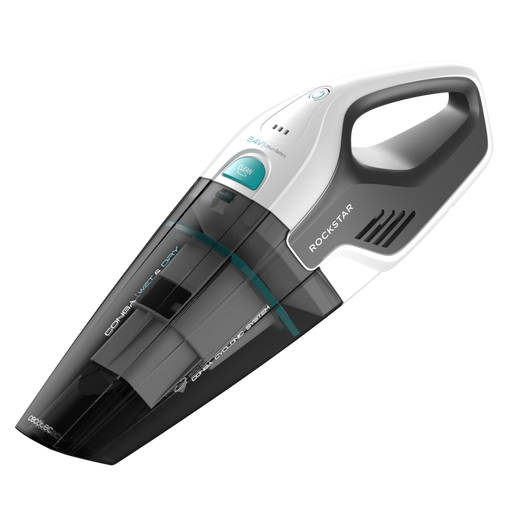
Why this choice suits this profile: Its compact design is ideal for students, smaller homes and everyday cleaning around the home or in the car.
The specifications state up to 20 minutes of battery life, a 500 ml container and a high-efficiency filter. These are concrete details that make it easier to understand what the appliance is designed for.
Bagless cyclonic technology, suitable for vacuuming solids and liquids according to the specifications, accessories for furniture and awkward corners, and an advertised noise level below 62 dB.
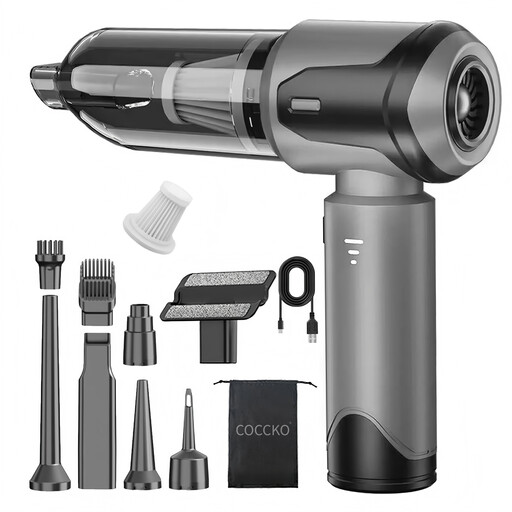
Why this choice suits this profile: Its rechargeable design and three power levels are ideal for anyone looking for a versatile appliance for the car, office and home.
The specifications distinguish between three suction levels and mention a 6,000 mAh battery that can be recharged via USB-C. This means you can reserve maximum power for dirt that genuinely requires it.
Advertised suction power of up to 15,000 Pa, washable dual HEPA filter, vacuuming, blowing, inflating and deflating functions, LED light and several nozzles.
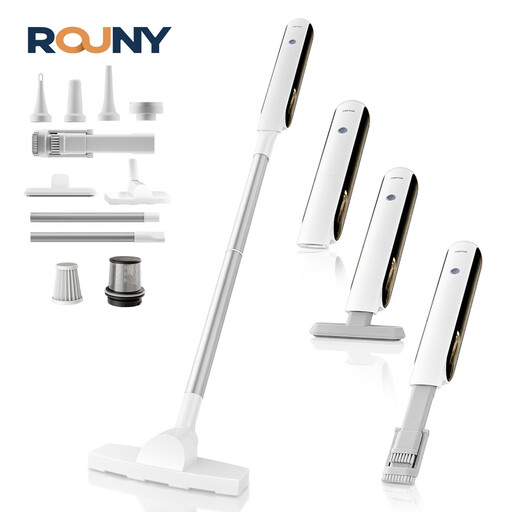
Why this choice suits this profile: It is aimed at people who regularly clean a car, office, student bedroom or small floor areas.
The two modes let you prioritise either battery life or power. However, the washable HEPA filter and metal mesh require regular maintenance.
Advertised suction power of up to 18 kPa, 15 minutes of battery life in high-power mode or 30 minutes in low-power mode, seven nozzles, extension tube, floor brush and blower function.
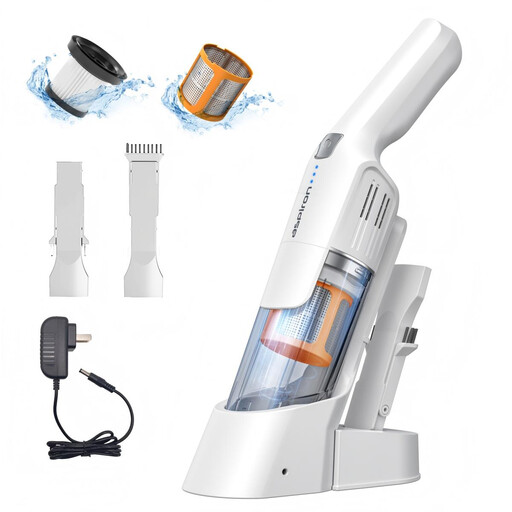
Why this choice suits this profile: Its 500 ml container and two modes are suitable for crumbs, pet hair and everyday dirt on sofas or car seats.
The specifications provide a reduced-power mode and a boosted mode, with an advertised battery life of 13 to 25 minutes. This lets you adjust the power to suit the area being cleaned.
500 ml container, washable two-layer filter, charging station, two nozzles and an advertised noise level below 70 dB.
We have put together a complete, real-time updated list of products that meet these demanding selection criteria and European safety regulations.
To maintain consistent performance, empty the container after short cleaning sessions and remove any hair or pet fur caught in the nozzles. A washable filter should be rinsed according to the instructions, then dried completely before being put back in place.
Running costs mainly depend on three factors:
In the long term, a model with filters that are easy to source may prove more convenient. For replacement filters, particularly those compatible with certain Eureka or BISSELL appliances, always check the vacuum cleaner’s exact reference.
It is suitable for targeted cleaning, stairs, furniture, car seats and small areas. Its container and battery life are generally more limited than those of a cylinder or upright vacuum cleaner designed to clean an entire home.
The time depends on the battery and charger used. The specifications for some models state a charging time of around 2 to 4.5 hours for a battery life of between 15 and 30 minutes. Check the instructions before first use.
Only if the manufacturer clearly states that the appliance is designed for wet and dry vacuuming. Several models are intended exclusively for dry dust. Never vacuum up liquid, hot ash or flammable substances unless the manufacturer explicitly confirms that it is safe to do so.