
Livraison le jour même ou le lendemain

Qualité garantie

Débloquez vos offres de bienvenue: Livraison GRATUITE | Jusqu'à -80 % | 30 jours d'essai gratuits à JoyPlus
Téléchargez l'application
Repainting a piece of furniture, a fence or a wall sounds simple… until paint starts splattering, the nozzle clogs or the battery runs flat. A cordless electric paint sprayer gives you genuine freedom of movement, particularly in a garage, garden or room without a nearby power outlet. The key is choosing a device suited to your project.
This selection from the Joybuy Product Recommendation Officer focuses on the factors that really matter before you buy: power source, tank capacity, nozzles, spray patterns and maintenance. The goal? To help you distinguish a genuine HVLP paint sprayer from a model marketed as versatile but likely to show its limitations quickly.
Going cordless makes it easier to move around, but runtime depends on several factors: battery capacity, paint viscosity and the selected flow rate. A battery advertised as compatible with a cordless tool does not, by itself, guarantee long operating time.
Start by checking whether the battery and charger are included. For a major project, a second battery can save you from having to stop work. For a few touch-ups or a small piece of furniture, a compact, lightweight device will often be more comfortable to use than a more powerful model that is also heavier and bulkier.
Thick wall paint, stain and varnish cannot all be sprayed in the same way. If the device is not designed for the product’s viscosity, the spray may become uneven, cause splattering or quickly clog the nozzle.
The TILSWALL Shark, for example, specifies compatibility with products up to 120 DIN-S. This figure should be compared with the information on the paint tin. Thinning may be necessary, but it should always be carried out in accordance with the coating manufacturer’s recommendations.
Post-use maintenance is often the weak point of electric sprayers. Paint residue dries inside the nozzle, passageway or seals. If disassembly is laborious, every subsequent use can quickly become a chore.
Whenever possible, choose a model supplied with a cleaning brush, needle or replacement seals. After each session, rinse the parts that are compatible with water, or use the product recommended for solvent-based paints. The motor unit and battery must never be immersed.
A cordless paint sprayer may run on a proprietary battery or on a battery platform you already use in your workshop. If you are looking for a Makita 18 V-compatible paint sprayer, carefully check the accepted battery series.
The Gisam model featured below states that it is compatible with several Makita 18 V B-series batteries, including the BL1850B, BL1840B and BL1830B. However, it excludes certain G-series batteries as well as 18 V Ni-Cd models. This distinction matters: a battery marked simply “18 V” is not necessarily mechanically or electrically compatible.
A 1,000 to 1,300 ml tank is suitable for medium-sized surfaces, but its weight increases noticeably when full. When painting a ceiling or fence, a heavy device can quickly strain your wrist.
The stated flow rate should also be interpreted with care: it varies according to the paint used, the fitted nozzle and the selected setting. Precise flow control helps limit runs along edges and adjust the amount of product applied, whether you are using furniture paint, painting a wall or coating an outdoor surface.
The three most common spray patterns are horizontal, vertical and circular. A horizontal spray is suitable for vertical strips, while a vertical spray complements left-to-right movements. The circular pattern is useful for details and small areas.
Nozzle diameter also plays an important role. A fine nozzle is generally better suited to finishing work and low-viscosity liquids. A wider nozzle allows you to cover a fence or large surface more quickly, but increases the risk of overspray if the flow rate is poorly adjusted.
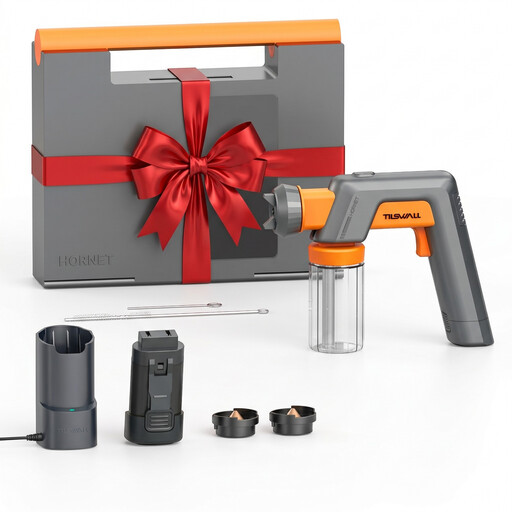
Why this model may suit you: weighing a stated 450 g, it is designed for touch-ups, small pieces of furniture and occasional jobs in an apartment or home.
Its lightweight design helps reduce fatigue. Even so, check the exact contents of the package, particularly whether the two advertised batteries and two nozzle sizes are included.
Stated weight of 450 g, three spray modes and two nozzle sizes according to the product listing.
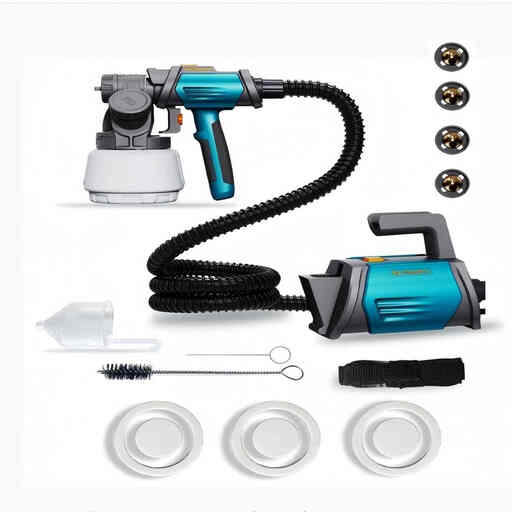
Why this model may suit you: this corded electric sprayer is designed for walls, ceilings, fences and furniture when continuous power matters more than mobility.
Its viscosity guidance and cleaning accessories make paint preparation easier and help reduce the risk of clogging. However, regular maintenance remains essential.
Stated power of 800 W, 1,300 ml tank, four brass nozzles and three spray patterns.
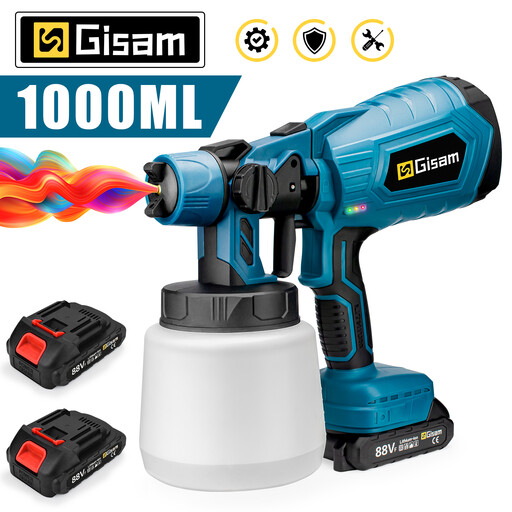
Why this model may suit you: it can be a practical addition to a workshop equipped with certain Makita 18 V B-series batteries, provided you verify the exact reference.
The product listing distinguishes compatible batteries from the excluded G-series and Ni-Cd ranges. A quick check is therefore enough to avoid buying a tool you cannot use.
1,000 ml tank, three spray modes, 1.8 mm nozzle and adjustable flow control, according to the listing.
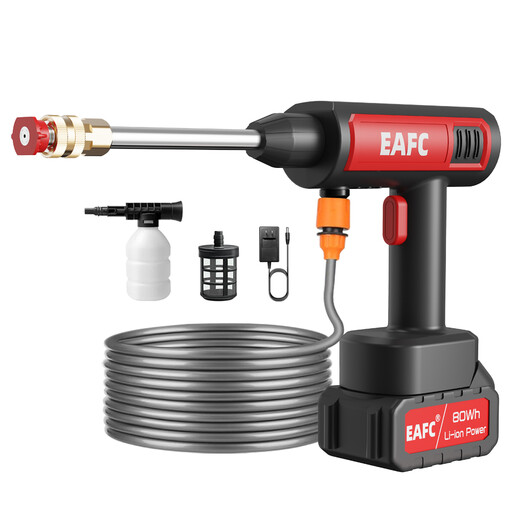
Why this model may suit you: this portable device is intended for car washing, outdoor cleaning and watering when access to a tap or power outlet is limited.
The listing mentions drawing water from a bucket, self-priming or connecting to a tap. However, this is not a paint sprayer for coatings.
Cordless operation, bucket-based water intake and an adjustable nozzle advertised for cars, floors, bathrooms and watering.
Browse our updated selection to compare features, accessories and intended uses before placing your order.
Before filling the tank, filter the paint if the instructions recommend it and carry out an initial test on a piece of cardboard. Then adjust the flow rate and spray pattern. Maintain a consistent distance from the surface and move in a steady motion, avoiding lingering in one spot to prevent overly thick areas.
For wall paint, protect floors, switches, windows and nearby furniture. In an enclosed room, ensure adequate ventilation and wear the protective equipment recommended in the product listing, including suitable respiratory protection where necessary. For a fence or piece of furniture, also check that the coating is compatible with the substrate.
A paint sprayer is not a substitute for a car-washing pressure washer. A cordless pressure washer operates with a different circuit and pressure: never pour paint into its tank.
Yes, some models can be used on walls. However, the result depends on the paint’s viscosity, the nozzle, the settings and how well the surface has been prepared. For a large area, check the runtime, tank capacity and whether you can use an additional battery.
The time required depends on the paint used and the device’s design. Clean the sprayer immediately after use, dismantling the tank and nozzle. If residue is allowed to dry, the risk of clogging increases and spray quality may deteriorate during the next session.
No. Voltage alone does not guarantee compatibility. Check the battery series, connector design and references accepted by the manufacturer. For the Gisam model, the listing identifies several compatible Makita B-series batteries while excluding the stated G-series and Ni-Cd models.