
Livraison le jour même ou le lendemain

Qualité garantie

Débloquez vos offres de bienvenue: Livraison GRATUITE | Jusqu'à -80 % | 30 jours d'essai gratuits à JoyPlus
Téléchargez l'application
A cordless electric air duster can easily replace cans of compressed air for cleaning a keyboard, a car or a workbench. At first glance, the models all look very similar. In reality, their battery life, nozzles and power settings can vary enormously.
Before you buy, three common mistakes keep cropping up:
The right choice therefore depends above all on how you plan to use it: regular car cleaning, computer maintenance, dusting around the house or occasional jobs in the garage.
The speed given in RPM refers to the motor's rotation, but it isn't enough on its own to compare two devices. To judge the performance of an electric duster, also look at the available data on exit speed, airflow or blowing force.
The Foursun TF100, for example, claims a brushless motor that can reach 150,000 RPM, a maximum air speed of 50 m/s and a wind force of up to 280 g. The WOLFBOX DF100, meanwhile, boasts a maximum speed of 150,000 RPM, an air speed of up to 45 m/s and an airflow of up to 70 CFM. These figures come from the product pages: they should be treated as data declared by the manufacturers, not as a guarantee of identical results in every situation.
For a keyboard or computer, start at the lowest setting. For door seals, seat rails or exterior equipment, a more powerful blast will prove far more practical.
A rechargeable compressed air duster with multiple levels lets you tailor the airflow to the surface you're cleaning. Four speeds offer a finer progression than a simple on-off switch, especially when you need to move from a keyboard to a car air vent.
The TF100 has a 10,000 mAh battery, charges via USB-C at 9 V/2 A and takes around 2.5 hours to fully charge. Its claimed battery life ranges from 120 minutes on low mode to 13 minutes on turbo mode. The DF100, meanwhile, claims up to 100 minutes on low power. These differences highlight a key point: battery life only makes sense if the corresponding power level is clearly stated.
For cleaning an entire car, also think about the charging time, how easily you can plug the device in where you'll be working, and whether it has a battery indicator.
A versatile device should come with nozzles suited to each situation:
When cleaning a PC or keyboard, always switch off and unplug the equipment. Hold the fans in place to stop them spinning freely under the force of the airflow. Keep a sensible distance and don't direct a powerful jet at fragile components or liquids.
A car duster doesn't replace a vacuum cleaner: it shifts dirt but doesn't collect it. To pick up the loosened dust inside the cabin, use it alongside a handheld vacuum or a detailing brush.
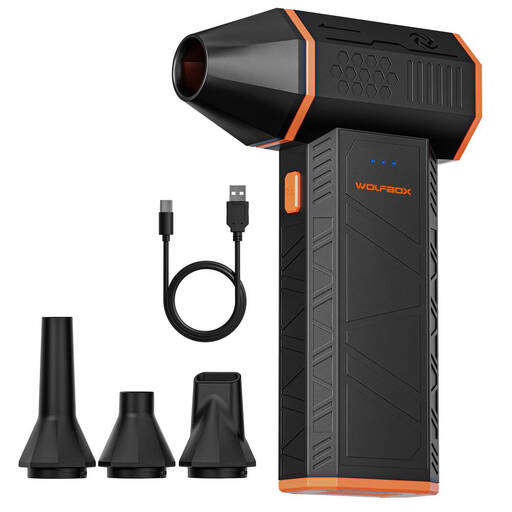
Why this choice suits this profile: With its three adjustable levels and compact design, this mini duster is ideal for getting started, whether on a keyboard, in a car or in the small nooks and crannies around the house.
The three speeds mean you don't have to use maximum power all the time, while the fast charging lets you ditch disposable air cans.
Up to 110,000 RPM according to the product page, three speeds and claimed compatibility with keyboards, cars, household equipment and outdoor gear.
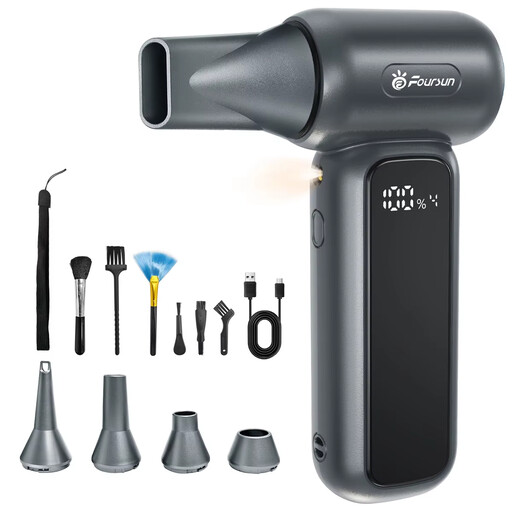
Why this choice suits this profile: With its comprehensive kit and four power levels, it's aimed at those who want a single device for the car, PC, home and certain outdoor equipment.
Power isn't limited to a single mode: choose a gentle blast for electronics and save the turbo for tougher surfaces and areas.
Claimed 10,000 mAh battery, four levels, USB-C charging and accessories including multiple nozzles, inflation attachments and various brushes.
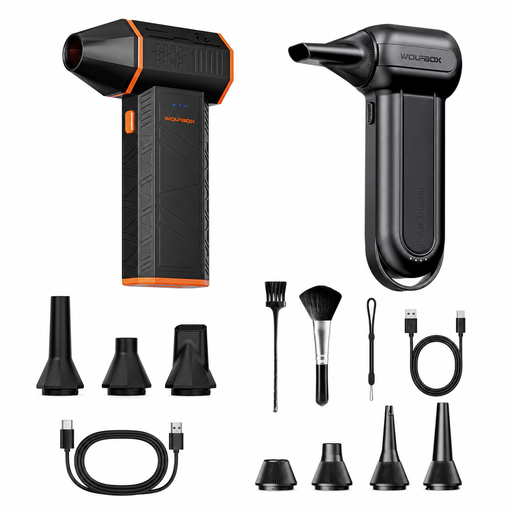
Why this choice suits this profile: This duo splits the tasks: the MF50 handles precise areas, while the DF100 takes on the more demanding cleaning jobs in the garage, car or outdoors.
Two devices mean you don't have to use a powerful blast on every surface, and it makes switching from precision cleaning to a quick job much easier.
The MF50 claims up to 110,000 RPM; the DF100, up to 150,000 RPM, 45 m/s, three settings and 100 minutes of battery life on low power.
We've put together a comprehensive, real-time updated selection of products that meet these demanding criteria and European safety standards.
Yes, provided you switch off and unplug the keyboard before you start, then choose a moderate power setting. Hold the device at a distance and use the appropriate nozzle. On a desktop computer, stop the fans from spinning at high speed and work in a well-ventilated area.
It all depends on the mode you're using. Product pages often quote a long battery life at low power, but significantly less in turbo mode. For regular use, compare the claimed battery life for each level, the charging time and the type of connection offered, such as USB-C.
No. The duster loosens and moves dust, whereas the vacuum cleaner collects it. For car detailing, the two devices are complementary: you gain precision, especially in seat rails, air vents and seals.