
Livraison le jour même ou le lendemain

Qualité garantie

Débloquez vos offres de bienvenue: Livraison GRATUITE | Jusqu'à -80 % | 30 jours d'essai gratuits à JoyPlus
Téléchargez l'application
A cordless drill driver with batteries and accessories is enough for most everyday jobs: assembling furniture, putting up a shelf, drilling into wood, screwing into metal or carrying out small repairs. But be warned: not all well-stocked kits are created equal. Behind an attractive presentation can lie limited battery life, poorly suited accessories, or power figures that are hard to compare fairly.
Before you place an order, it’s best to match the numbers against your actual needs. Here are the criteria to examine, the pitfalls to avoid, and a selection of kits suited to different profiles.
A figure like “16 V”, “18 V” or “21 V” refers to the system voltage, but it isn’t enough to judge the tool’s real capabilities. The maximum torque, expressed in newton-metres, gives a much clearer idea of the force available for driving screws.
Also look at the no-load speed, the number of mechanical gears and the chuck capacity. A 2-speed drill generally lets you favour torque at low speed or speed at high speed, depending on the task. However, it’s still intended for materials and uses that match its specifications: drilling wood and metal, general screwdriving – but not every material indiscriminately.
A kit can contain a multitude of bits, drill bits and sockets without them being genuinely suited to your work. In particular, check:
A worthwhile drill driver kit should above all bring together the accessories you’ll actually need, rather than a long list of items that will stay at the bottom of the case.
A high-capacity lithium-ion battery can offer longer run time, but that also depends on the torque demanded, the material being worked and how often you stop. A drill with 2 batteries lets you keep working while the second one charges.
Read the specification sheet carefully: some titles show a different voltage from the one listed in the detailed specs. For example, a product presented as a 16 V drill may come with batteries showing a different value in the component list. This point is worth checking before you buy.
Figures like “25+1 torque settings” or “25+3 torque settings” usually refer to adjustment positions designed to tailor the screwdriving force. They are complemented by one or more drilling modes. The finer the adjustment, the easier it is to avoid damaging a screw head or a soft material.
However, the maximum torque should be interpreted in context. A value of 25 Nm is suitable for many household tasks, while higher torque gives you more leeway for assembling furniture or prolonged screwdriving. Always use a suitable bit and start with a moderate setting.
Two mechanical speeds, a variable-speed trigger and a 10 mm keyless chuck make the tool more versatile day to day. An LED light can also come in handy for working inside a piece of furniture, a cupboard or under a worktop.
The weight, the shape of the handle and the balance between the battery and the motor all directly affect comfort. For longer jobs, a lightweight cordless electric screwdriver can be more pleasant to use than a more powerful model that is also heavier and bulkier.
Lithium-ion batteries recharge without any noticeable memory effect under normal use. They now equip most cordless DIY tools. To extend their lifespan, avoid high heat, moisture and impacts. Only use the charger supplied or one explicitly stated as compatible.
If you’re looking for a cordless hammer drill, make sure this function is clearly stated in the specification sheet. It can be useful for some light masonry work, but it won’t replace a rotary hammer for intensive work in concrete.
The three options below have different features. The right choice depends on the level of power you need, how often you’ll use it, and whether – or not – you need a specialised tool.
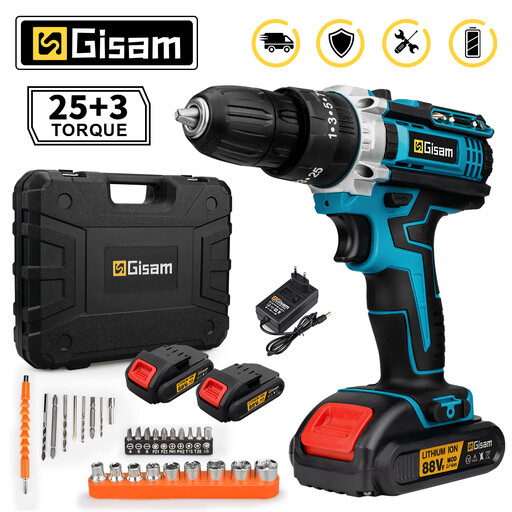
Why this choice suits this profile: this kit brings together a cordless drill, two batteries, a charger, 29 accessories and a carry case. A complete foundation for starting out on various household jobs without having to buy each item separately.
The pack contents are detailed: two 1.3 Ah batteries, a 2 to 10 mm chuck and two speed ranges. This information gives a clearer picture of the intended use than the number of accessories alone.
Maximum torque stated at 25 Nm, 25+3 adjustment, LED light and forward/reverse rotation with lock.
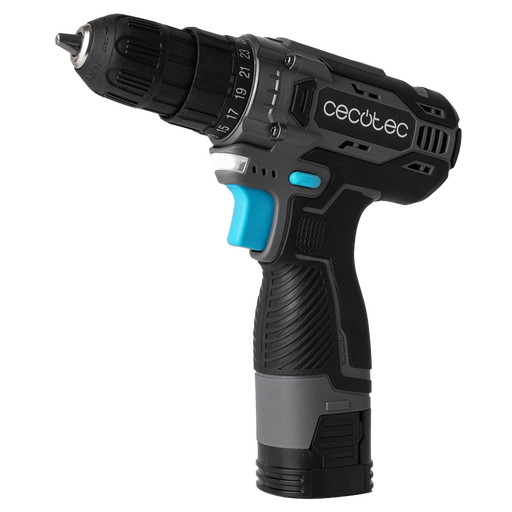
Why this choice suits this profile: this configuration is aimed at those looking for a versatile set for assembly, home maintenance and regular projects. It includes two 2.0 Ah batteries and a well-organised case.
The spec sheet mentions two speeds, 25+1 settings, a 10 mm keyless chuck and a stated capacity of 10 mm in wood and 9 mm in metal. However, check the exact battery voltage shown before buying.
Maximum torque stated at 38 Nm, two 2.0 Ah batteries, LED light and accessories including drill bits, screwdriver bits, sockets and a flexible extension.
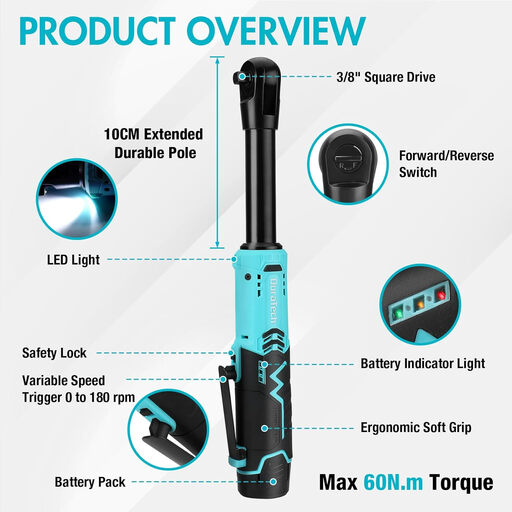
Why this choice suits this profile: this cordless electric ratchet wrench is designed for car maintenance, equipment assembly and fastenings in hard-to-reach spaces.
It doesn’t present itself as a general-purpose drill: its format and 3/8-inch drive square are intended for tightening with sockets. Expectations are therefore clearly set.
Torque stated up to 65 Nm, variable speed from 0 to 180 rpm, two 2.0 Ah batteries, built-in light and charge indicator.
We’ve put together a comprehensive, real-time updated selection of products that meet these demanding criteria as well as European safety standards.
Two batteries are the most practical setup: one can be in use while the other charges. A 2.0 Ah capacity generally offers more reserve than a 1.3 Ah battery, but the actual run time depends on the effort demanded and the material being worked.
Not necessarily. For assembly and general screwdriving, a 16 V drill can be perfectly adequate if its torque and settings match the jobs you have in mind. 18 V or 21 V models can offer extra headroom, but you also need to consider their weight, the charger and the cost of replacement batteries.
Yes, provided the dimensions and fixing systems are compatible. Hex bits are often interchangeable, while batteries must be compatible with the voltage, connectors and electronics of the manufacturer. Never force an accessory or battery that doesn’t fit properly.