
Livraison le jour même ou le lendemain

Qualité garantie

Débloquez vos offres de bienvenue: Livraison GRATUITE | Jusqu'à -80 % | 30 jours d'essai gratuits à JoyPlus
Téléchargez l'application
For a car enthusiast, nothing beats the satisfaction of seeing your bodywork restored to a showroom shine. The cordless car polisher is the dream tool for achieving this, freeing you from the constraints of cables. However, the market is flooded with marketing promises that too often lead to disappointing purchases. As a product expert for Joybuy, my mission is to help you decode the spec sheets to make a truly informed decision.
Before you start, beware of these 3 classic traps that can cost unwary buyers dearly:
To avoid these disappointments, simply focus on a few non-negotiable technical specifications. These are what determine the performance, safety, and versatility of your future rechargeable polishing machine.
There are two main types of polishers:
The orbit diameter (or throw) should also be considered. An orbit of 8 to 15 mm offers an excellent balance between correction power and finishing quality.
For a cordless tool, power management is key.
The diameter of the backing plate determines the size of the pads you can use. A 125 mm plate is the most versatile standard. It allows you to work efficiently on large surfaces (hood, doors) while remaining manageable enough for more complex areas. Ensure the attachment system is hook-and-loop (Velcro), which is essential for swapping pads in seconds.
Rather than an endless list, here is one model that checks all the boxes for a home user looking to achieve excellent results without taking risks.
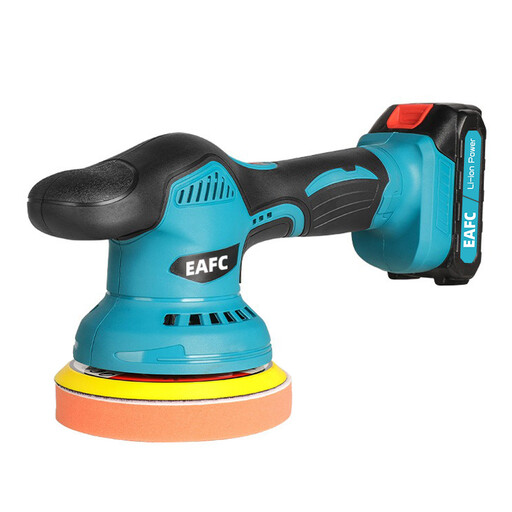
Why this model stands out: This polisher combines key features for both beginners and experienced hobbyists. Its 5 mm orbital motion is very safe on clear coats, while its cordless design and light weight (1.13 kg) offer complete freedom of movement to work on the entire vehicle.
This model directly addresses the pitfall of vague battery life with a 21V battery and a generous 7500 mAh capacity, complemented by a charge indicator. The kit includes several quality pads to get you started, avoiding the problem of unusable accessories.
8 adjustable speeds (2800-5500 RPM) provide maximum versatility, from simply applying wax to correcting micro-scratches. Its 125 mm backing plate is the ideal size for most work areas.
A good car polisher is an excellent starting point, but the ecosystem around your tools is just as crucial. Many automotive accessories and companion devices are battery-powered. Ensuring their compatibility and power supply is essential to never be caught off guard.
For your other tools and accessories, discover our selection of power solutions that meet the same strict selection criteria for performance and safety.
1. What is the real-world battery life of a cordless polisher? Actual runtime depends heavily on usage: selected speed, pressure applied, ambient temperature, etc. On average, expect 30 to 60 minutes of effective work time. This is why a model that comes with a second battery or features fast charging (via a modern port like USB-C) is a real game-changer.
2. Orbital or rotary polisher for a beginner? Hands down, a cordless orbital polisher (also known as a "dual-action" or "DA" polisher). It is much more forgiving, and the risk of causing irreversible damage to the clear coat (holograms, burn-through) is virtually zero. It's intuitive to use, allowing you to focus on your technique and the product, not on taming the tool.
3. Can I use any polishing product with a machine? No, it's crucial to use products (compounds, polishes, waxes) specifically formulated for machine application. Products designed for hand application do not have the same composition of lubricants and abrasives. Always check the product manufacturer's recommendations to ensure its compatibility with a 125 mm dual-action polisher or other machine.