
Livraison le jour même ou le lendemain

Qualité garantie

Débloquez vos offres de bienvenue: Livraison GRATUITE | Jusqu'à -80 % | 30 jours d'essai gratuits à JoyPlus
Téléchargez l'application
Achieving a mirror-like finish is the holy grail for any car enthusiast. Yet, getting a flawless, professional-grade result often feels like an uphill battle. Fine scratches, swirl marks, and a lack of shine... these are all imperfections that even the best car wash can't remove. This is where the cordless car polisher comes in, a tool that finally makes high-end car care accessible to everyone.
As a product expert for Joybuy, I'm here to guide you through the jungle of available models. This guide breaks down the essential criteria and presents our top picks, so you can get started and polish your car yourself like a pro.
To ensure you make the right choice, it's crucial to understand what separates a good car polishing machine from a mere gadget. Here are the three key points to check.
There are two main types of polishers: rotary and orbital.
For a battery-powered polisher, battery life is obviously the crucial factor. Running out of power mid-panel? Not on our watch. There are two numbers to watch closely:
A good machine never comes alone; it's accompanied by a more or less complete car polishing kit. The variety of pads provided is a real bonus. Ideally, a good starter kit includes:
A variable speed control is also essential to adapt the machine's action to the product being used and the stage of the process (correction, finishing, waxing).
After scrutinising the technical specifications and evaluating their suitability for a private user, one model stands out for its excellent balance of performance, ease of use, and versatility.
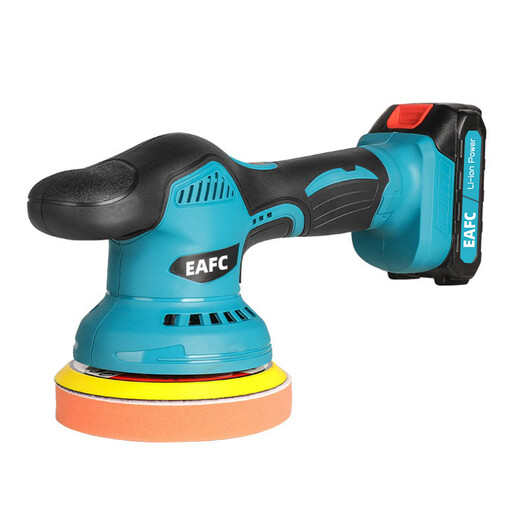
Why it stands out:
This EAFC polisher ticks all the boxes for the demanding detailing enthusiast. Its 21V battery-powered motor delivers comfortable and stable power, while its 8 adjustable speeds, ranging from 2800 to 5500 RPM, allow you to adapt to any situation, from the most aggressive correction to a gentle wax application. Its 5 mm orbital motion ensures a flawless, risk-free finish, which is perfect for beginners. Its light weight of 1.13 kg makes it particularly easy to handle on vertical surfaces without excessive fatigue.
Pros:
Who is it for?
This polisher is aimed at individuals who want a high-performance, all-in-one tool to maintain their car to professional standards. Easy to get the hang of, it's the ideal choice for a first car polishing machine, but its performance will also impress more experienced users.
But car care doesn't stop at the bodywork. For owners of modern cars, and especially electric vehicles, the health of internal components is just as vital. Taking care of your car's heart is essential.
If you're looking for solutions to optimise your vehicle's performance, take a look at our product selection.
? Discover our selection of electric vehicle batteries to ensure optimal performance.
Although the terms are often used interchangeably, there is a real difference. Polishing (with a polisher) is a corrective action: you use a slightly abrasive product (polish) to remove a tiny layer of clear coat to erase defects (fine scratches, oxidation). Buffing or waxing (with a buffer) is a finishing step: you nourish the paint and give it maximum shine (gloss), usually just before protecting it with a wax. Today, most machines, like a good cordless car buffer, can do both; you just need to change the pad and the product.
Absolutely, as long as you have the right equipment. For a beginner, the orbital polisher is a must-have: its safe motion virtually eliminates any risk of damaging the clear coat. Our advice: do your first tests on an inconspicuous area (like the bottom of a door), work at a moderate speed, and let the machine do the work without ever forcing it.
A deep polish is only necessary once a year, or even every two years, to restore the paint to a like-new condition. However, applying a protective wax is recommended every 3 to 6 months. This is the secret to maintaining shine and protecting the clear coat from daily aggressors (UV rays, acid rain, bird droppings...). Good paint care is all about consistency.