
Livraison le jour même ou le lendemain

Qualité garantie

Débloquez vos offres de bienvenue: Livraison GRATUITE | Jusqu'à -80 % | 30 jours d'essai gratuits à JoyPlus
Téléchargez l'application
Ditching your old, noisy, and polluting gas-powered brushcutter for a battery-powered model is an excellent idea, especially if you have a large garden to maintain. But be warned: the market is flooded with marketing promises that too often lead to disappointment. An underpowered or poorly designed tool will surrender to dense grass and brambles, turning your investment into pure frustration.
To help you avoid this letdown, we'll help you decode the spec sheets and sidestep the most common pitfalls. Here are the essential criteria to check before you buy.
The Illusion of Voltage (Volts) Alone: Many manufacturers tout a high voltage (48V, 60V…) as the sole proof of performance. This is a misleading shortcut. While high voltage provides the necessary torque to tackle dense vegetation, without sufficient battery capacity (measured in Amp-hours, Ah), the runtime will be laughable. The result: a powerful grass trimmer on paper, but one that will die on you after just 15 minutes in a large yard.
The "2-in-1" Tool's False Versatility: The idea of a 2-in-1 garden tool that serves as both a string trimmer and a brushcutter is appealing on paper. The catch? On entry-level models, the motor often lacks the power to effectively drive a metal blade. The head-swapping mechanism, often flimsy and insecure, makes the brushcutting function trivial, if not downright dangerous.
To make the right decision, focus on this technical trio that defines the true effectiveness of a cordless brushcutter.
The true performance of a battery-powered tool isn't defined by a single number, but by the combination of two key values:
The choice of cutting head is crucial: it must be perfectly suited to the vegetation you plan to clear.
A powerful but poorly balanced tool quickly becomes a chore to use.
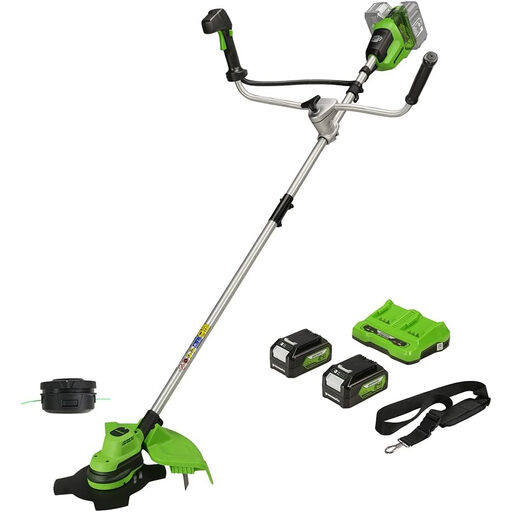
Who is it for? Owners of large properties with overgrown areas who need gas-equivalent power to tackle dense brambles and brush, without the hassles of gasoline.
This model is a true 2-in-1 garden tool without compromise. Its 48V power (via two 24V batteries) effortlessly drives both the 38 cm string head and the 25 cm metal blade. The ergonomics are excellent, with an included bike handle and harness.
The combination of Greenworks 48V power, a metal blade, and the runtime from two 4 Ah batteries makes it a highly credible alternative to gas models for the most demanding jobs.
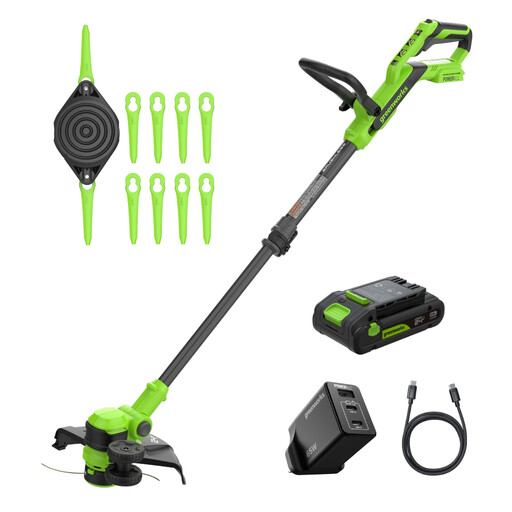
Who is it for? Ideal for maintaining small to medium-sized gardens. It's for those seeking a lightweight, maneuverable tool for trimming, creating clean edges, and clearing everyday weeds.
It doesn't promise to clear a forest. It's an excellent cordless string trimmer that perfectly handles its dual function (trimming and edging) thanks to its pivoting head. Its 24V power is ideal for its 30 cm cutting width.
Its versatility for daily maintenance: switching from trimming to edging mode is done with the push of a button. Its brushless motor guarantees quiet and efficient operation. The battery is compatible with all other 24V tools in the range.
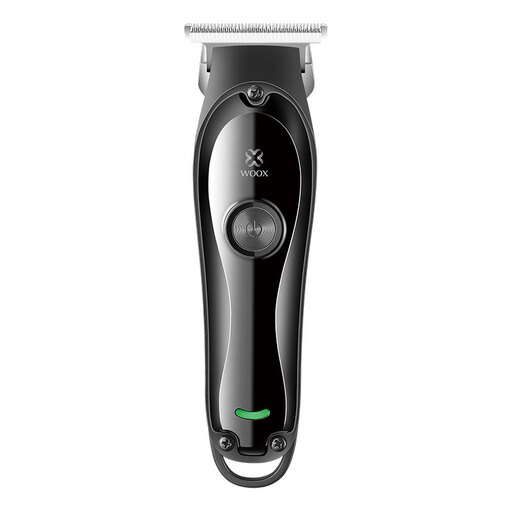
Who is it for? For those who need a tool with surgical precision for touch-ups on boxwoods, flower bed borders, or for shaping ornamental grasses. Note: this is not a brushcutting tool.
By being perfectly clear about its mission. This isn't a brushcutter, but an ultra-compact finishing shear. It avoids all the pitfalls because it meets a radically different need: detail and precision.
Its light weight, its precision blade for clean cuts, and its convenient USB-C charging. It's the perfect tool for millimeter-perfect finishing touches, where a conventional brushcutter would be far too coarse and destructive.
Discover our full selection of products that meet our criteria for performance and safety.
Yes, provided you choose the right model. To effectively tackle brambles and small brush, you absolutely need a tool with high voltage (40V or more), a brushless motor for optimal torque, and most importantly, the ability to mount a metal blade. A simple string trimmer, even a powerful one, will be ineffective on this type of tough vegetation.
The lifespan of a lithium-ion battery is measured in charge cycles (generally between 500 and 1,000 full cycles). In practical terms, for a homeowner, this represents several years of use. To maximize its longevity, follow a few golden rules: avoid fully depleting it, don't store it in direct sunlight or freezing temperatures, and keep it in a dry place, charged to between 40% and 60% during long periods of inactivity (over the winter, for example).
This is one of its major advantages over a gas model! Maintenance is minimal. After each use, remove the battery. Clean grass debris from the protective guard and cutting head with a simple brush. Check the condition of the string or blade; sharpen or replace the blade if it's dull or damaged. And that's it: goodbye to oil changes, carburetor cleaning, and spark plug replacements.