
Livraison le jour même ou le lendemain

Qualité garantie

Débloquez vos offres de bienvenue: Livraison GRATUITE | Jusqu'à -80 % | 30 jours d'essai gratuits à JoyPlus
Téléchargez l'application
A 150 000 rpm cordless electric air duster can be an excellent alternative to disposable compressed-air cans for cleaning a keyboard, dusting a computer or maintaining a car interior. But the number printed on the box is not the whole story. Two models advertised at the same speed may deliver very different airflow, offer unequal battery life or become uncomfortable to hold after just a few minutes.
Before placing an order, it is therefore worth looking beyond the marketing claim. Here are the key criteria to consider when comparing models sold in France and choosing a rechargeable electric air duster suited to your needs.
A speed of 150 000 rpm indicates how fast the motor rotates, not directly how much air the device expels. To assess real-world performance, also look at the airflow rate, air velocity in m/s and, when provided, the pressure of the air stream.
A very fast motor may prove ineffective if the nozzle fails to direct the air properly. Conversely, a well-designed set of nozzles can take you from tight spaces to broader surfaces and even inflate small objects.
A high-capacity battery does not guarantee several dozen minutes of operation at full power. Advertised runtimes are often measured at the lowest setting. For sustained cleaning, consider whether you plan to use the device for a few minutes at a time or run several sessions across a car, garage and computer equipment.
A USB-C rechargeable battery makes it easy to recharge at home, in the office or in a car equipped with the appropriate charger. Still, check that the cable is included and review the stated charging time.
A mini air duster can remove dust from a computer effectively, but avoid placing the nozzle too close to fans, connectors and moving parts. Always switch off and unplug the device, immobilise the fans, then start at the lowest power setting.
When cleaning a keyboard, game console or computer case, the aim is to dislodge dust without forcing it further into gaps and openings. A soft brush and fine nozzles provide better control over the airflow.
A brushless motor contains fewer wear-prone parts than a conventional motor. This can contribute to a more durable design, but the device’s longevity also depends on the battery, cooling system, build quality and operating conditions.
It is best to choose a model offering 3 adjustable speeds or 4 speed settings. A gentle airflow is suitable for keyboards and delicate surfaces, while the maximum setting is better suited to air vents, car mats and accumulated dust in a garage.
These specifications complement one another and should be assessed together:
For example, the WOLFBOX DF100 specification sheet states up to 150 000 rpm, a maximum air velocity of 45 m/s and airflow of up to 70 CFM. These figures provide a more complete picture of performance than a rotation-speed figure alone.
For a multifunction air duster intended for use both indoors and outdoors, look for a model supplied with several accessories : a flat nozzle, round nozzle, fine extension, cleaning brush or inflation nozzle. A wrist strap and storage pouch can also make the device more convenient to use.
Before switching it on for the first time, check the information provided by the manufacturer, whether a French-language manual is included, the identity of the importer and the applicable regulatory markings. Never use the air duster on a person, animal or liquid. When working with electronics, ensure they are powered off and avoid allowing fans to spin freely for an extended period.
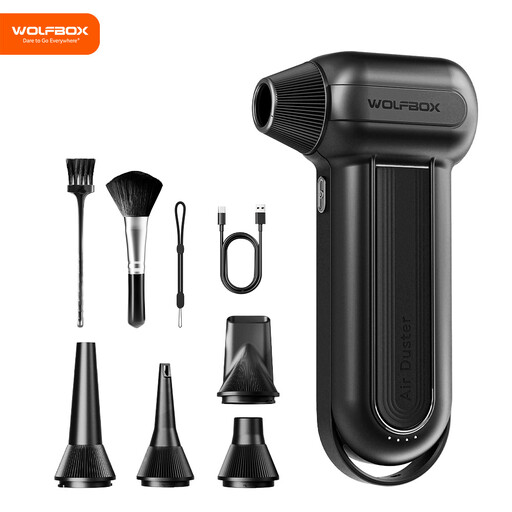
Why this choice suits this profile : Its cordless design is ideal for anyone looking to replace compressed-air cans when cleaning a computer, keyboard, home or car interior, without accumulating multiple devices.
The product specifications list a brushless motor and 3 adjustable settings, allowing you to reduce the airflow on delicate surfaces rather than relying on maximum power every time.
A portable design, rechargeable power and a configuration suited to keyboards, electronics, car interiors and everyday dust.
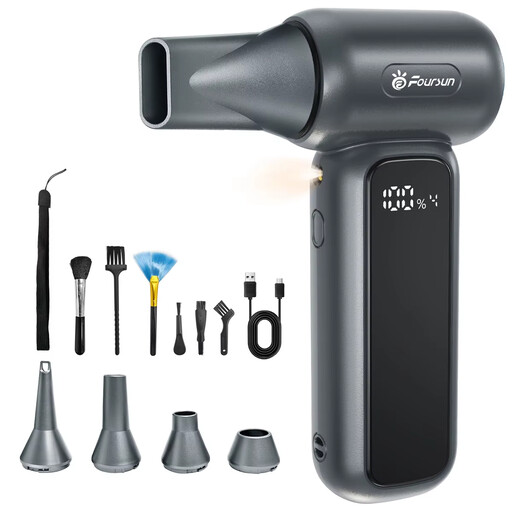
Why this choice suits this profile : The included accessories are aimed at users looking for a versatile device for their PC, car, home, outdoor storage areas and small-object inflation needs.
The 4 power levels eliminate the need to work with a single airflow that is too aggressive for electronics or too weak for car grooves.
A stated 10 000 mAh battery, Type-C charging, air velocity of up to 50 m/s and a comprehensive accessory set including nozzles, brushes and a storage bag.
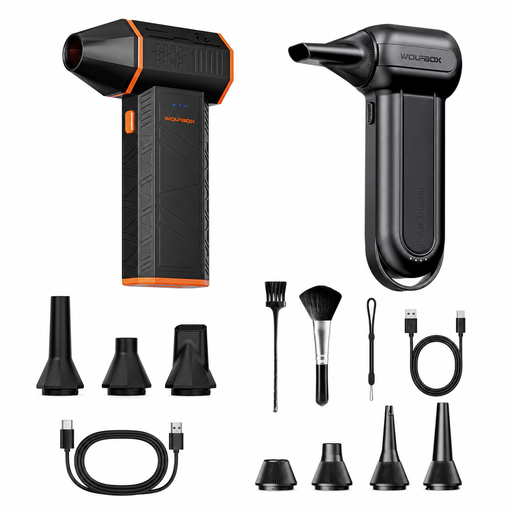
Why this choice suits this profile : Two devices make it possible to separate delicate tasks, such as cleaning a keyboard, from more demanding work in the garage, car or outdoors.
The MF50 is rated at up to 110 000 rpm with 3 settings, while the DF100 is designed for more stubborn dust, allowing each tool to be assigned to a specific task.
The DF100 is rated at up to 150 000 rpm, 45 m/s and 70 CFM, with USB-C charging and several nozzles, brushes and a wrist strap.
We have assembled a comprehensive, real-time selection of products that meet these exacting criteria as well as European safety requirements.
Yes, provided you power the computer off, unplug it and immobilise its fans to prevent them from spinning freely. Start at a low speed, choose a suitable nozzle and maintain a reasonable distance. An air duster does not replace the disassembly precautions recommended by the manufacturer.
It depends entirely on the power level used. Advertised runtimes are generally measured at low speed and drop significantly in turbo mode. For occasional keyboard or dashboard cleaning, average battery life may be sufficient. To clean an entire car or several devices, compare battery capacity, charging time and whether the device can be recharged via USB-C.
Yes. It can dislodge dust from air vents, seals, seat grooves, the boot and the spaces around the centre console. For heavy or wet dirt, however, use the appropriate tool. And never vacuum up liquid with a device designed solely for blowing air.