
Livraison le jour même ou le lendemain

Qualité garantie

Débloquez vos offres de bienvenue: Livraison GRATUITE | Jusqu'à -80 % | 30 jours d'essai gratuits à JoyPlus
Téléchargez l'application
Dust is the sworn enemy of our electronics, keyboards, and car interiors. To dislodge it from the most inaccessible corners, the old habit of using compressed air cans dies hard. However, this solution is not only costly but also not very eco-friendly. The cordless air duster stands out as a far more sustainable and effective alternative to canned air.
The only problem? The market is flooded with models boasting flattering spec sheets. To help you see clearly and avoid marketing traps, here are the essential criteria to check before you buy.
To ensure you make the right choice, focus on these key points.
The motor's rotation speed in RPM (revolutions per minute) is a primary indicator. Opt for a brushless motor, a true mark of longevity and efficiency. But be careful, raw power isn't everything. The actual airflow (sometimes indicated in m/s or CFM), which depends on the overall design, is just as crucial. For a PC duster, multi-level power adjustment is essential to avoid damaging fragile components.
Take a look at the battery capacity (in mAh) and the advertised runtime for each mode. The real game-changer today? A USB-C charging port. No more juggling cables; you can charge it anywhere with the same charger as your smartphone.
A good electric duster always comes with a well-thought-out set of accessories. Fine-point nozzles are perfect for electronics, brush attachments are ideal for keyboards, and wider nozzles can easily tackle large surfaces like a workbench or a car's interior.
Rather than an endless list, we've selected a few models that stand out from the crowd, each tailored to a specific user profile.
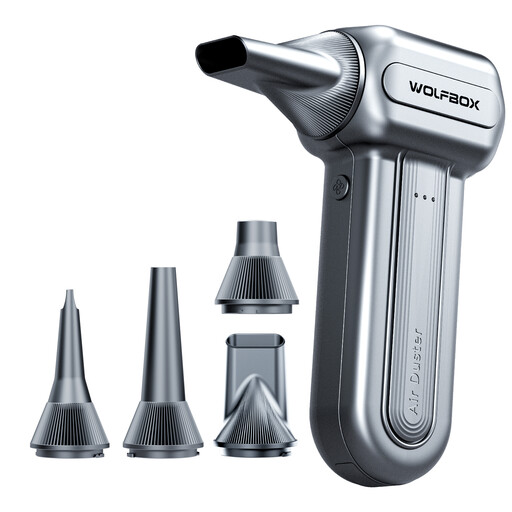
Why we recommend it: Perfect for efficient yet occasional cleaning of your PC, shelves, or hard-to-reach corners at home. An excellent everyday tool.
It offers the right balance between comfortable power (110,000 RPM) and a battery life suited for home use, without overdoing it with power that would drain the battery in a flash.
Its 3 adjustable speeds make it very versatile: perfect for gently dusting a keyboard or for cleaning an HVAC filter with more force.
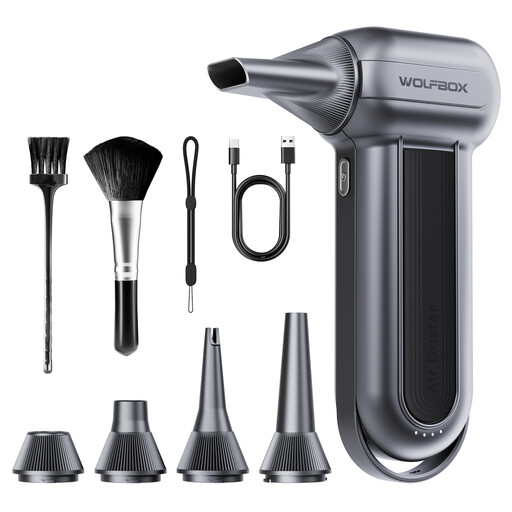
Why we recommend it: This is the choice for those who are serious about dust: deep cleaning for gaming PCs, servers, or even car detailing.
Its 150,000 RPM power comes from a brushless motor designed for sustainable performance. There's no risk of the airflow weakening mid-task, unlike with entry-level models.
Formidable blowing power to dislodge the most stubborn dust. Its accessories are up to the task, designed for precise and demanding jobs.
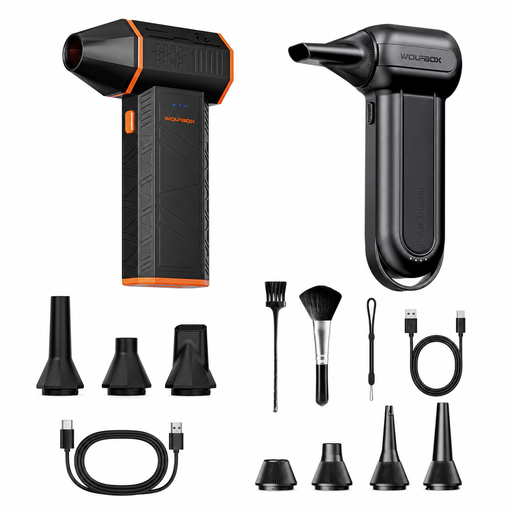
Why we recommend it: For those who want an all-in-one solution for the home, garage, and even outdoors. This bundle combines two complementary tools for unbeatable versatility.
Instead of the compromise of a single "jack-of-all-trades" tool that's average at everything, this bundle offers the best of both worlds: a compact blower (MF50) for precision, and a powerhouse (DF100) for heavy-duty jobs. You always have the right tool for the right mission.
An ultra-complete duo that covers every scenario, from pinpoint dusting of a circuit board to a major clean-up of a car trunk or garden furniture.
Discover our full selection of air dusters that meet our criteria for performance, reliability, and safety.
The longevity of an electric duster depends on two components: the motor and the battery. A model with a brushless motor will last much longer than one with a conventional brushed motor. As for the battery, expect several hundred charge cycles. In practical terms, a well-made device will easily last you for several years of regular use.
In the vast majority of cases, the answer is a resounding yes. The cordless air duster is infinitely reusable, produces no waste, doesn't risk spraying liquid, and doesn't freeze. Its airflow is constant, whereas a can weakens as it's used. The only downsides: the initial investment is higher, and you have to remember to charge it.
Yes, as long as you follow a few basic rules. The airflow itself does not create dangerous static electricity. As a precaution, always use the lowest power setting necessary and maintain a safe distance of a few inches between the nozzle and the components. Most importantly, avoid any direct contact between the plastic nozzle and the printed circuit boards.