
Livraison le jour même ou le lendemain

Qualité garantie

Débloquez vos offres de bienvenue: Livraison GRATUITE | Jusqu'à -80 % | 30 jours d'essai gratuits à JoyPlus
Téléchargez l'application
A cordless air blower can replace disposable compressed-air cans and make it easier to clean your car, keyboard, garage or patio. However, product listings often highlight an impressive figure without always explaining what it means in practice.
Before checking out, three pitfalls come up frequently: a speed expressed in RPM that does not directly indicate airflow, a runtime measured at the lowest power setting, and accessories that are poorly suited to delicate surfaces. Here are the key criteria to examine, followed by a selection of recommended models for different uses in France.
A motor rated at 110,000 or 150,000 RPM may give the impression of exceptional power. However, rotational speed alone is not enough to assess blowing performance. Nozzle diameter, air volume, pressure and jet shape also play an important role.
For dusting a keyboard, a fine nozzle combined with a gentle setting will generally be more practical. To dry hard-to-reach areas in a car or move leaves, a higher airflow is often preferable. Compare the available specifications: airflow in CFM, outlet speed in m/s or km/h, and the number of power settings.
A USB-C rechargeable battery is convenient, but runtime varies depending on the speed used, temperature and battery condition. The maximum runtime quoted by the manufacturer generally corresponds to the lowest power setting.
For regular use, check:
A keyboard and computer blower will not necessarily replace a shop vacuum. A blower moves dust without collecting it, while compact devices are not designed to vacuum up gravel, water or wet leaves.
In the garden, a device combining blowing and vacuuming will often be more suitable. For electronics, choose a compact model with precision attachments. Also avoid holding the jet too close to fans or components.
Compact cordless electric dusters often feature high-speed motors and several power settings. A device rated at up to 110,000 RPM or 150,000 RPM can handle a variety of tasks, provided that the airflow intensity can be reduced.
Three speeds are a practical minimum for moving from a keyboard to a car’s air vents. For leaves, airflow, nozzle width and ergonomics matter more than motor speed alone.
A brushless motor has fewer wear-prone parts and can help maintain consistent performance over time. That does not make the device indestructible, however: the battery, bearings, turbine and charging system still require attention.
Also consider the weight, handle design, presence of a wrist strap and ease of cleaning. A device that is too heavy quickly becomes tiring to use inside a vehicle or over a desk.
A rechargeable compressed-air blower eliminates the need to regularly buy disposable cartridges. For light-duty tasks, USB-C allows the device to be recharged using a power adapter, power bank or compatible computer. Always use a charger that complies with the instructions in the manual.
Read the manufacturer’s warnings before use. Wear protective eyewear if debris could be projected, never direct the jet at a person or animal, and remove the battery before carrying out any cleaning. For outdoor use, also check local rules regarding noise and permitted operating hours for powered tools.
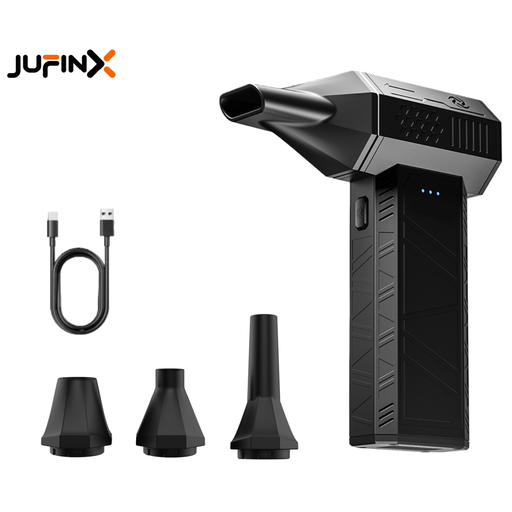
Why this choice suits this profile: its compact format is ideal for everyday cleaning in a car, keyboard, computer or small spaces around the home.
Its three speeds make it unnecessary to rely on the maximum setting when working on delicate surfaces.
Up to 110,000 RPM, fast 20 W charging and an integrated rechargeable battery, according to the product listing.
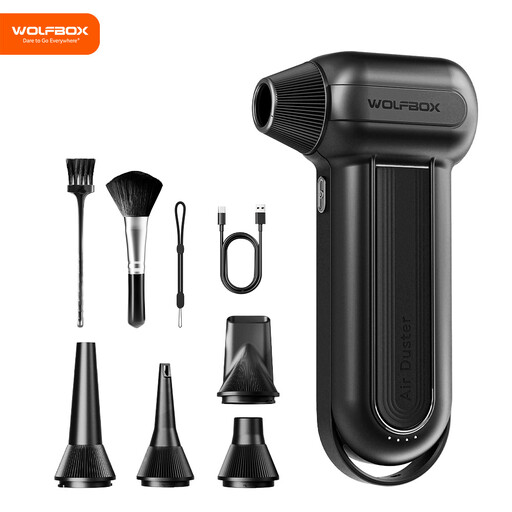
Why this choice suits this profile: it is aimed at users looking for a versatile device for the car, home, garage and outdoor equipment.
The listing specifies three levels, airflow of up to 70 CFM and several nozzles, allowing the airflow to be tailored to the task.
Brushless motor, advertised speed of up to 150,000 RPM, USB-C charging and runtime of up to 100 minutes at low power.
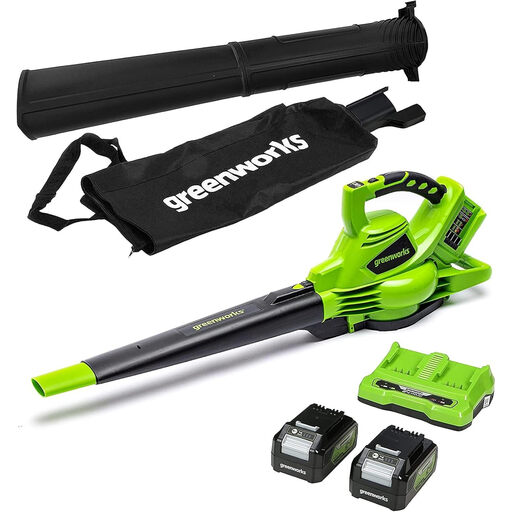
Why this choice suits this profile: this model is designed for garden owners who need to maintain lawns, driveways, patios and dry leaves.
It does more than blow: the vacuum function and 45 L bag reduce the amount of handling required after collection.
Two 24 V 4 Ah batteries, six settings, advertised speed of 322 km/h, airflow of 9 m³/min and a 45 L mulching bag.
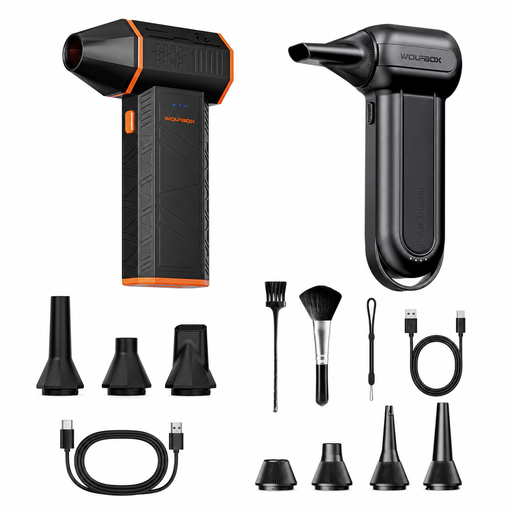
Why this choice suits this profile: this duo lets you dedicate one device to precision work and the other to more demanding cleaning tasks.
With two devices, there is no need to compromise between the precision required for electronics and the stronger airflow useful in a garage.
The MF50 is rated at up to 110,000 RPM with three speeds; the DF100 reaches up to 150,000 RPM and offers USB-C charging and several accessories.
We have brought together an up-to-date selection of cordless blowers for different budgets, power levels and uses, both indoors and outdoors.
Yes, for regularly dusting a keyboard, computer, car or household equipment. Rechargeable and reusable, it can nevertheless produce a potentially stronger jet than a conventional can. Start at the lowest speed and maintain a reasonable distance.
The electricity consumed by a small recharge is generally modest. However, it depends on the battery capacity, frequency of use and your supplier’s tariff. USB-C models can be recharged with an adapter you may already have at home. For a garden device equipped with two batteries, allow more time and energy for recharging.
No universal lifespan can be guaranteed. It depends in particular on charging cycles, storage conditions, temperature and maintenance. Allow the device to cool down after extended use, clean its air inlets, keep it away from water and store the battery in a dry place, in accordance with the instructions in the manual.