
Livraison le jour même ou le lendemain

Qualité garantie

Débloquez vos offres de bienvenue: Livraison GRATUITE | Jusqu'à -80 % | 30 jours d'essai gratuits à JoyPlus
Téléchargez l'application
A cookware set can seem like a great deal when it bundles several pots and pans at a reduced price. But a poorly chosen set soon ends up at the back of a cupboard: incompatible with induction hobs, a coating that deteriorates within months, bulky handles or capacities that don't suit everyday meals.
Before buying a set of pots and pans, it's worth looking beyond the simple number of pieces. Here are the criteria that really matter when comparing materials, dimensions, maintenance and compatibility with your equipment.
A cookware set designed for gas, electric hobs and ceramic hobs won't necessarily work on induction. This technology generally requires a magnetic base, most often made from suitable stainless steel.
Carefully check the product description and look for the explicit mention compatible with induction. The phrase "all hobs" should ideally be accompanied by a detailed list: gas, electric, ceramic, halogen and induction.
A non-stick cookware set makes cleaning easier and often allows you to cook with less fat. However, its lifespan depends on several factors: the temperature used, the utensils employed and the washing method.
To preserve a non-stick frying pan, preferably use wooden, silicone or plastic spatulas. Avoid abrasive sponges and never heat the pan when empty. Mentions of "PFAS-free", "PTFE-free" and "PFOA-free" don't all mean the same thing: take the time to check the full composition.
A 15-piece set isn't necessarily more useful than a five-piece set with well-chosen dimensions. Some sets multiply the number of lids, protectors and accessories that take up space without matching your cooking habits.
For a household of two to four people, start by determining the sizes you actually need: a saucepan of 16 to 20 cm, a frying pan of 24 to 28 cm and a stockpot or casserole dish for family meals.
Each material suits different uses:
Indications about the absence of certain substances remain product description information. They do not replace reading the usage and care instructions.
A flat, sufficiently thick base limits hot spots and improves stability on the hob. For an induction cookware set, also check the diameter of the base: some hobs struggle to detect smaller pans.
If you use several types of hob or plan to move house, opt for a range advertised as compatible with all hobs. However, remember to check the maximum oven temperature separately.
Capacity in litres is often more telling than diameter alone:
In a small kitchen, a space-saving cookware set made up of stackable pieces can prove more practical than a large conventional set. A removable handle also frees up space and makes it easier to go from hob to oven, when the manufacturer allows it.
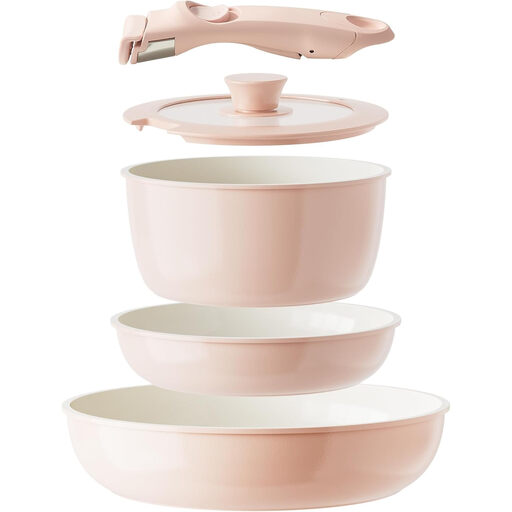
Why this choice suits this profile: This set includes a 20 cm saucepan, two frying pans of 20 and 26 cm, a lid and a removable handle. It covers everyday needs while taking up little space in kitchens where every centimetre counts. The description states compatibility with gas, electric and induction hobs.
The description details the materials stated as PFAS, PTFE and PFOA-free, as well as dishwasher compatibility. To protect the coating, however, use moderate heat and non-metal utensils.
A 5-piece format, stackable elements and a removable handle make storage easy. The manufacturer states it can be used in the oven, subject to respecting the maximum temperature and the instructions on the description.
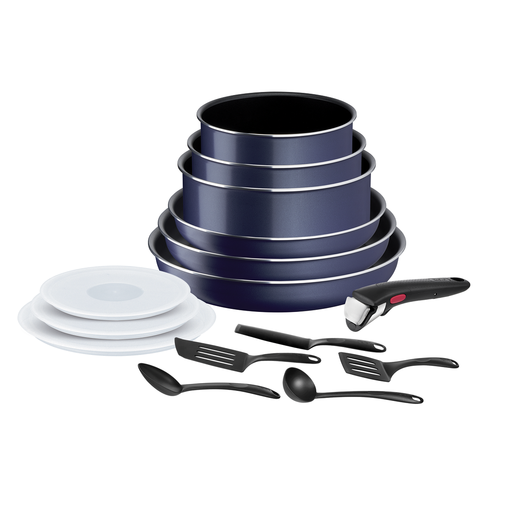
Why this choice suits this profile: Cooks looking for a complete set will appreciate the six cooking elements, glass lids, storage lids and two handles. The system is designed to go from hob to oven, then to the fridge, without a fixed handle.
Compatibility is clearly limited to gas, electric, ceramic and halogen hobs: this model is not suitable for induction. A detail that avoids nasty surprises at installation time.
Stackable storage could save up to 50% space, while the handle is rated for a maximum load of 10 kg. The manufacturer states oven use up to 250°C without the handle.
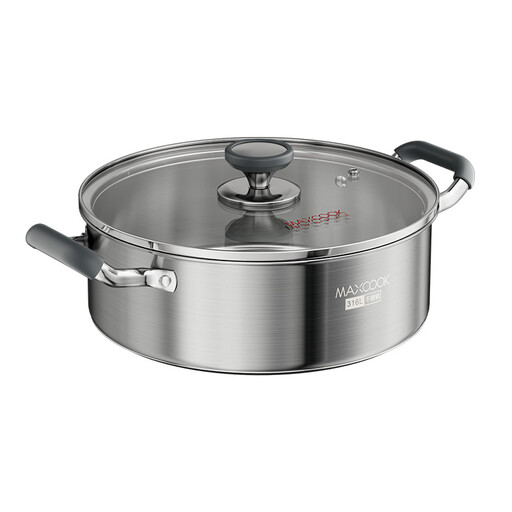
Why this choice suits this profile: Its large capacity suits soups, fondues, stews and family meals. The glass lid allows you to monitor cooking, while the composite base is stated as compatible with induction, gas, electric, ceramic and halogen hobs.
The list of compatible hobs is detailed. The description also states that washing should be done by hand and recommends low to medium heat: so you know what to expect in terms of maintenance.
A 6.5 litre capacity, a transparent lid and silicone handles stated as heat-insulating. The container has no non-stick coating.
We've put together a comprehensive selection, updated in real time, of products that meet these demanding criteria as well as European safety standards.
Look for the explicit mention compatible with induction as well as a suitable magnetic base. A magnet can serve as a first indicator, but the manufacturer's description remains the reference. Also check the base diameter and the maximum permitted temperature.
It all depends on the type of coating, frequency of use and maintenance. Avoid metal utensils, very high temperatures and abrasive products. If the coating is scratched, peeling or shows visible deterioration, stop using the piece in question and refer to the manufacturer's recommendations.
Stainless steel and enamelled cast iron do not necessarily have a non-stick interior coating. Stainless steel is suitable for many uses and cleans easily with gentle products. Enamelled cast iron retains heat better, but it is also heavier. The choice therefore depends above all on your recipes, the weight you are prepared to handle and the space available, rather than on a general health promise.