
Livraison le jour même ou le lendemain

Qualité garantie

Débloquez vos offres de bienvenue: Livraison GRATUITE | Jusqu'à -80 % | 30 jours d'essai gratuits à JoyPlus
Téléchargez l'application
Buying cookware isn’t just about picking a colour or counting how many pieces come in the box. A set might look complete on paper, but it can prove impractical if it’s not compatible with your hob, if the handles take up too much cupboard space, or if the coating requires high-maintenance care.
Here are the main pitfalls to avoid, the technical specs to check, and a selection of products suited to different needs in the UK.
The phrase “all hob types” isn’t always enough. Make sure the product page clearly states induction compatibility. Several Tefal Ingenio sets with a non-stick coating work on gas, electric, ceramic or halogen hobs, but not necessarily on induction.
An induction-compatible frying pan generally needs a magnetic base. A pan made entirely of aluminium won’t necessarily work on an induction hob.
A 12- or 15-piece set may count several lids, handles or accessories in the total. That doesn’t mean it contains more genuinely useful pans. For a family, focus on the diameters, capacities and whether there’s a 24 cm or 28 cm frying pan, plus a saucepan of at least 1.5 litres.
In a small kitchen, a cookware set with removable handles can be far more practical than a bulky set with fixed handles.
A non-stick frying pan makes cleaning easier, but it isn’t indestructible. Metal utensils, abrasive sponges and overheating all speed up coating deterioration. Ceramic coatings can also lose their non-stick properties over time, especially after exposure to very high heat or harsh cleaning.
Always check the manufacturer’s recommendations regarding dishwasher safety, allowed utensils and maximum oven temperature.
If you’re looking for a PFAS-free ceramic coating, check that this is explicitly stated on the product page. It can’t be assumed from marketing terms like “natural” or “mineral”.
The stated diameter usually refers to the top rim. The base may be narrower, which reduces the actual heating surface on an induction hob.
A removable handle makes storage easier and allows the pan to go from hob to oven, but it must be properly locked before each use. It usually needs to be removed before oven cooking. Also check whether it’s dishwasher-safe – this isn’t always the case.
Space-saving cookware should stack without scratching the surfaces. In a narrow cupboard, dividers or pan protectors can make all the difference.
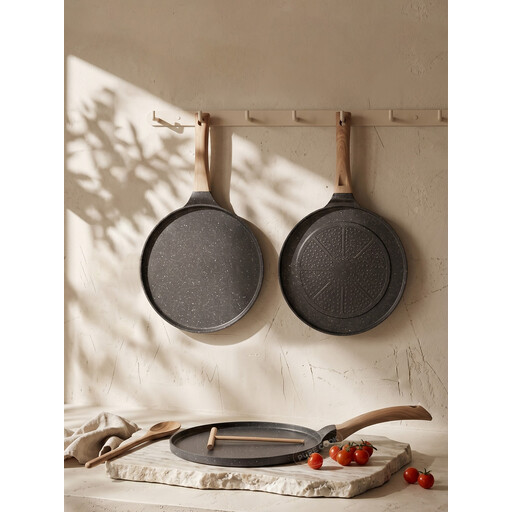
Why this suits this profile: Its versatile size and light weight make it an ideal companion for everyday meals, especially if you’re looking for a first pan that’s easy to handle.
The product page states compatibility with induction, gas and ceramic hobs. It also specifies hand washing only, which reduces the risks associated with dishwasher use.
Lightweight aluminium, 26 cm diameter, non-stick coating and a rounded pouring rim.
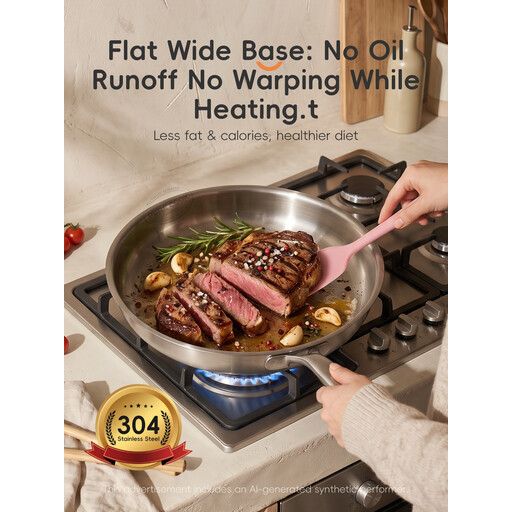
Why this suits this profile: Its tri-ply construction is aimed at cooks who value stainless steel, versatility and a pan that works with different hob types.
The product page details the three-layer construction, the aluminium core and compatibility with induction, gas, ceramic and halogen hobs.
304 stainless steel, even heat distribution thanks to the aluminium core and stated dishwasher compatibility.
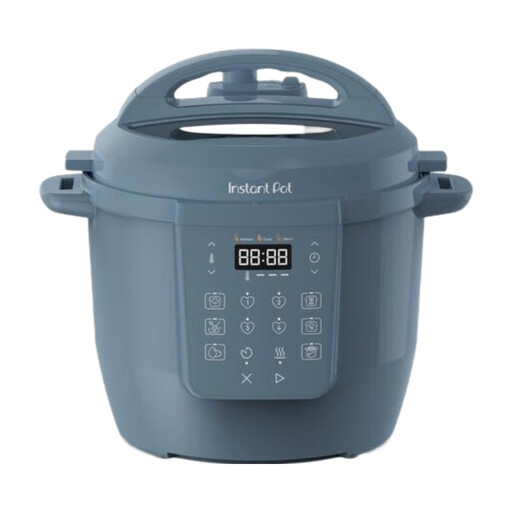
Why this suits this profile: Its many functions and large capacity make it ideal for families and anyone who regularly cooks in bulk.
The 5.7 litre capacity and filling instructions are clearly stated. The appliance also has a steam release and automatic shut-off.
Seven cooking modes, stainless steel inner pot and dishwasher-safe removable parts, according to the product page.
Look for the explicit mention “induction compatible” and, if in doubt, hold a magnet to the base of the pan. Multi-layer stainless steel, enamelled cast iron and some aluminium models with a magnetic base are generally suitable. A non-compatible set won’t work properly, even if it’s fine for gas or ceramic hobs.
It depends on how often you use it, the cooking temperature and how you care for it. Stick to moderate heat, use wooden or silicone utensils and a soft sponge. Replace the pan as soon as you see visible signs of coating damage or when the surface is no longer perfectly smooth.
Energy consumption depends on the wattage, the programme you select and how long you use it. Compare the wattage, capacity and the functions you’ll actually use. A 2-litre appliance may suit a single person or a couple, while a 5.7-litre model is better for a family, though it does take up more space.