
Livraison le jour même ou le lendemain

Qualité garantie

Débloquez vos offres de bienvenue: Livraison GRATUITE | Jusqu'à -80 % | 30 jours d'essai gratuits à JoyPlus
Téléchargez l'application
Upgrading your cookware set often proves to be a headache. Between marketing promises and opaque technical jargon, it's easy to make a mistake and invest in equipment that won't go the distance. As a product expert for the editorial team, my mission is to help you see things more clearly. Let's break down the most common pitfalls together so you can make the right choice with full confidence.
The "Healthy Coating" Mirage, Decoded: The "PFOA-free" claim is everywhere, but it's often misleading. PFOA is just one of many compounds in the large family of PFAS (per- and polyfluoroalkyl substances), nicknamed "forever chemicals." A coating can be PFOA-free while still containing other PFAS. For true peace of mind, look for an explicit "PFAS-free" label or turn to alternative materials like ceramic cookware or stainless steel.
The "All Hobs" Scam That Excludes Induction: This is a classic mistake that can render a brand-new set of pans completely useless on your new cooktop. The "all hobs" label is no guarantee of induction compatibility. You must check for the coil-shaped pictogram or the clear mention "all hobs including induction." Only a magnetic base allows induction technology to work.
The Low-Price Trap: A bargain-priced pot and pan set is almost always synonymous with disappointment. A base that is too thin will warp with heat, which not only compromises even cooking but also drastically reduces efficiency on an induction hob. Likewise, a low-end non-stick coating will scratch and lose its properties within a few months, turning your non-stick pan into a nightmare to use and clean.
To avoid making the wrong choice again, here are the technical specifications that truly make a difference in your daily routine.
The choice of material determines durability, heat distribution, and ease of maintenance.
The coating dictates the comfort of daily use and cleaning.
Rather than an endless list, here are three targeted options that meet specific needs while respecting our criteria for safety and practicality.
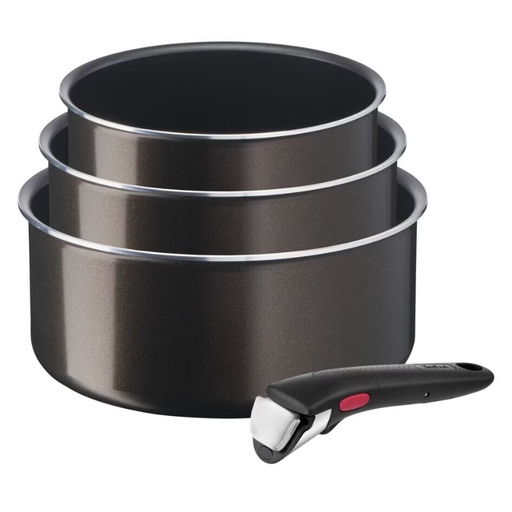
The editor's verdict: For anyone short on space, the removable handle system is the gold standard. This set allows you to cook, move to the oven, store in the fridge, and serve at the table with minimal clutter. Their perfect stackability frees up precious cupboard space.
Transparency first: this set is upfront and is not compatible with induction. This is crucial information that prevents any disappointment for owners of gas, electric, or ceramic hobs.
3-in-1 versatility (cooking, oven, fridge) and up to 50% space saving thanks to perfect stacking. Its non-stick coating is guaranteed free of PFOA, lead, and cadmium.
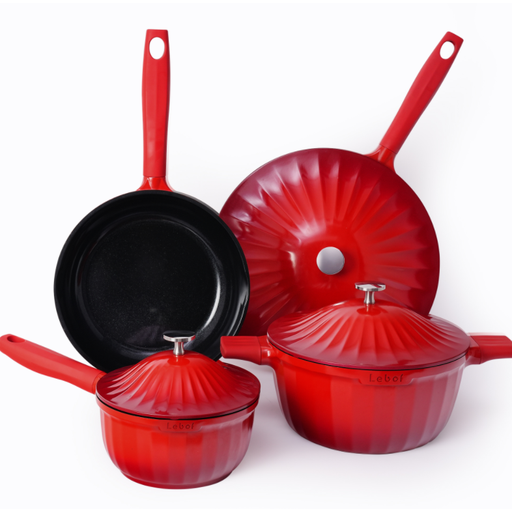
The editor's verdict: This comprehensive set (pans, saucepans, Dutch oven) is an excellent foundation for equipping a family kitchen from A to Z. Its titanium-infused ceramic coating is a healthy alternative to traditional coatings, and its all-hob compatibility makes it particularly future-proof.
It goes beyond just "PFOA-free" by guaranteeing a composition that is PFAS-free, PTFE-free, lead-free, and cadmium-free. It also ticks the crucial box of all hobs including induction compatibility, avoiding any nasty surprises.
A complete and versatile set, featuring a non-toxic ceramic coating and a die-cast aluminium body that ensures fast, even heating.
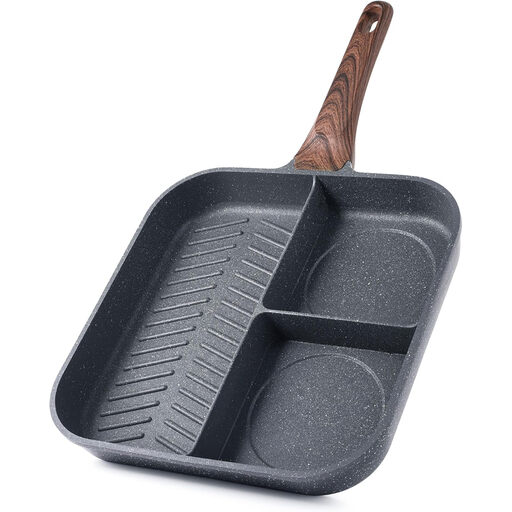
The editor's verdict: This ingenious pan is designed entirely for efficiency. It allows you to cook several foods at once (eggs, bacon, pancakes) without ever mixing flavours. The perfect tool for complete breakfasts or quick meals, whether for one or two people.
It doesn't try to do everything. It's a specialised tool that meets a specific need, thus avoiding the trap of mediocre versatility. Its induction compatibility and PFOA/PFOS-free coating make it a smart and safe choice.
3-in-1 cooking for maximum time savings. Its 4.5 mm thick base guarantees even heat distribution, regardless of the hob type.
Discover our full selection of products that meet our selection criteria and current regulations.
It all depends on the quality of the coating and how you care for it. An entry-level pan can become unusable in less than a year. A good model with a reinforced coating that is well-maintained (no overheating, hand-washed, using wood or silicone utensils) can last 3 to 5 years. The appearance of deep scratches or food consistently sticking are signs that it's time for a replacement.
The magnet test is foolproof: if a magnet sticks firmly to the outside bottom of your pan, it is compatible. Manufacturers also place a specific logo on the base and packaging: it's a symbol shaped like a coil (a series of loops), which represents the hob's electromagnetic field.
There's no one-size-fits-all answer; it depends on your priorities.
For daily, intensive use, a reinforced PTFE will likely offer better longevity. For those whose absolute priority is to avoid all fluorinated compounds, ceramic remains the best alternative.