
Livraison le jour même ou le lendemain

Qualité garantie

Débloquez vos offres de bienvenue: Livraison GRATUITE | Jusqu'à -80 % | 30 jours d'essai gratuits à JoyPlus
Téléchargez l'application
Choosing a new cookware set can quickly become a headache. Between marketing promises and technical jargon, it's easy to get lost and make a purchase you'll regret a few months later. Peeling coatings, warped pans, disappointing induction compatibility... unfortunately, these issues are all too common.
As the Head of Product Recommendations at Joybuy, my role is to help you see things more clearly. Let's cut through the marketing noise and focus on the facts. This guide gives you the keys to choosing a set of pots and pans that is not only durable and suited to your habits but also a true long-term investment.
The market is flooded with options, but not all are created equal. Here are the three most common pitfalls that can turn a good deal into a bad investment.
The "PFOA-free pan" claim has become standard. The problem? PFOA is just one compound in the vast family of PFAS (per- and polyfluoroalkyl substances), often found in traditional non-stick coatings. A "PFOA-free" product can therefore still contain other substances from the same family, like PTFE. For peace of mind, it's better to look for clear statements like "PFAS-free" or turn to alternatives like a ceramic cookware set.
A pan may be technically compatible with induction, but if its ferromagnetic base is too thin or only partial, heating will be slow, uneven, and energy-intensive. A true induction-ready cookware set must have a thick, fully magnetic base to ensure optimal performance. Don't just rely on the pictogram; the quality of the base is the real criterion.
A 16-piece set might seem like the deal of the century, but how many of those items will you actually use daily? All too often, these XXL sets contain awkwardly sized or poor-quality utensils that just clutter up your cupboards. It's better to prioritise quality over quantity by opting for versatile pieces or modular systems, like those with a removable handle.
To make the right choice, three fundamental aspects must be examined closely.
The choice of material directly impacts cooking performance, maintenance, and the longevity of your cookware.
Your cookware set should adapt to your equipment and your lifestyle.
For non-stick pots and pans, manufacturer transparency is a sign of quality. Look for products that clearly specify the absence of the following compounds:
Rather than looking for a one-size-fits-all product, it's better to find the one that meets your specific needs.
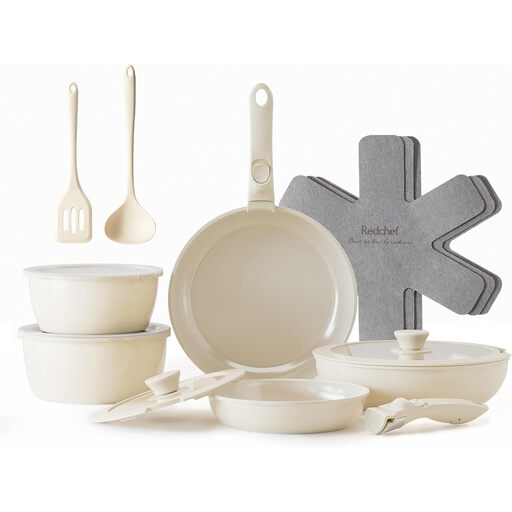
Why it's a match: This comprehensive set meets the varied needs of a family. The removable handle and stackable design allow for considerable space savings, a bonus in kitchens where every inch counts. Its compatibility with all hobs, including induction, makes it universal.
It avoids the trap of the oversized and impractical set thanks to its modularity. The ceramic coating is explicitly free of PFAS, PTFE, and PFOA, meeting the demand for transparency about its composition.
Maximum versatility: Goes from the hob to the oven, then to the table and the fridge. Space-saving: Stackable for up to 75% more space in your cupboards.
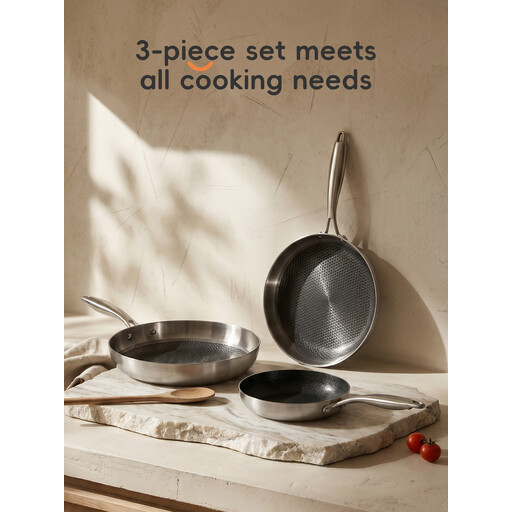
Why it's a match: For those who prioritise longevity and performance for searing meats and vegetables, stainless steel is a top-tier choice. This set of three different sizes covers most daily needs, from fried eggs to a family meal.
This set bypasses the problem of degrading non-stick coatings. 304 stainless steel is a raw, durable material by nature: it won't peel or lose any of its properties over time. A true long-term investment.
Robustness and longevity: Resists corrosion, scratches, and high temperatures. Multi-layer composite base: Ensures fast, even heating, compatible with all hobs including induction.
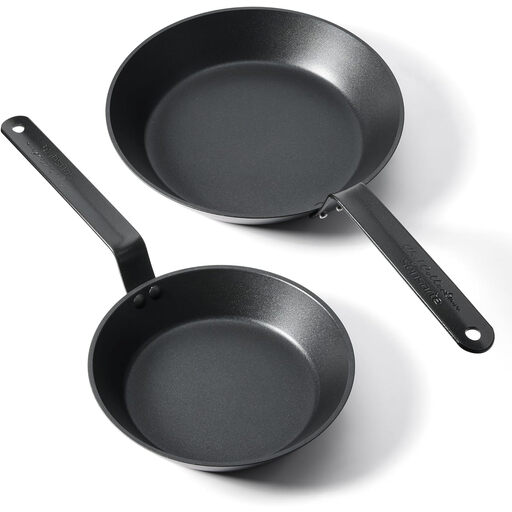
Why it's a match: To get the essentials without breaking the bank, this duo of pans is a smart option. The two sizes are versatile for everyday cooking. The non-stick coating makes cooking and cleaning easy, which is ideal for beginner cooks.
It avoids the trap of the unnecessary set by focusing on the two most commonly used pan sizes. The coating is PFOA and PFOS-free, and the base is induction-compatible, making it a modern and high-performing choice for its price.
Excellent value for money: An effective and affordable basic setup. Ease of use: The non-stick coating performs well and cleaning is simple.
We have compiled a complete and up-to-date list of products that meet these strict selection criteria and current regulations.
The longevity of a coating, whether ceramic or other, depends mainly on its care. To preserve it, it is advisable to use wooden or silicone utensils, avoid thermal shock (never run a hot pan under cold water), and opt for hand washing, even if the product is advertised as dishwasher-safe. With proper care, a quality coating can remain effective for several years.
The simplest test is the magnet test: if a magnet sticks firmly to the bottom exterior of your pot or pan, it is compatible with induction. Additionally, manufacturers place a pictogram shaped like a spiral (or spring) on the packaging and under the product to indicate this compatibility.
Ceramic coatings are made from natural materials (sand and water) and are generally free of PFAS, PTFE, and PFOA. They are an interesting alternative to traditional non-stick coatings for those looking to avoid these substances. However, it should be noted that European and French health authorities consider compliant PTFE coatings to be safe for food contact, provided the manufacturer's usage recommendations are followed. The choice therefore depends on your personal preferences.