
Livraison le jour même ou le lendemain

Qualité garantie

Débloquez vos offres de bienvenue: Livraison GRATUITE | Jusqu'à -80 % | 30 jours d'essai gratuits à JoyPlus
Téléchargez l'application
Upgrading your cookware set can quickly become a daunting task. Between the promise of a "scratch-proof" non-stick pan that starts sticking after two months and "all-hob" logos that hide disappointing performance on induction, it's easy to feel lost. It's a significant investment, and nobody wants to replace their pots and pans every year.
As a Product Expert at Joybuy, my role is to help you cut through the noise. Let's forget the marketing jargon and focus on the facts. Here are the most common pitfalls and the essential criteria for making an informed and lasting choice.
To avoid these traps, you just need to check a few key points. These objective parameters will allow you to judge the real quality of a piece of cookware, beyond the marketing claims.
The choice of material impacts everything: heat distribution, durability, and food safety.
For an induction pot, the base must be perfectly flat and made of a ferromagnetic material. A thick base (often a "sandwich" construction with a layer of aluminium encapsulated between two layers of stainless steel) is a guarantee of performance: it prevents warping and ensures rapid, even heat diffusion across the entire surface. This is what separates a mediocre all-hob stockpot from a truly versatile piece of cookware.
In modern kitchens, every inch counts. A stackable cookware set is a significant space-saver in cupboards. The removable handle system is a major advantage: it allows you to move from the hob to the oven, then straight to the table, and simplifies storage.
Rather than an impersonal list, here are targeted suggestions based on specific needs and uses, drawing on the quality and practicality criteria we've just discussed.
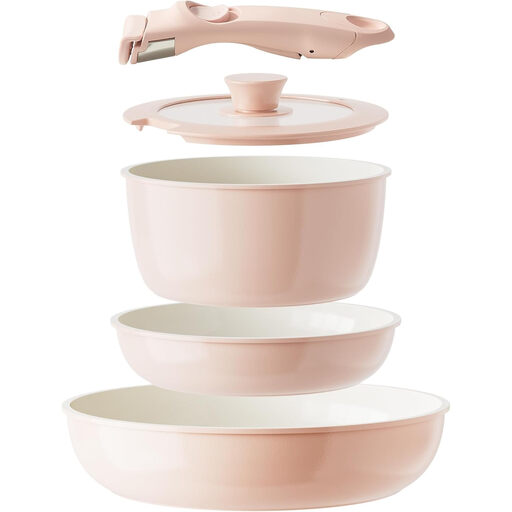
Why we chose it: For those looking to optimise space and cook healthily every day, this set combines practicality and safety. The removable handle and stackable design are major assets for kitchens where storage is a challenge.
Its ceramic coating is explicitly formulated without PFAS, PTFE, or PFOA, directly addressing concerns about harmful substances. It's a transparent choice for healthy cooking.
Stackable design and a removable handle for maximum versatility, from the hob to the oven and then to the table. Compatible with all hobs, including induction.
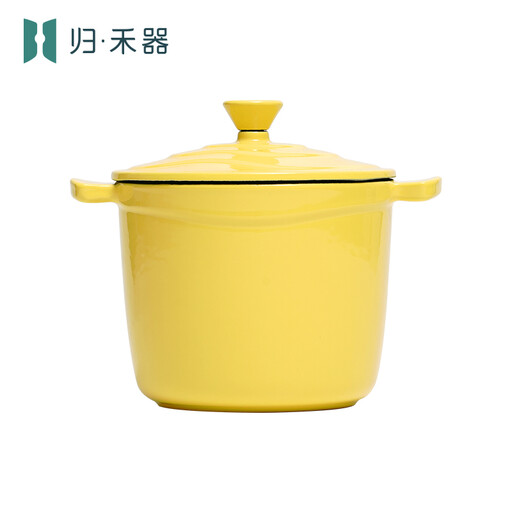
Why we chose it: Ideal for single meals, sauces, or preparing a baby's first foods. This mini casserole is as stylish as it is functional, perfect for serving directly at the table.
Enamelled cast iron ensures even heat distribution, preventing the hot spots that damage food and fragile coatings. It's a durable material that won't warp.
Excellent heat retention for slow-cooked dishes and soups. Its compact size is versatile and easy to store. Induction compatible.
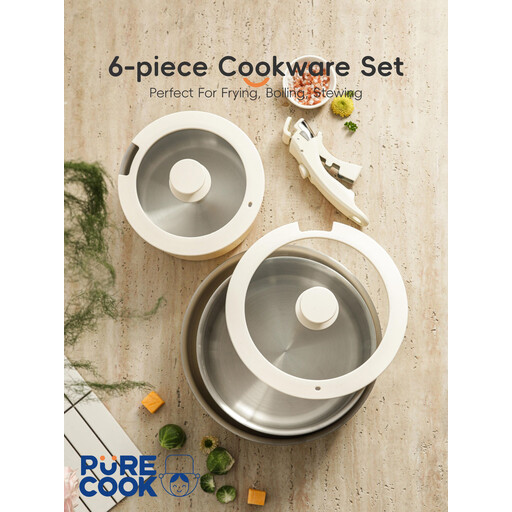
Why we chose it: For those who prioritise durability and material purity, this set is a solid foundation. Stainless steel is ideal for searing meats and creating complex sauces without altering flavours.
The food-grade 304 stainless steel interior eliminates any risk of coating degradation, a common problem with low-quality non-stick pans. This is a long-term investment.
A healthy and highly durable material, ideal for all types of cooking. The modular design with a removable handle and stackable format adds a modern and practical touch.
We've compiled a complete, up-to-date list of products that meet these strict selection criteria and safety standards.
Maintenance is simple but essential. Use wooden, silicone, or nylon utensils to avoid scratching the surface. Avoid overheating it while empty and opt for hand washing with a soft sponge, even if it's dishwasher-safe. Let it cool completely before running it under cold water to prevent thermal shock.
The main health advantage of a quality ceramic coating is the absence of controversial compounds like PFOA and PFAS, which were sometimes used in the manufacturing of older PTFE (Teflon) coatings. By choosing a certified PFOA/PFAS-free product, you are opting for a cooking surface that does not release these substances.
No, absolutely not. Performance on an induction hob depends directly on the quality of the ferromagnetic disc integrated into the base of the pan. A thick, wide base ensures a better connection with the hob, faster heating, and more even heat distribution. A low-quality model will heat slowly and unevenly, making for a frustrating cooking experience.