
Livraison le jour même ou le lendemain

Qualité garantie

Débloquez vos offres de bienvenue: Livraison GRATUITE | Jusqu'à -80 % | 30 jours d'essai gratuits à JoyPlus
Téléchargez l'application
Equipping a first apartment or simply replacing your old cookware can quickly become a headache. Faced with a jungle of options, it's hard to avoid the most common marketing traps. As the Head of Product Recommendations at Joybuy, my mission is to demystify the topic and help you make an informed choice that's truly tailored to your needs.
Before you get started, here are the three pitfalls to avoid at all costs:
To ensure you make the right choice, focus on the few technical features that truly make a difference.
The choice of material depends primarily on your cooking habits.
Induction cookware worthy of the name must have a thick, perfectly flat, ferromagnetic base. This base ensures perfect contact with the cooktop, resulting in fast and even heat distribution. The magnet test is foolproof: if it sticks firmly to the bottom of the utensil, you can expect excellent responsiveness. A "sandwich" bottom (a layer of aluminium encased between two layers of stainless steel) is often a sign of high performance.
For small kitchens or simply to optimise storage, a removable handle is an incredibly effective solution. It not only allows you to stack pots and pans for maximum space-saving but also lets you move a dish to the oven, serve directly at the table, or store leftovers in the fridge. It's a major plus for both space and versatility.
Rather than just listing products, we've matched concrete solutions to specific needs.
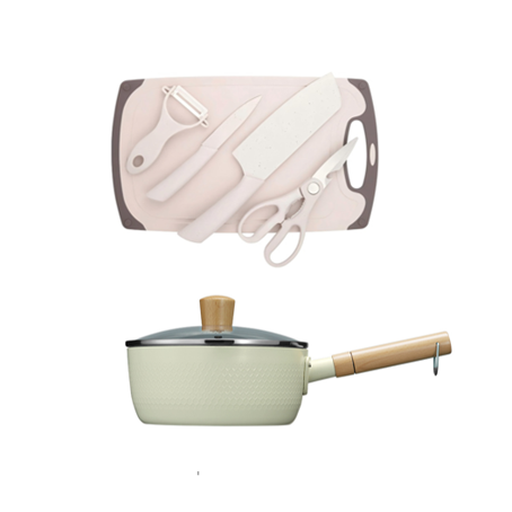
Why this choice: Ideal for students or a first apartment, this kit gets straight to the essentials: a versatile saucepan for pasta, sauces, or milk, accompanied by basic prep tools. A smart and budget-friendly starting point.
This set avoids the "useless all-in-one" trap by focusing on the fundamentals. Its non-stick saucepan is compatible with all hobs, including induction, for maximum versatility from day one.
Immediate practicality: Everything you need to get started: the set includes a saucepan, its glass lid for monitoring cooking, a cutting board, and a knife. The essentials to begin, with no unnecessary extras.
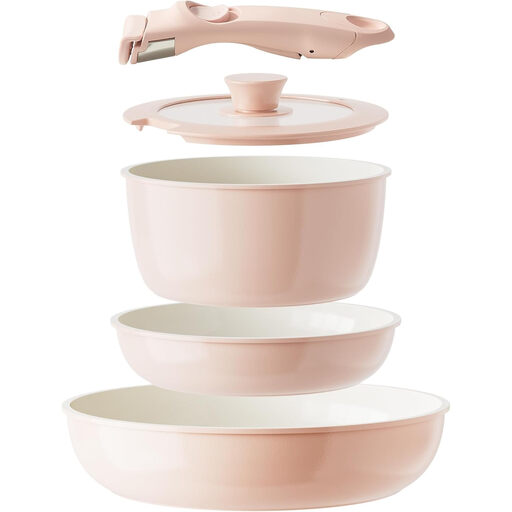
Why this choice: The perfect solution for kitchens where every square inch is precious. The removable handle revolutionises storage and versatility, while the ceramic coating meets the needs of families concerned with healthy cooking.
This is the antithesis of an overflowing cabinet. Thanks to its single handle and stackable design, it frees up an incredible amount of space. Its ceramic coating, formulated without PFAS, PTFE, or PFOA, eliminates any risk associated with controversial materials.
Versatility and space-saving: From the hob to the table, and into the oven: the removable handle ensures total versatility. The pieces stack perfectly for optimal space-saving. Compatible with all hobs, including induction.
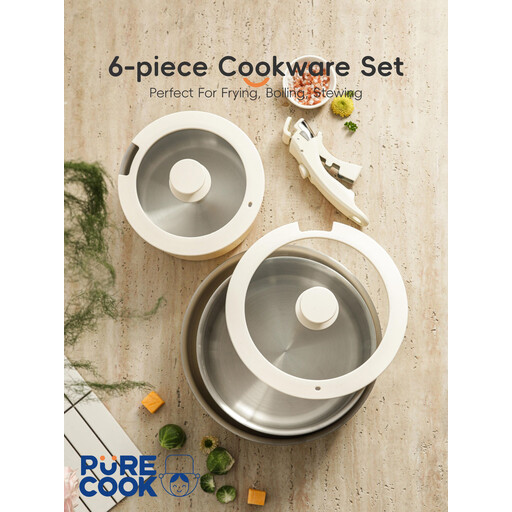
Why this choice: For those who make no compromises on performance and durability. The triple-ply (Tri-Ply) construction and 304 stainless steel offer perfect control over cooking, especially for searing meats. A true investment for years of joy in the kitchen.
Here, the focus is on quality, not quantity. The 304 stainless steel is indestructible, healthy, and free of any coating that could degrade. The Tri-Ply construction ensures optimal heat-up and distribution on induction hobs.
Cooking mastery: 304 stainless steel is the key to achieving perfect Maillard reactions (the famous caramelisation of food juices). The removable handle and oven/dishwasher compatibility provide total flexibility.
We have curated a full range of products that meet our strict selection criteria and current safety standards.
The lifespan of a non-stick coating depends on its quality and care. An entry-level model can lose its effectiveness in less than a year, while a high-quality coating, when well-maintained (using silicone or wooden utensils, gentle cleaning), can last for several years. Also, remember to avoid thermal shock (running a hot pan under cold water), which can damage it.
The easiest way is the magnet test: place a magnet on the bottom of your pot or pan. If it sticks firmly, it's compatible! The spiral logo is another indicator, but it alone doesn't guarantee good performance. Instead, rely on the thickness of the base, a much more reliable criterion for even heat distribution.
Both are excellent choices for healthy cooking. Stainless steel is a perfectly inert, stable, and durable material that releases no substances, even at high temperatures. It's the choice for purity and longevity. On the other hand, quality non-stick cookware, certified PFOA-free, PFAS-free, or free of other controversial compounds, is just as safe. Its advantage? It allows you to cook with very little fat, which is a plus for a balanced diet. It all depends on your priorities: the absolute durability of stainless steel or the everyday ease of use of non-stick.